Late-Season Pheasants: Read the Cover and Your Dog’s Work
· 7 min read · HuntWithDog
Reassess late-season cover, running-bird uncertainty, dog contact and partner positions without diagnosing scent from head height or promising a tactic.
On this page
- What late season can change
- Treat running birds as a possibility, not a diagnosis
- A head position cannot tell you the whole scent story
- When a pointer keeps moving or points empty ground
- Reduce the commitment, not just your walking speed
- Partners and a second dog require a new plan
- Compare the task, not the pose
- Keep an exit plan when the field becomes harder
What late season can change
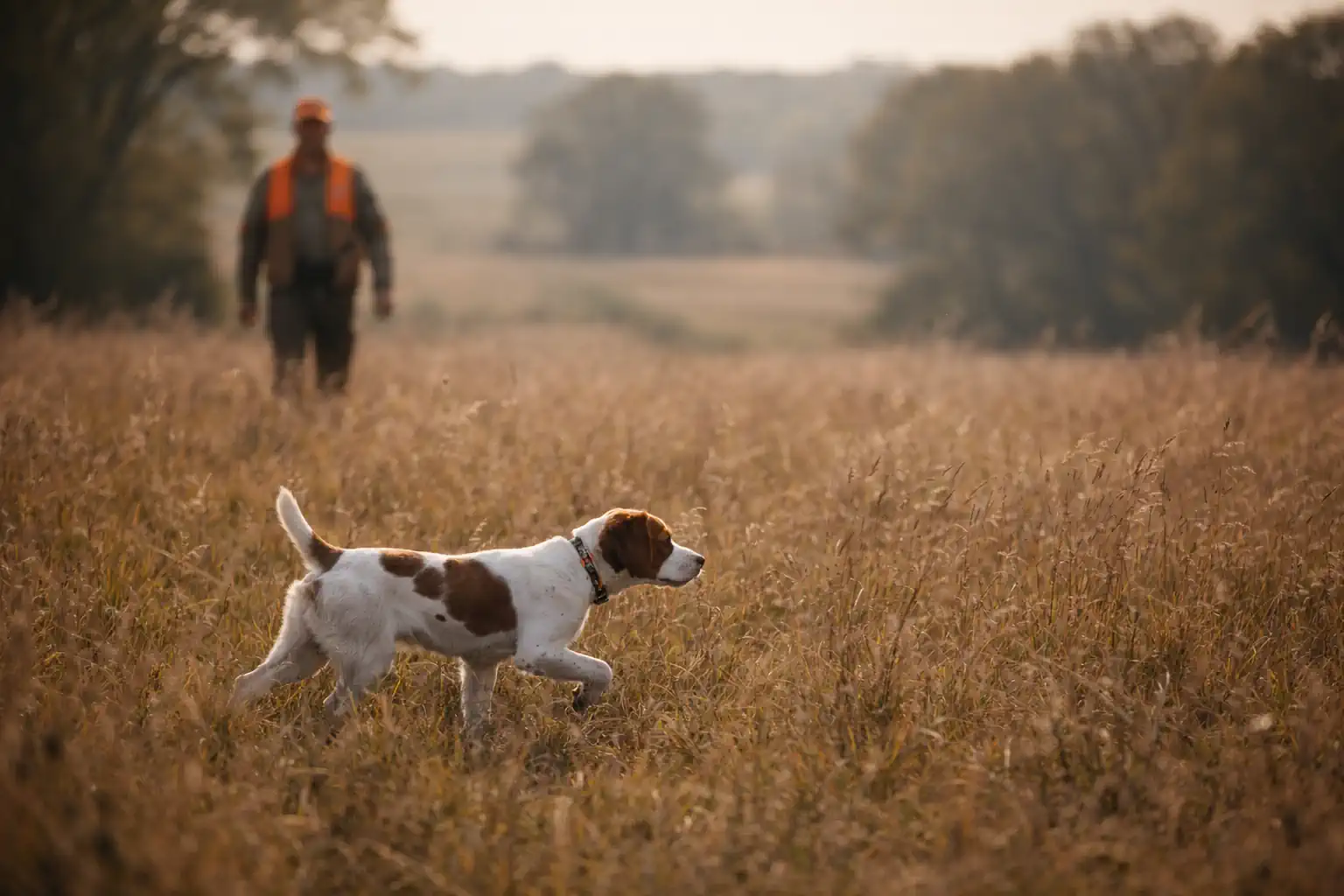
Late-season pheasant hunting asks you to reassess the ground and the dog’s task, rather than repeat the route that worked earlier. Harvest, remaining vegetation, weather and other hunters can change the scene. A bird that leaves before you arrive does not by itself show that the dog has forgotten its training.
Minnesota DNR’s pheasant guide describes farm-country grass and crop habitat, cattail shelter in winter, and pheasants escaping on foot or hiding. This supports looking again at available cover. It does not establish that every late bird runs, that every cattail patch holds birds or that every moving dog is following one.
Treat running birds as a possibility, not a diagnosis
A wild pheasant can leave a strip on foot before a handler sees it. If you saw a bird enter cover or found clear tracks, record that evidence. If all you saw was the dog change pace, leave the bird’s location and movement uncertain. “Educated rooster” can be a useful description of the challenge, but it is not an explanation you have proved for every empty point.
Compare the current habitat with your earlier visit: crop removal, gaps, blocked access and remaining cover. Choose the next accessible piece from those observations. Avoid turning a cold month into a rule that all birds occupy the deepest available vegetation. The weather guide addresses conditions as a separate planning question.
A head position cannot tell you the whole scent story
A dog that lowers its head, loops or relocates has made observable movements. Those movements alone do not identify a particular bird’s trail, the age of that trail or whether the bird is still present. Likewise, a high-headed point does not reveal every cue the dog used.
NAVHDA’s February 2026 guidance allows different head positions in productive field search and successful tracking. It evaluates the task and performance in the test setting, not a single preferred pose. For the full distinction between locating a source, following a route and searching an area, see air scenting versus tracking. Do not use head height to decide automatically that a dog deserves a correction or should be released to pursue.
When a pointer keeps moving or points empty ground
First ask what you actually know. Was a bird seen? Did the dog remain in contact? Could you reach its position safely? Was there a change of cover or breeze? A repeated relocation may require a different plan, but this page cannot distinguish a moving bird, uncertain odor or a learned-skill problem from a short description.
If you cannot follow safely or regain communication, recover the dog and leave that piece. If work remains manageable, observe without adding repeated whoa commands or physical repositioning to demand a photograph. Review the separate stages of steadiness if a familiar response repeatedly breaks down. Noise concerns and changes suggesting discomfort deserve their own assessment.
A bird-free walk cannot recreate every hunting distraction, but it can clarify whether a familiar cue is still understandable in an easier setting. Use the troubleshooting guide to separate the observation from a guessed cause before asking for instruction.
Reduce the commitment, not just your walking speed
Instead of prescribing one pace for every late-season field, choose a section small enough to assess and leave. Mark its boundaries, accessible edges, hazards and return route. Pause where you can see and communicate. Recheck local wind when cover or terrain changes; a route that was workable at the vehicle can become confusing behind a shelterbelt.
A slower approach cannot guarantee that a pheasant will hold. A fast move to get ahead can create a worse problem if it separates people or puts you beyond the dog. Keep the outing within established contact and recovery limits. The range decision guide helps define those limits without assigning a universal late-season distance.
Partners and a second dog require a new plan
Do not send someone to the far end of cover as an automatic answer to a suspected runner. Once people occupy different sides, the old shooting arrangement may no longer be safe. Stop and agree on positions, zones and how everyone will regroup before anyone moves. TPWD’s hunter-education guidance emphasizes communicating changed zones and passing shots between or behind the group. A standing partner is not a guarantee that a bird will remain in the strip.
Adding another dog also adds management. Two dogs must already work safely around one another without competing or interfering; a completed season alone proves neither. Use the two-pointing-dog prerequisites before considering shared work. A flusher has a different job, explained in flushing-dog management; it is not a device for fixing an uncertain point or forcing a pheasant into shooting range.
Compare the task, not the pose
A training history built around one setting does not prove the same response everywhere. Record what the dog was asked to do, what changed and what remained comfortable. Do not infer a live, fresh track from purposeful-looking movement, or a stale trail from a loop. A visually impressive search can still leave you without enough information.
Fictional example: Lee’s pointer stops at a grass edge, moves again and revisits the strip. Lee never sees a bird. Instead of declaring that the dog broke on a runner, Lee notes the sequence, checks the accessible route and recovers the dog before a hidden drainage. On a later easier session Lee checks the familiar stop response. This invented example illustrates a decision; it is not a documented outcome or a diagnostic test.
Keep an exit plan when the field becomes harder
Do not enter uncertain ice or send the dog through hidden water because birds may be beyond it. Choose dry, accessible alternatives when the route cannot be assessed. If you cannot safely reach a possible fall, do not use the chance of a flush as a reason to take the shot. Account for the dog and every person before any shooting decision.
Choose the outing length from the dog and actual work, not a fixed number of hunting days per week. Stop for lameness, apparent pain, reluctance or abnormal behavior and seek veterinary advice rather than treating them as weak drive. The soundness guide helps plan the next conversation; it does not clear a dog to resume hunting.
Check the current rules for the actual place and date. South Dakota’s pheasant rules differ from Minnesota’s and include area-specific details; neither is a nationwide late-season calendar. Finally, record the route, cover changes, observed dog work and why you stopped in the field journal. A clear record is a better starting point for the next outing than blaming the dog for an unseen rooster.
Frequently asked questions
Why do late-season pheasants run instead of holding?
Pheasants can escape on foot, and remaining habitat can differ from earlier in the season. That does not explain every encounter: some birds may hold, and you may not know whether a bird was present. Record the evidence rather than assuming all late birds behave alike.
Is my dog breaking point if it keeps relocating?
Not necessarily, and this page cannot diagnose the cause from that description. Record whether a bird was seen, the dog’s movements and your ability to stay in contact. Head position alone cannot distinguish tracking, uncertain odor and a learned-skill problem.
Should I hunt cattails first or last?
There is no universal order. Cattails can provide winter shelter, but access, hidden water or ice, dog contact and a safe return route govern whether you should enter at all. Leave a patch when those conditions cannot be managed.
Will a flushing dog solve a running-pheasant problem?
Not automatically. Flushing and pointing are different tasks, and an individual dog still needs appropriate skills and management. Adding a flusher to an uncertain encounter can increase the difficulty rather than solve it.
Do I need a blocker for late-season pheasants?
No. An additional hunter changes positions and possible shooting zones; it does not guarantee that birds stay. Agree on a safe arrangement before moving, or choose a smaller accessible piece without that added complexity.
How many days a week can I hunt my dog late in the season?
This guide gives no fixed schedule. Consider the actual workload, recovery, conditions and individual health. Stop for lameness, reluctance, pain or abnormal behavior and ask your veterinarian about exercise and return to work when needed.
Where to go next
Choose the step that matches the question you still need to answer.
Prerequisite
Can the movement identify the scent task?A low head or a relocation alone cannot establish which clues the dog used.
Next decision
Reconsider contact as cover changesConcentrated cover and route constraints change what you can manage.
Related problem
When should the day be shortened or stopped?The dog's condition matters independently of a seasonal explanation for bird behavior.
Browse guides by question or find your training starting point.