Running Two Pointing Dogs: Bracing, Range, and Teaching Honor
· 8 min read · HuntWithDog
Hunting two pointing dogs at once multiplies the ground covered — but only if both dogs know their job. A guide to bracing, range management, and teaching a dog to honor another's point.
On this page
- Why Bracing Is Harder Than It Looks
- What Honoring Actually Is
- Prerequisites Before You Brace
- Teaching Honor Step by Step
- The Planted-Point Drill
- Moving to Real Field Situations
- Range and Bracing Dynamics
- Common Failure Modes
- Point Stealing
- Competition Breaking Steadiness
- When Two Dogs Are Worse Than One
- When a Brace Actually Works
- FAQ
- Does honoring come naturally to pointing dogs or does it always need to be trained?
- Can I brace a young first-season dog with an experienced dog?
- My dog honors in training but not in the field — what is the gap?
- Should I correct a dog that steals a point, or just restart the sequence?
- Does one dog in a brace typically dominate the bird work?
- Is there a minimum steadiness standard before attempting a brace?
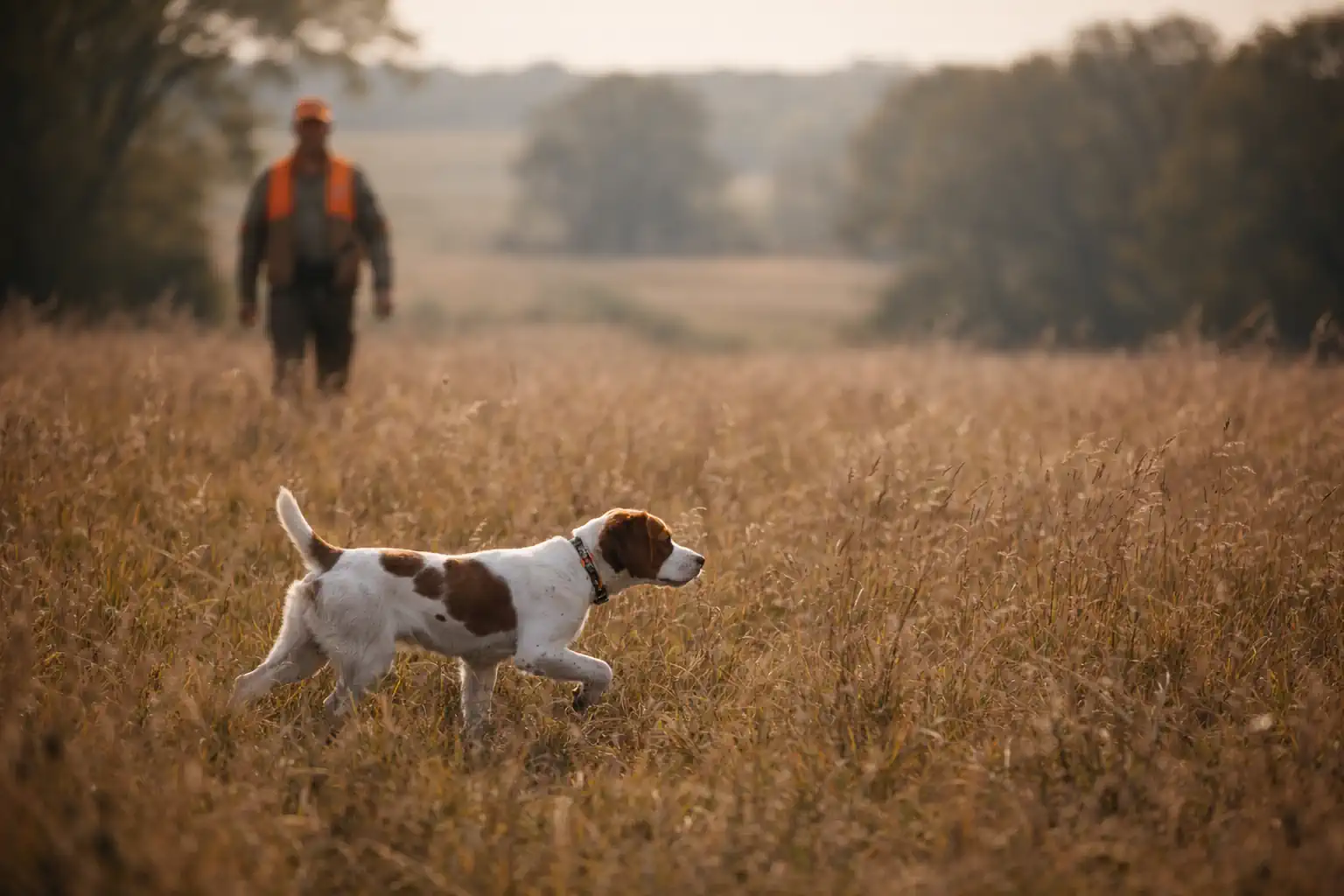
Why Bracing Is Harder Than It Looks
Two dogs covering the same ground should, in theory, find more birds in less time. In practice, two dogs that aren't ready to work together find fewer birds, bump more of them, and create a level of chaos that makes the whole day worse than if you'd run one. The issue isn't the number of dogs — it's the unresolved competition between them.
When a single dog finds birds and points, the situation is clean. One dog on point, handler walks in, birds flush, shot happens. When two dogs are in the same field, the second dog is always a variable. Does it honor the first dog's point and hold? Does it come charging in and steal the work? Does the competition between them erode steadiness in both?
A brace of well-trained dogs that hunt in range and honor each other's points is one of the most satisfying things you can watch in the uplands. But the operative word is trained. It doesn't happen on its own, and rushing it tends to make the problems worse than they were before you tried.
What Honoring Actually Is
Honoring — sometimes called backing — is the behavior where a dog sees another dog on point and immediately stops and holds its own position, mimicking a point, without being commanded to do so. The honoring dog wasn't the one who found the birds. It's responding to a visual cue: the sight of a bracemate locked up.
Honoring is partly instinctive in pointing breeds and partly trained. Some dogs will naturally stop and acknowledge a bracemate on point — the behavior has roots in pack hunting patterns where one dog flagging a location carried social meaning. But natural tendency alone doesn't produce reliable field behavior. A dog that sometimes honors when it feels like it is not a dog you can brace safely.
Reliable honoring means: the dog sees its bracemate on point, locks up immediately, and holds that position through the flush and shot without moving unless released. It's the same self-control requirement as steadiness, applied to a different trigger. And like steadiness, it needs to be built deliberately before the birds get involved.
Prerequisites Before You Brace
Before you put two dogs in the same field, both of them need to be individually reliable on a few fundamentals. This isn't optional — it's the reason bracing fails when handlers skip it.
Each dog should have a solid whoa or stop command that holds under distraction. If a dog won't hold position when you tell it to in a yard with no birds and no other dogs, it isn't going to hold when there's a bracemate on birds twenty yards away. The command needs to be there before the situation demands it.
Each dog should also be steady or at minimum controllable at flush. A dog that routinely breaks at the flush when hunting alone is not ready to run in a brace. Introduce the second dog only after each individual has demonstrated they can manage themselves in the field.
The dogs should also know and tolerate each other. Running two dogs that have unresolved social tension produces a dog fight in the field, not a brace. Time around each other off the hunt — kenneled near each other, walking together, released together in open ground — smooths the social dynamic before you ask them to cooperate on birds.
Teaching Honor Step by Step
The Planted-Point Drill
The most reliable way to introduce honoring is with a planted point — a controlled setup where Dog A is placed on point near a bird, and Dog B is brought up on a check cord to see the scene. When Dog B locks up or shows hesitation at the sight of Dog A, reinforce it immediately. If it keeps moving toward Dog A, use the check cord to stop it and issue the whoa command, then hold it there.
The goal in early repetitions is simple: Dog B stops when it sees Dog A on point. Not a perfect honor posture, not a hold through the flush — just the habit of stopping. Build that first. Once stopping is reliable, hold Dog B through the flush and shot exactly as you would a dog on its own point.
Moving to Real Field Situations
After the controlled drill is solid, run both dogs together with both on check cords. When Dog A points naturally, read Dog B's body language as it approaches. The moment it sees Dog A and shows any hesitation — tail check, body pause, head up — reinforce it. That moment of hesitation is the natural honoring instinct; your job is to catch it and reward it before the dog talks itself out of stopping.
If Dog B never naturally hesitates, use the check cord to stop it and command whoa when it's in a clear sightline of Dog A on point. Repetition over many sessions builds the visual-cue-to-stop association. Some dogs get it quickly. Others take most of a season of controlled work before it becomes reliable.
Range and Bracing Dynamics
Range management in a brace is different from running a single dog. With one dog, you set a range that matches the cover and your walking pace, and you manage one animal. With two dogs, you have two range tendencies that may not match, plus the social competition factor — a wider-running dog will push a closer-running dog to extend its range to keep up, and vice versa.
Dogs that run at similar ranges brace better. A close-working Brittany and a big-running English Pointer are going to frustrate each other and frustrate the handler. This doesn't mean you can only brace identical dogs, but a significant mismatch in natural range creates practical problems that get worse on birds. The wider dog finds birds before the close dog gets there; the close dog either breaks range to keep up or falls behind and becomes irrelevant to the find.
In practice, most handlers work a brace by releasing dogs in the same direction but with enough separation at the start that they're not competing for the same ground immediately. Let them establish their natural casts. If both dogs are hunting parallel to you, you'll see them working the same cover from different angles — that's productive. If one dog is always undercutting the other's ground, you get competition rather than cooperation.
Common Failure Modes
Point Stealing
Point stealing — where Dog B runs to the bird rather than honoring Dog A's point — is the most common bracing failure. It doesn't just flush the bird prematurely. It actively teaches Dog B that ignoring the bracemate leads to bird contact, which is self-reinforcing. Every stolen point makes the next one more likely. Address it early, consistently, and with the check cord. A dog that has been allowed to steal points repeatedly is much harder to correct later.
Competition Breaking Steadiness
A dog that is reliably steady when hunting alone can lose that steadiness in a brace because the presence of the other dog raises the general arousal level. The flush is more exciting, the retrieve competition more intense. If you're seeing a dog that handles itself alone but breaks at flush when braced, the solution is to go back to controlled brace work rather than treating it as a steadiness regression in isolation. The trigger is social arousal, not a gap in the steadiness training.
When Two Dogs Are Worse Than One
There are situations where running a single dog is simply the better choice. Dense cover where both dogs are invisible to each other eliminates the visual cue that makes honoring possible. A dog recovering from injury or fatigue should not be competing for ground. A young dog in its first season learning to find and point birds needs to do that without the interference and competition of a bracemate. The brace is a tool for capable, trained dogs in conditions that support it — not a default way to double your bird count.
When a Brace Actually Works
When it works — both dogs trained, ranges compatible, birds in the field — a brace is a genuinely different kind of hunt. You're watching two animals process the same cover from slightly different angles, cross-checking scent, and communicating through posture in a way that goes beyond what any single dog can do alone. One dog may relocate a running bird that the other couldn't commit to. The honoring dog holds and marks while you move toward the pointing dog.
The work looks effortless from the outside when it's right. That's the product of significant training investment in each dog individually before the brace was even attempted. The shortcut — putting two dogs out because you have two dogs — produces the chaos version. The long way is the one that actually gets you to a productive brace.
FAQ
Does honoring come naturally to pointing dogs or does it always need to be trained?
Some dogs show a natural tendency to stop and acknowledge a bracemate on point — you'll see a hesitation, a tail check, sometimes a spontaneous honor posture. But natural tendency rarely produces reliable field behavior on its own. The instinct gives you something to work with; training is what makes it consistent enough to count on.
Can I brace a young first-season dog with an experienced dog?
Usually not a good idea. The first season is when a young dog is building confidence on birds, establishing its own pointing pattern, and learning to handle itself in the field. Adding a bracemate introduces competition and social pressure at exactly the time the young dog needs clear, simple bird work. Most handlers wait until the young dog has at least one solid season of solo work before introducing a brace.
My dog honors in training but not in the field — what is the gap?
The gap is usually arousal level. Controlled training setups have lower stimulation than a real hunt. The solution is to proof the honor behavior in progressively higher-stimulation situations — more bird contact, more realistic field conditions — before assuming it is field-reliable. If it falls apart under pressure, the behavior wasn't as solid as the training environment suggested.
Should I correct a dog that steals a point, or just restart the sequence?
If the dog is on a check cord and you can prevent the steal before it happens, prevention is better than correction after. Once the bird has been flushed by a stolen point, the dog has already gotten the reward — the correction lands in a context where the cause is no longer clear. Focus on catching it before it happens and stopping it with the cord. Consistent prevention is more effective than repeated corrections after the fact.
Does one dog in a brace typically dominate the bird work?
Often yes, especially early in a brace relationship. One dog may range wider, find birds more consistently, and set the pace of the work. The other may honor more than it points in that field. That's not necessarily a problem — a reliable honoring dog is doing real work. But if one dog is completely disengaged from finding birds and only honoring, it may be a range mismatch or a confidence issue worth addressing.
Is there a minimum steadiness standard before attempting a brace?
At minimum, each dog should hold point reliably and not break at flush when hunting alone. Full steadiness through the shot is ideal but not always where dogs are when you want to start brace work. The critical thing is that neither dog's self-control is so marginal that adding a bracemate will guarantee failure. If a dog is regularly breaking at flush solo, fix that before introducing the brace.
Frequently asked questions
Does honoring come naturally to pointing dogs or does it always need to be trained?
Some dogs show a natural tendency to stop and acknowledge a bracemate on point — you'll see a hesitation, a tail check, sometimes a spontaneous honor posture. But natural tendency rarely produces reliable field behavior on its own. The instinct gives you something to work with; training is what makes it consistent enough to count on.
Can I brace a young first-season dog with an experienced dog?
Usually not a good idea. The first season is when a young dog is building confidence on birds, establishing its own pointing pattern, and learning to handle itself in the field. Adding a bracemate introduces competition and social pressure at exactly the time the young dog needs clear, simple bird work. Most handlers wait until the young dog has at least one solid season of solo work before introducing a brace.
My dog honors in training but not in the field — what is the gap?
The gap is usually arousal level. Controlled training setups have lower stimulation than a real hunt. The solution is to proof the honor behavior in progressively higher-stimulation situations — more bird contact, more realistic field conditions — before assuming it is field-reliable. If it falls apart under pressure, the behavior wasn't as solid as the training environment suggested.
Should I correct a dog that steals a point, or just restart the sequence?
If the dog is on a check cord and you can prevent the steal before it happens, prevention is better than correction after. Once the bird has been flushed by a stolen point, the dog has already gotten the reward — the correction lands in a context where the cause is no longer clear. Focus on catching it before it happens and stopping it with the cord. Consistent prevention is more effective than repeated corrections after the fact.
Does one dog in a brace typically dominate the bird work?
Often yes, especially early in a brace relationship. One dog may range wider, find birds more consistently, and set the pace of the work. The other may honor more than it points in that field. That's not necessarily a problem — a reliable honoring dog is doing real work. But if one dog is completely disengaged from finding birds and only honoring, it may be a range mismatch or a confidence issue worth addressing.
Is there a minimum steadiness standard before attempting a brace?
At minimum, each dog should hold point reliably and not break at flush when hunting alone. Full steadiness through the shot is ideal but not always where dogs are when you want to start brace work. The critical thing is that neither dog's self-control is so marginal that adding a bracemate will guarantee failure. If a dog is regularly breaking at flush solo, fix that before introducing the brace.