How Far Should a Pointing Dog Range? A Practical Field Decision Guide
· 7 min read · HuntWithDog
Decide whether your pointing dog's range works for the cover, wind, contact and hazards. Learn when to allow more search, simplify the outing or stop.
On this page
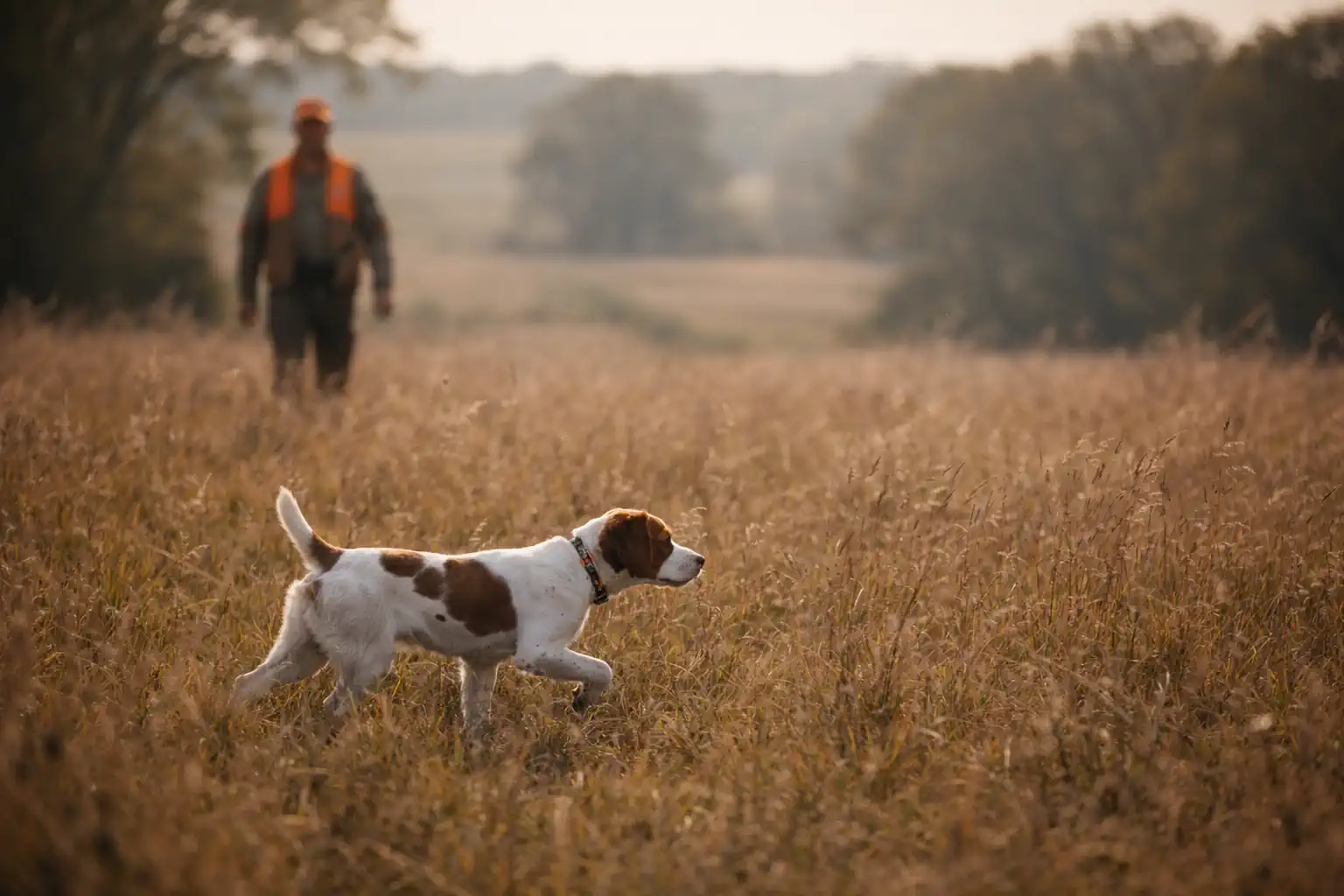
A pointing dog should search far enough to investigate useful cover while you can still communicate, reach it and keep it out of trouble. There is no universal distance in yards. The same separation can work in an open field and fail behind a ridge or inside dense brush.
Start with that working relationship before deciding that your dog is too close or too far. A dog beside your boots may need confidence or a clearer opportunity to explore. A dog far ahead may be searching effectively. Distance alone cannot tell you which is happening.
NAVHDA's current testing standard makes a useful distinction: practical range depends on terrain, cover, control and cooperation. It evaluates a functional search rather than one prescribed yardage. That is a test standard, not a complete training method, but it is a helpful starting point for a hunting companion. NAVHDA, Aims, Programs, Test Rules, revised February 2026, §3.3.
Decide what you need from this field
Before letting the dog search, identify your route, the cover you want investigated and the places the dog must not enter. Confirm that access and dog activity are permitted there. Choose another location if you cannot keep the dog within those limits.
Then ask three practical questions:
- Can we stay in contact? Think about the dog's response to a familiar cue here, not its response in the yard.
- Can I get to the dog? A short straight-line distance may conceal a steep bank or an impassable fence.
- Can I prevent a foreseeable problem? A road or property edge matters before the dog reaches it.
This is a pointing-dog question. Do not borrow a flushing dog's working pattern simply because both dogs hunt birds. For an inexperienced dog, choose an easy, manageable setting and establish the safety responses described below before extending free search.
Use this decision table when the setting changes
These are planning examples, not prescribed distances or predictions about every dog.
| What you see | What to check | A useful next decision |
|---|---|---|
| Open cover with clear sight lines | Is the dog investigating useful ground and responding when needed? Can you reach it? | Allow the search that remains manageable; do not demand extra distance for its own sake. |
| Brush, a fold in the ground or a ridge interrupts contact | Where will you lose sight or hearing? Does the dog know the relevant cue in that setting? | Choose a smaller area or a route that preserves contact before releasing the dog. |
| Wind changes or the dog alters its search | Did the direction change at the cover edge? Is the dog revisiting one patch? | Observe and reassess your route; a changed pattern alone does not establish disobedience. |
| The dog stays close on unfamiliar ground | Is it exploring willingly? Is this cover harder than the last location? | Offer an easier, safe setting and let confidence develop; avoid manufacturing distance. |
| The dog repeatedly leaves your planned area | Can you recover and redirect it reliably here? | End the free search and return to controlled practice with help if needed. |
| A hazard appears ahead | Can you prevent entry without relying on an unproven response? | Recover the dog before the hazard and change the plan. |
Read wind as context, not a distance allowance
Notice the breeze before entering a new field and when you cross a substantial cover edge. Wind and cover affect the scenting problem the dog faces. NAVHDA's evaluation guidance explicitly considers weather and ground conditions and cautions against judging successful scent work by a preferred head position. NAVHDA, §§3.2–3.3.
For the beginner, the useful habit is to record the change: “The breeze shifted, and the dog returned to the same edge.” That is an observation. “The dog is ignoring me” or “There must be a bird there” adds an explanation you have not established.
Stronger wind does not grant permission for a longer cast. Your ability to communicate, reach the dog and avoid hazards still governs the decision. You do not need a perfect zigzag or an exact angle to begin observing useful search.
Picture contact before measuring yards
This diagram represents two fictional situations. It is not a map to scale or a search pattern to teach.
OPEN FIELD                         BRUSH WITH A HIDDEN ROAD

       D  useful cover                    ? D
       | clear view                  [dense brush]
       | accessible route                 | ROAD
       H                                  H

H = handler     D = dog     ? = contact and recovery uncertain
The dog in the right-hand scene may be physically closer. It still has less usable room because the handler cannot confidently manage what happens next. Reducing the area or choosing another field solves a different problem from trying to teach a shorter range.
Build flexibility in manageable steps
Treat the following as a planning framework to adapt with a qualified instructor, not a fixed test your dog must pass on a schedule.
- Establish the safety response in an easy setting. Practice the recall and other cues you need using rewards and appropriate physical management. A familiar cue must be taught across settings; assuming it will transfer creates a poor field experiment.
- Start with a simple area. Choose ground where you can observe and recover the dog without having to test its limits. Let it explore within the plan.
- Watch the response to ordinary movement. Does it notice a meaningful change in your direction? Does it rejoin the shared outing without constant prompting? Keep those observations separate from distance.
- Change one challenge at a time. For example, introduce a different cover type while keeping the area and distractions manageable. Adding cover, distance, other dogs and birds together makes a setback difficult to interpret.
- Repeat the manageable version. Progress when the dog remains comfortable, explores willingly and responds reliably in comparable conditions. If contact repeatedly fails, simplify rather than adding more demands.
Reward useful check-ins and clear responses. Avoid turning every return into a long interruption. AVSAB's 2025 statement reaffirms its recommendation for reward-based training throughout dog training; historic punishment protocols are not the basis of this plan. AVSAB position statements.
Fictional example: A young dog explores comfortably in a familiar open area but returns to the handler's feet in unfamiliar scrub. Instead of urging it farther out, the owner returns to easier cover and makes the next visit simpler. The record is “search became shorter in new cover,” not “the dog has no hunting ability.”
Know when to simplify and when to stop
Simplify the next session when a change in cover or distraction repeatedly breaks communication, or when you need to repeat cues to keep the outing together. Return to an easier context and seek instruction if you cannot identify the missing skill. Avoid testing recall farther away to see whether it improves.
End the activity now if you cannot maintain safe contact, the dog repeatedly tries to withdraw, or its movement or behavior changes in a concerning way. Limping and reluctance to move can indicate pain; stop working the dog and contact your veterinarian rather than explaining the change as laziness. AAHA, common pet pain signs.
Do not wait for enthusiasm to disappear before taking heat risk seriously. Cornell's April 2026 report on sporting dogs explains that their drive can outweigh self-preservation. It does not establish a universally safe working duration. Cornell veterinary research report.
Heavy panting, seeking shade, drooling or reluctance to play can be early overheating signs. Stop activity and move the dog to a cool environment. Persistent excessive panting, breathing difficulty, vomiting, weakness, confusion or collapse warrant immediate veterinary care; do not resume the outing. Cornell, summer heat safety.
Keep a record you can actually use
After each outing, write down the cover, approximate wind direction, where contact was easy or difficult, which cues were needed and why you stopped. Compare similar outings rather than treating one difficult day as a verdict on the dog.
The useful question for next time is specific: “Can we stay connected in this smaller area of new cover?” Answer that before asking the dog to search farther.
Related field guides
Where to go next
Choose the step that matches the question you still need to answer.
Prerequisite
What contact response has actually been taught?A location on a map and a dog turning toward you are not a completed recall.
Next decision
What changes when wind or cover changes?Use the observations to reconsider the route, not grant a distance allowance.
Related problem
Why does a familiar cue change in the field?Compare the setting and task before interpreting the missed response.
Browse guides by question or find your training starting point.