Bird Dog Recall and Whistle Training: Teach the Return Before Adding Distance
· 6 min read · HuntWithDog
Teach your bird dog to return on a clear voice or whistle cue. Start close, reward arrival, and use observed progress and safe management before adding difficulty.
On this page
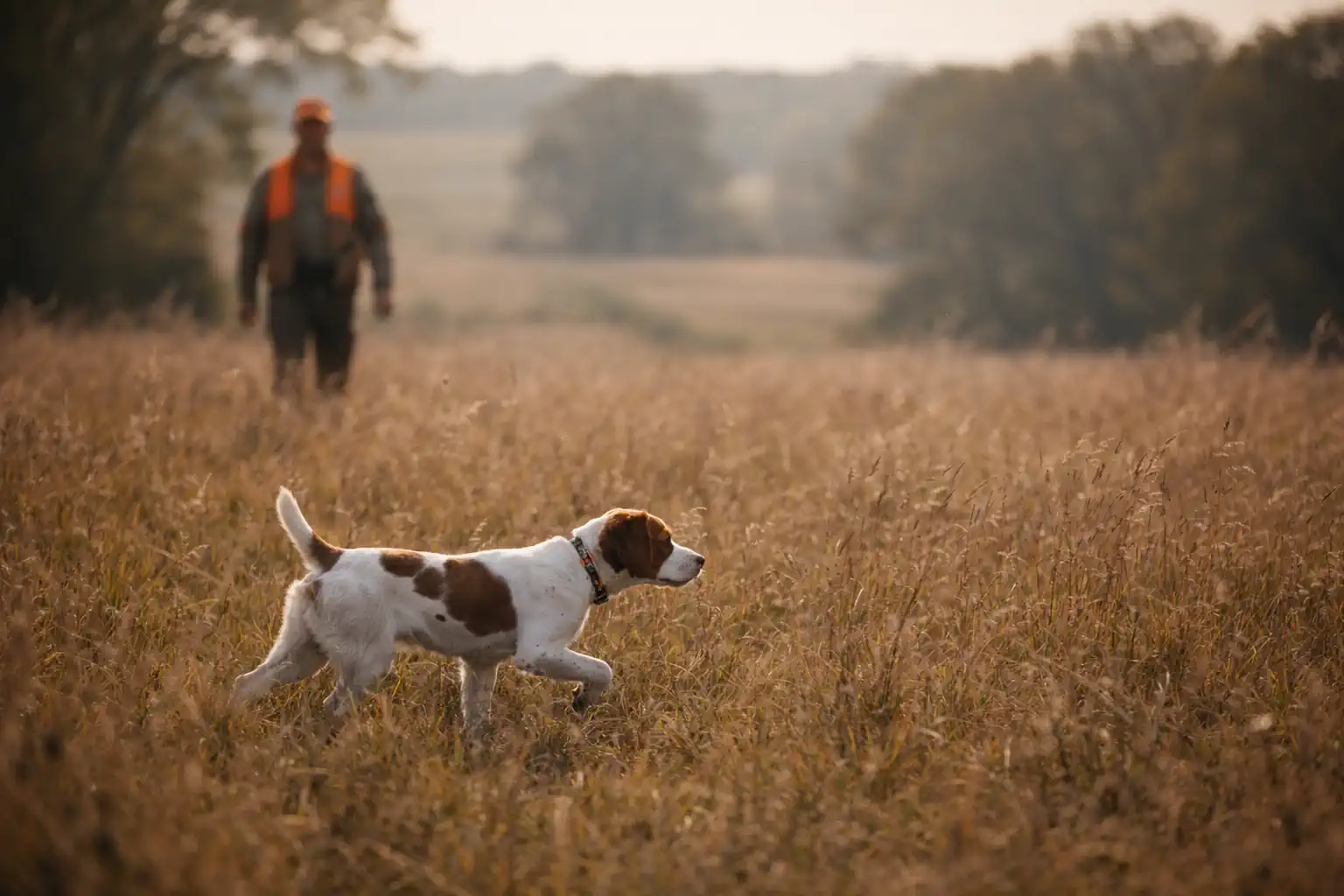
Teach recall in a quiet, secure space: give one clear cue, make returning easy, and reward your dog when it reaches you. A whistle follows the same principle. Its sound has to acquire meaning through training; buying one does not create a response around birds.
For this guide, a completed recall means the dog comes close enough for you to take control calmly, rather than glancing at you or passing nearby. That is a useful foundation for a pointer, flushing dog or retriever. It does not establish that the dog can safely run loose beside roads, livestock or wildlife.
Choose what your signal means
Separate attention from returning. You might teach the dog's name to mean “look toward me,” then use “here” to request an approach. Rewarding a look is appropriate when teaching attention; it is not the finished recall.
Agree on the recall word with everyone who handles the dog. If one person says “come,” another says “here-here,” and somebody whistles a different tune, your instructions are harder to keep consistent. Dogs Trust accepts a short word or a whistle as the cue and emphasizes household consistency. Its separate name-training guide explains how to reward attention before asking for more.
| Signal | What you teach it to request | What it does not establish |
|---|---|---|
| The dog's name | Orient toward the handler | Return all the way |
| Your recall word | Approach within comfortable reach | A sit, heel or retrieve unless separately taught |
| Your chosen whistle pattern | The same defined return | An instinctive response or universal gun-dog code |
Keep recall distinct from a whistle stop or a directional signal. If you work with an instructor, agree on the sounds and their intended responses before practising.
Prepare a practice the dog can finish
Choose a quiet room or genuinely secure enclosure with comfortable footing. Have a reward the dog enjoys ready before you start. Use small suitable treats or a brief game with a familiar toy; put other pets elsewhere so rewards do not become a competition.
Start with just a little space between you. This session does not need birds, gunfire, a retrieving dummy or an exciting field. You are teaching what to do when the signal occurs.
Pick a moment when the dog is relaxed and able to engage. If it is asleep, worried, absorbed in something else or trying to leave the activity, choose another moment rather than testing the cue.
Teach the first return
- Get the dog's attention. Use its name if that response is already taught. Stay nearby and inviting.
- Give your chosen recall word and move a step away. Make the approach easy; avoid looming over the dog.
- Reward arrival. Deliver the food or short game beside you when the dog reaches you. Do not add an untrained sit before paying for the return.
- Reset without pressure. Allow a pause and another easy opportunity. A few comfortable returns are more useful than continuing until the dog disengages.
The RSPCA's recall instructions likewise begin with an appealing reward, a friendly invitation and short separation before gradually increasing distance. They also advise against making every recall mean the lead goes on and the fun ends.
Build a calm finish too. If your dog is comfortable with gentle harness handling, include a brief touch while rewarding, then release it again when appropriate. If reaching causes it to duck away, do not grab. Practise comfortable handling separately with help as needed. A return that cannot be followed by safe handling needs more preparation.
Add a whistle through easy practice
A whistle is optional. Choose one short, repeatable sound and keep its meaning consistent. The number of pips in somebody else's program is not a rule your dog already knows.
If you want a whistle recall, teach it in the same easy setting as the word: get the dog's attention, give your chosen sound, invite the nearby approach and reward the arrival. Keep the sound and distance comfortable. Do not begin by blowing repeatedly at a dog already hunting far away.
If the voice recall already works, returning to this simple version gives you a clear observation: does the dog approach after the whistle, or is it waiting for the familiar word? Treat the second response as information that the new signal still needs teaching. Avoid stacking whistles, words and gestures until you cannot tell which one prompted the return.
Dogs Trust's recall guidance supports teaching either a word or whistle with rewards in an enclosed setting. The short whistle practice here adapts that foundation; it is not a specialist field-handling system.
ATTENTION       RECALL CUE       RETURN          REWARD
dog notices  -> word OR sound -> comes close -> food or brief game
handler                         enough to manage

The sound asks for the response. The reward follows the response.
Example: the new sound is still new
This is a fictional teaching example. Lena's spaniel, Moss, returns to “here” in their quiet kitchen. Lena introduces a whistle nearby, but Moss only looks up. She follows with “here,” and Moss approaches.
Her useful note is: “Looked at the whistle; approached after the word.” It would be premature to record “knows whistle recall” or try it at greater range. At the next short practice, Lena keeps the same easy setting and rewards the approach after the chosen sound. If she cannot make that task clear, she asks a reward-based trainer to watch her timing.
The lesson concerns a new cue. A familiar response that changes in a new environment needs a separate look at the setting and distractions.
Progress from what you observe
Use this editorial checklist to choose the next practice. It is not a pass mark, fixed calendar or guarantee.
| Observation | Next choice |
|---|---|
| Dog approaches comfortably after the cue in the current setup | Repeat in short practices, then add a little separation |
| Dog returns only after repeated calls | Make the setup easier and review whether the first cue is understood |
| Dog approaches but stays beyond reach | Practise the finish nearby and review comfort with handling |
| Adding a small distraction interrupts the response | Reduce that distraction; keep the dog safely managed |
| Dog avoids the sound or repeatedly withdraws | Stop that practice and seek help rather than increasing intensity |
Battersea's recall guide, updated June 2026, recommends establishing the response before adding distractions and retaining a long line and harness while learning on walks. Increase one challenge at a time so you can see what changed.
Keep management in place
A lesson indoors is not permission for unrestricted field freedom. Use secure areas and suitable lead management; a long line belongs on a well-fitted harness. Choose ground where you can handle the line safely, and get practical instruction if unsure. It is a management aid, not a tool for jerking the dog into position. Do not pull it back as the training method.
If a call fails, avoid a stream of louder repetitions. Calmly collect the safely managed dog and make the next task easier. Welcome a return even when it was slow. Dogs Trust's escaping guidance warns against scolding returns or chasing and notes that some dogs cannot safely go off lead in public.
Stop if you cannot keep the practice safe or the dog appears distressed. Ask your veterinarian about a sudden change suggesting a health or hearing concern; ask a qualified reward-based trainer about persistent training difficulties. AVSAB's current position, reaffirmed in 2025, recommends reward-based methods throughout dog training. Pressure from a choke chain or shock collar is not part of this guide.
For your next note, record the cue, place, separation, distraction and finish. “Returned after one word and accepted a gentle harness touch” gives you a clearer starting point than “recall done.”
Where to go next
Choose the step that matches the question you still need to answer.
Next decision
Will the same cue work in a different place?Plan practice under changed conditions instead of assuming a yard response transfers.
Next decision
How should I plan a pointing dog's first field walk?Keep exploration and familiar management together; the walk does not establish hunt readiness.
Next decision
What should a turn or directional signal mean?Keep a field signal distinct from recall and teach one recognizable response at a time.
Browse guides by question or find your training starting point.