Your Bird Dog Responds in the Yard. Why Not in the Field?
· 6 min read · HuntWithDog
When a familiar cue stops working outside the yard, compare the conditions. Use a hand-target example and context record to choose what to repeat or simplify.
On this page
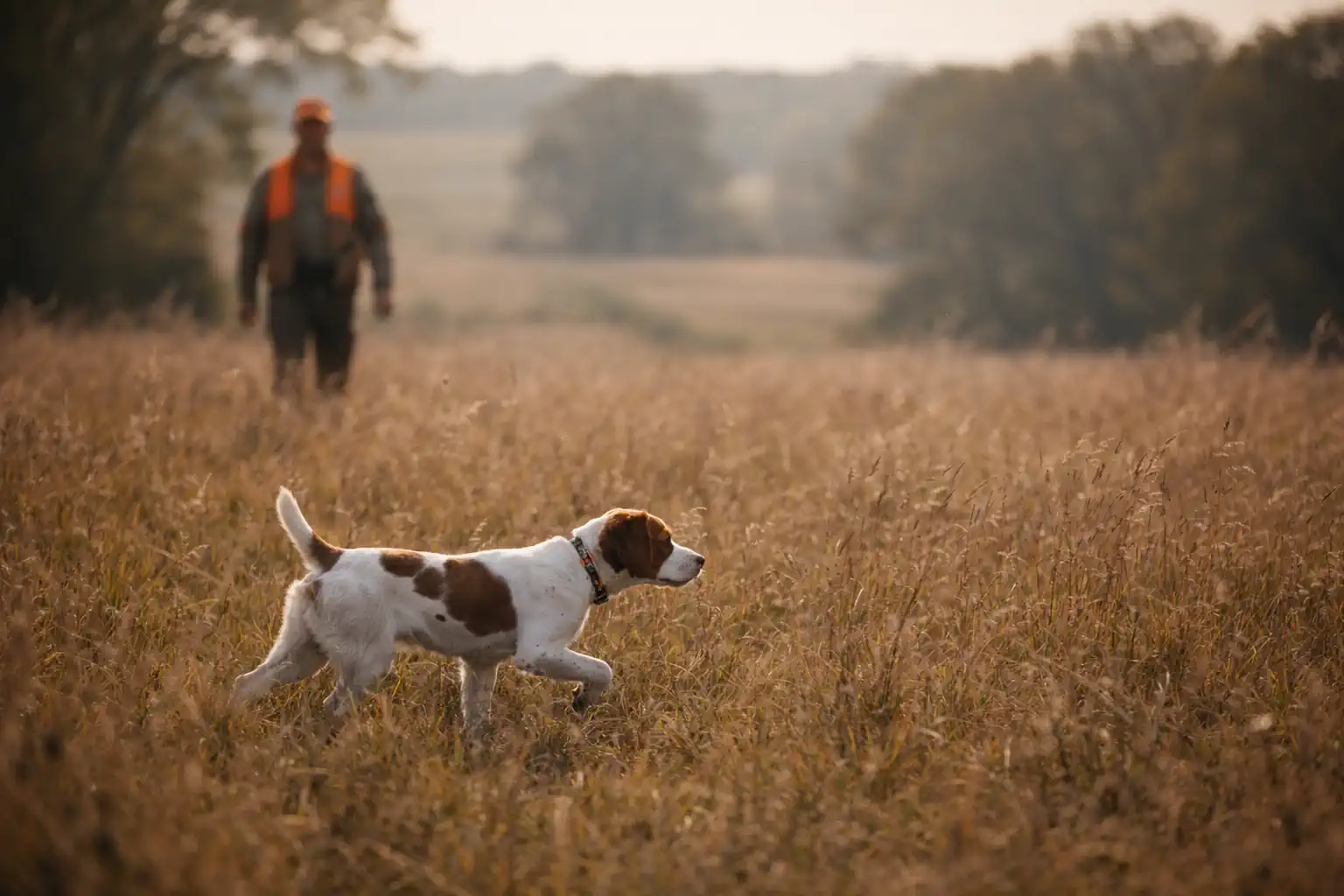
A response learned in the yard does not establish that your dog can perform it in a new field setting. Start by comparing what changed: the surroundings, your position, the cue, the distance, and the reward. Return to a manageable version of the task and practice there before making another change.
Calling the dog stubborn gives you no next step. A more useful description is, “He touched my hand in the yard, but looked past it in the new grass enclosure.” That identifies a response and a setting you can compare.
This is about transferring a familiar skill. It is useful for pointing dogs, flushers, and retrievers, but the example stays close to the handler in a secure space. A successful exercise beside you does not establish safe off-lead control in hunting cover.
What generalization means here
In training, generalization means performing a learned response under changed conditions. You may also hear proofing: planned practice across situations and distractions. It does not mean deliberately overwhelming the dog to find its breaking point.
The AKC's explanation of duration, distance, and distraction describes how changing those features can make a familiar task harder. The sensible conclusion is that transfer needs practice. It is not that dogs cannot generalize, or that every missed cue has the same cause.
A field brings several changes together. There may be different smells, moving vegetation, unfamiliar ground, or another dog. You may also behave differently: standing straighter, holding your hand higher, delaying a reward, or asking while the dog is absorbed elsewhere. Record these possibilities without claiming to know exactly what distracted the dog.
Establish a comparison you can recognize
Use a simple behavior your dog already performs willingly. Our example is a brief nose touch to an offered hand, with the hand close enough that the dog does not have to travel toward you. It is not a recall exercise.
If hand targeting is unfamiliar, teach it first using a reward-based approach; Dogs Trust's target-training guide provides that foundation. Its advice explicitly allows repeating early steps when practicing in new places. You do not need a prolonged nose hold for this comparison.
Write your starting version in one sentence:
“In the quiet, enclosed yard, I stand beside my dog, offer my right palm near nose height, use our familiar touch cue, and reward a brief voluntary nose contact.”
Use the same cue and hand presentation you have taught. Choose a reward the dog values, and reward the response promptly. Begin while the dog is comfortable and available to interact; do not push your palm into its face or hold it there insistently when it turns away.
The RSPCA's training guidance supports reward-based learning, quiet starting conditions, short practices, and allowance for individual learning rates. Those conditions make your comparison easier to interpret.
Use a context matrix instead of guessing
Select a comparison that answers one question. These rows are options, not a ladder every dog must climb.
| Question | Keep familiar | Change deliberately | What to record and decide |
|---|---|---|---|
| Does the response depend on our usual spot? | Same handler, cue, hand position, reward, and nearby dog | Another quiet corner of the same enclosed yard | If the touch stays comfortable, repeat there before choosing another setting. If it disappears, return to the familiar spot at the next practice. |
| Did my posture change the picture? | Usual yard spot, cue, hand, reward, and brief contact | Stand rather than use your usual seated position, or the reverse | A different response suggests that posture deserves practice separately. Keep location familiar while you work on it. |
| Can the dog respond in another quiet place? | Same close hand target and handler presentation | A safe, enclosed grass area with permission to train | Note attention and willingness before cueing. If the dog cannot engage comfortably, choose an easier setting rather than adding repetitions. |
| Is a particular distraction making this version harder? | A setting and target response already working | One mild, controllable distraction well away from the dog | Record whether the dog can notice it and still interact willingly. Increase separation or remove the distraction if the response becomes difficult. |
Best Friends Animal Society's proofing guidance recommends changing one variable at a time and remembering that handler position can be a variable too. Outdoors, you cannot hold every smell and sound constant. “One change” means controlling what you can and avoiding extra demands on top of a new setting.
For example, moving to a new place while also stepping away, changing hands, and asking for a longer hold leaves you with several possible explanations. Keep the response brief and close when the location changes.
A fictional record: what the comparison changes
The following is an invented teaching example, not a report of a real dog's training.
Sasha's spaniel, Fern, readily touches her palm in their usual yard. Sasha tries the same cue in another secure grass enclosure. Fern keeps sniffing and does not move toward the offered hand. Sasha initially writes “ignores touch outside.”
Her revised record is more useful:
BASELINE: familiar yard; standing; palm beside nose; brief touch
CHANGE:   new grass enclosure; same cue, palm, and reward
OBSERVED: Fern continued sniffing; no nose contact
DECISION: stop requesting; allow a quiet break; end this practice
NEXT:     choose an easier location and retain the close, brief target
At a later practice, Sasha uses another quiet corner of their own yard. Fern offers the familiar response there. Sasha now has one small piece of evidence: the behavior occurred in two yard locations. She repeats that manageable version rather than treating it as permission to try the cue farther away in bird cover.
The record does not prove that scent caused the earlier difficulty. It gives Sasha something specific to repeat and compare. If the problem continues, she can show a trainer what changed rather than asking for a cure for “stubbornness.”
Advance, simplify, or stop?
Plan a modest next comparison when the dog willingly performs the defined response on repeated opportunities in the current setting, without you adding prompts. Keep a note of the actual behavior. One successful touch is encouraging; it is not proof of reliability everywhere.
Simplify when the response becomes hesitant, another behavior replaces it, or you need repeated requests. Restore an easier condition at the next practice. If it is also unreliable in the original setting, revisit how the cue was taught with a reward-based instructor before adding context challenges.
Pause now if the dog repeatedly tries to avoid the activity or becomes distressed. Dogs Trust advises stepping back or taking a break when target work produces signs of confusion or frustration. Ending the practice is an available decision; the dog does not owe you a final successful repetition.
Stop for limping, apparent pain, or a concerning new behavior change and seek veterinary advice. AAHA's pain-sign guidance, published in 2024, explains that reduced movement and unusual behavior can reflect pain. A training comparison cannot diagnose the cause.
Use rewards throughout. AVSAB's current position, reaffirmed in 2025, recommends reward-based methods for all training and opposes aversive methods. A missed cue after a context change does not justify adding physical or electrical pressure.
Before the next practice, finish this sentence: “I will keep ___ familiar, change ___, and return to ___ if the response becomes difficult.” That turns an uncertain outing into a specific plan you can review.
Where to go next
Choose the step that matches the question you still need to answer.
Prerequisite
Define the response your cue requestsA comparison needs a recognizable action, not a vague expectation of obedience.
Next decision
Choose a manageable setting for the next field visitAn introductory walk provides context without adding birds or shooting.
Related problem
What if the changed setting does not explain the problem?Separate an unfamiliar task from health, fear or another concern that needs appropriate help.
Browse guides by question or find your training starting point.