Bird Dog Not Responding? Decide What to Check Next
· 7 min read · HuntWithDog
When your bird dog misses a cue or seems behind, review health, teaching and the actual history. Choose a useful next lesson or appropriate professional help.
On this page
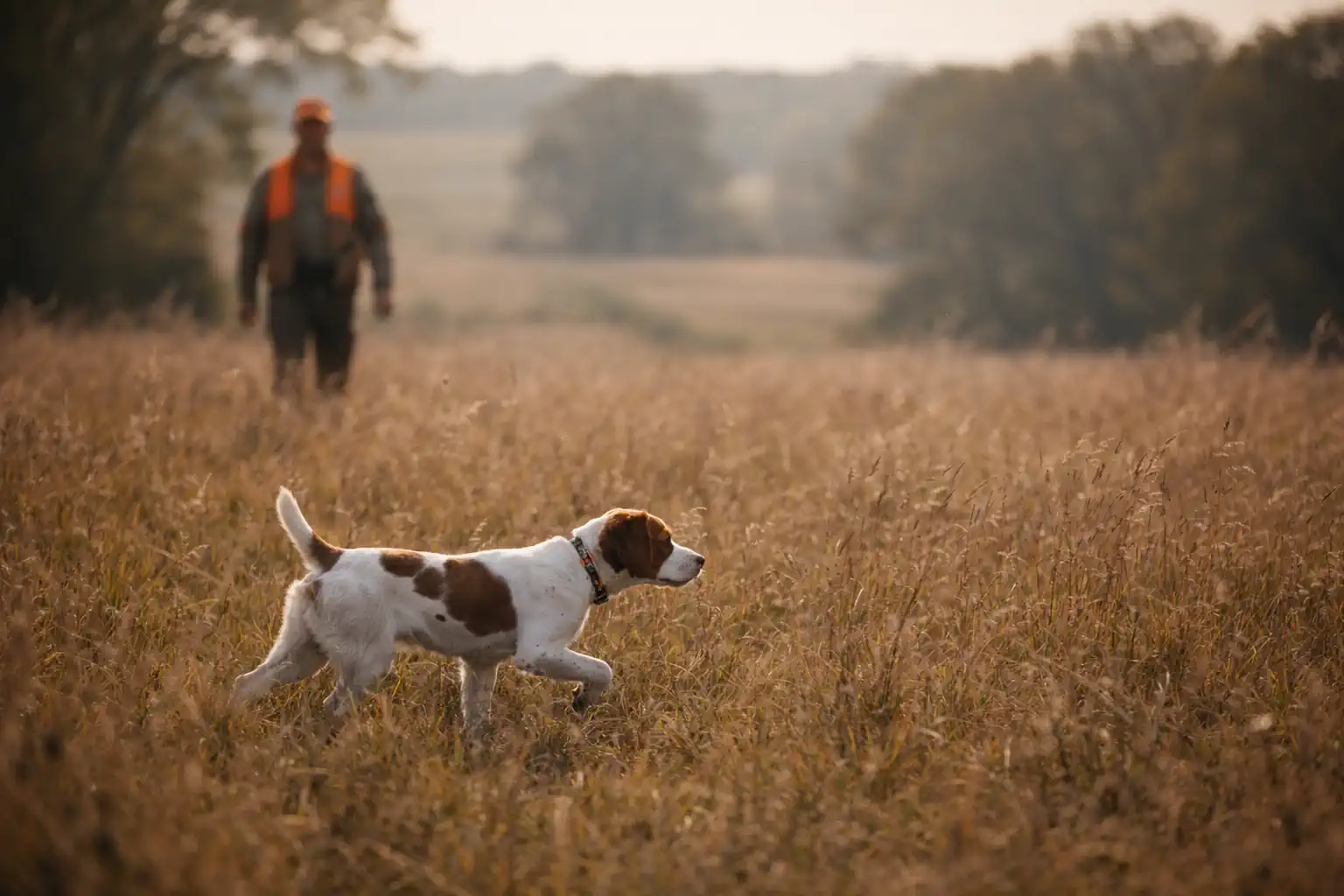
When your bird dog does not do what you asked, stop adding demands and decide which question needs answering. Is the dog safe and comfortable? Was this particular response actually taught? Has the setting changed? Do you need someone to assess the problem with you? A missed cue does not identify a motive or justify a stronger correction.
This guide helps you choose a next step. It cannot diagnose pain, fear, hearing loss or another medical or behavior condition, and a training record cannot clear a dog to continue working.
First, decide whether this is a training question today
Keep the dog safely managed and end a situation you cannot control. Roads, livestock, wildlife pursuit or a risk of injury are reasons to leave or change the setup, not opportunities to test whether the dog will eventually listen.
Stop work and contact your veterinarian for apparent pain, limping or a concerning new change in movement or behavior. AAHA's pain-sign guidance explains that discomfort can appear as withdrawal, irritability or reluctance to move. Labored breathing needs immediate veterinary attention. Do not run another exercise to investigate these signs yourself.
Fear, repeated avoidance, new aggression or an unexplained change across familiar activities also call for veterinary advice. Dogs Trust's guidance on fear and frustration recommends medical assessment for behavior changes, even when illness is not obvious. Give a worried dog space and avoid recreating a frightening event for a test or video.
Define the response before deciding it failed
Replace "won't obey" with a sentence someone else could observe: "After I said 'sit,' the dog remained standing." Include where you were, what cue you gave and what happened next.
Then check your expectation:
- What action did I request? Looking toward you, coming within reach and releasing an object into your hand are different responses.
- What has the dog actually done before? Record whether it responded to the word, a gesture, food being moved, or several prompts together. Do not assume one successful attempt established the word's meaning.
- Where and under what conditions did that happen? A familiar room, close handler and quiet surroundings describe a particular task, not every future version of it.
- What did I change? Include your own position, wording, equipment, the requested finish and anything happening nearby. Leave uncertain details marked unknown.
These questions separate possible teaching gaps from changes that deserve another kind of assessment. They do not prove why the dog acted as it did, and they do not make every difficulty the handler's fault.
SAFE AND COMFORTABLE ENOUGH TO CONSIDER TRAINING?
        no / uncertain -> stop; manage safety; seek appropriate help
        yes
         |
CAN YOU DESCRIBE THE RESPONSE AND WHEN IT HAS WORKED?
        no -> define a small goal; review how to teach it
        yes
         |
WHAT IS DIFFERENT THIS TIME?
        known change -> choose the relevant guide or simplify the plan
        unclear / persistent difficulty -> ask a professional to observe
My dog seems behind—what does “slow” mean?
If you call your bird dog “slow-starting,” identify the history behind that concern. If you mean little exploration rather than a missed cue, describe that activity and the opportunities it had to occur. It need not be a response to a command. A littermate's performance or a breed calendar cannot tell you what this dog has learned. RSPCA's training advice recognizes different learning rates; that does not promise that a particular response will appear with time.
Separate three situations:
- You have not observed the response yet, or the earlier history is unknown. Say what is missing from your observations. Do not turn an unknown into a lost skill or a verdict on the dog's future. An instructor can help define an appropriate teaching goal.
- You have seen the response, but with different help or in another setting. That is a comparison question. Identify the assistance and conditions before concluding that progress stopped.
- The dog has changed during familiar activities. Withdrawal, reluctance to move or other concerning changes belong with the veterinary questions above. Do not explain them away as a late start.
None of these histories rules out a health concern. Dogs Trust's veterinary-referral guidance notes that medical problems can develop gradually and may not be obvious.
Use relevant existing observations of this same dog, with the task and help identified. If records are useful, the training journal and comparison forms preserve those details; there is no new score or required number of sessions here. More assistance can change a result without demonstrating greater independence.
You need not wait for a birthday or another failed attempt before asking for help. If you cannot identify a manageable goal, or difficulties persist, discuss the plan with a reward-based instructor. Health, fear or safety concerns take priority over collecting a trend. “Give it time” is not an assessment, and a fixed deadline cannot establish either inability or eventual success.
Choose the relevant next step
Use the row that describes what you know, rather than choosing a more demanding exercise to find out what happens.
| What you can describe | What to do next |
|---|---|
| A new word or whistle has not yet produced the intended return without other prompts | Review teaching the response in recall and whistle training. A louder cue is not a clearer lesson. |
| A familiar response occurs in one setting but changes elsewhere, with no health or distress concern identified | Compare the conditions using yard-to-field transfer; do not add distance and distractions together. |
| The dog completes part of a retrieve but the finish changes | Identify the particular task in the retrieve chain, rather than repeating the whole retrieve farther away. |
| You are trying to interpret a point, flush or other unexpected bird encounter | Use early bird-work mistakes. A bird encounter does not provide a sensory diagnosis. |
| The response has changed across familiar activities, the dog appears uncomfortable, or fear or aggression is involved | Pause the training investigation and consult your veterinarian; ask about qualified behavior support. |
| You cannot describe a workable next goal, or repeated attempts leave you more confused | Ask a reward-based trainer to observe the lesson and explain the next step. You need not exhaust every exercise before seeking help. |
If an ordinary teaching task is appropriate, keep it short, rewarding and manageable. RSPCA training guidance supports quiet starting conditions, rewards and individual learning rates. End the practice if the dog withdraws or you become frustrated; a final successful repetition is not required.
When a response changes in season
Imagine a dog that previously stayed on point until a bird flew moves as a bird rises on a later outing. That is one observation, not an explanation or evidence of what the dog would do at a shot. If safety or control is uncertain, end the setup; do not recreate it or add shots to diagnose it. Note the setting, any cue, the observed response and what you could not see.
A recent change in behavior deserves veterinary advice; do not assume it is merely a training problem. For a persistent training question, ask a qualified professional who uses reward-based methods. The wing-and-shot glossary helps distinguish reported events without prescribing exercises.
A fictional example: the cue and the expectation differ
Rae and her retriever, Finn, are an invented example. At home, Rae says "sit" while raising a hand. Finn sits. Later she uses only the word and Finn remains standing. She writes, "He knows sit but refuses."
A more useful note says: "Sat after word plus hand movement; remained standing after word alone." Rae has not established what each signal means to Finn, or why this attempt differed. She does not press his hips down or repeat the word until he sits. She asks her trainer to watch the signals and help teach a clear, achievable response.
Her next goal concerns that lesson. It is not a test of whether Finn will obey near birds, and a successful practice would not establish reliability everywhere.
Choose help that matches the concern
A reward-based trainer can help define a skill, review cues and timing, and adapt an ordinary lesson. Medical concerns belong with a veterinarian. For fear, anxiety or aggression, AVSAB's trainer-selection guidance recommends a veterinarian with advanced behavior knowledge, a veterinary behaviorist or a credentialed behavior consultant.
Ask a prospective professional:
- What education and relevant experience support your approach to this problem?
- What methods would you use, and what would make you stop or refer us elsewhere?
- Can you explain what we will observe and how the plan will change if the dog struggles?
- How will you coordinate with my veterinarian when health or behavior concerns overlap?
Credentials alone do not guarantee quality. You should be able to ask questions, decline an exercise and discuss alternatives. AVSAB's current humane-training position recommends reward-based methods throughout training; force, intimidation and electrical or physical punishment are not the next troubleshooting step.
Bring a concise description of what changed, the cues and assistance used, and any health or behavior concerns. Share footage you already obtained safely; do not provoke the problem to collect more evidence.
Finish with a specific decision: stop and seek help, return to a suitable teaching task, or review a known change in context. If choosing the training goal itself is the difficulty, find your next guide before adding another demand.
Where to go next
Choose the step that matches the question you still need to answer.
Next decision
Was the same response taught in this setting?Compare task, cue and help before concluding that the dog refused.
Related problem
Is the problem within a retrieve?Separate finding, pickup, carrying, return and delivery before choosing practice.
Next decision
Choose help that matches the questionTrainer-selection questions support a decision about help, not a diagnosis of the dog.
Browse guides by question or find your training starting point.