What Steady to Wing and Shot Means for a Pointing Dog
· 8 min read · HuntWithDog
Holding point and remaining through wing, shot and fall are different observations. Clarify the task, cue and endpoint before deciding what your pointing dog needs next.
On this page
- Separate what starts the behavior from how long it continues
- Put the events on a timeline
- Separate a settled point from a training repetition
- Wing, shot and fall are separate goals
- Check the program before assigning an endpoint
- “Release” needs an action attached
- A fictional example: describe only the part you saw
- Keep the definition separate from the method
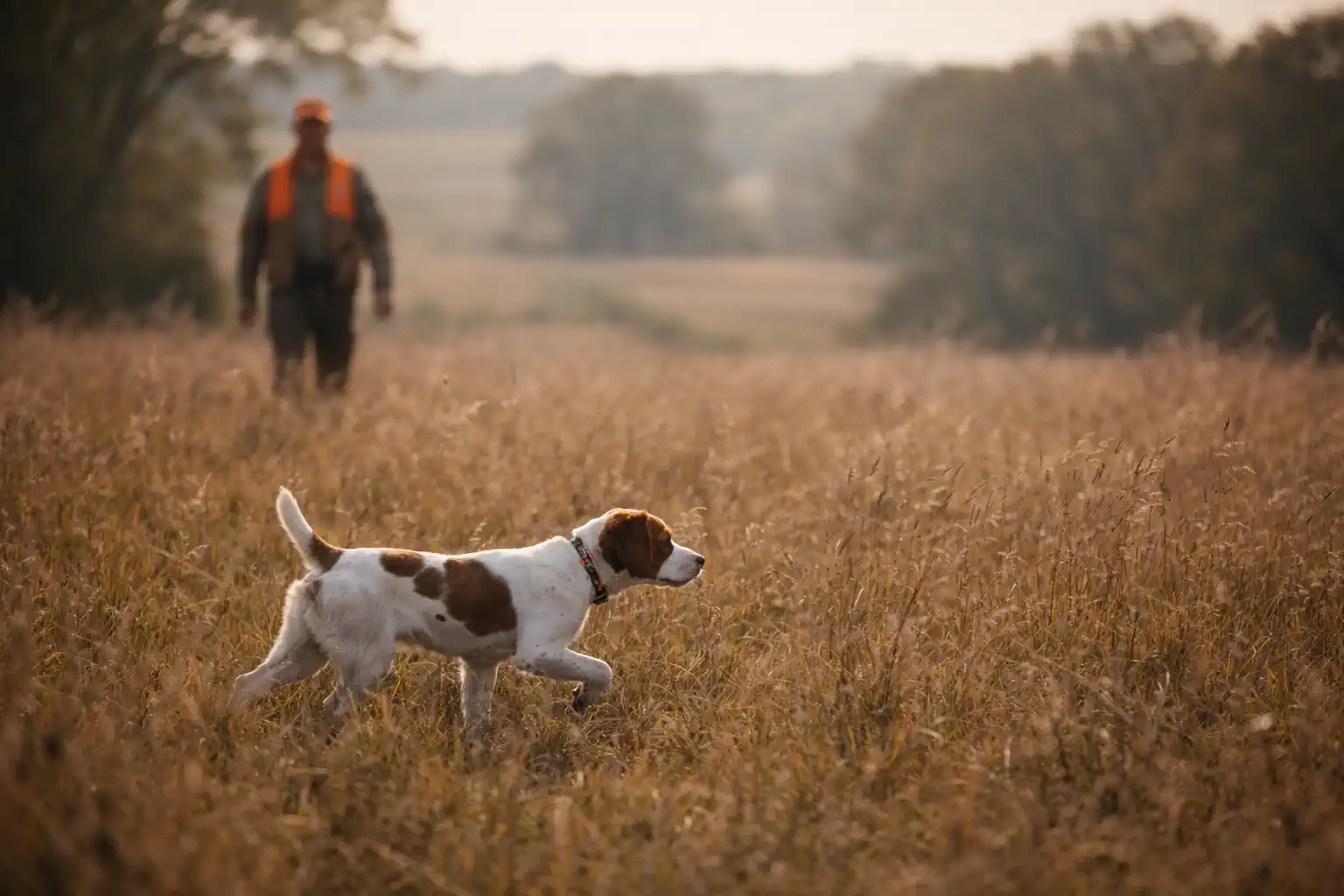
Holding a point describes what happens before the bird leaves; steadiness describes remaining in position through specified later events. “Steady to wing” and “steady to shot” identify different parts of that description. Ask which standard and endpoint the speaker means, rather than assuming every use of “steady” includes waiting for a retrieve signal.
This vocabulary helps you understand a report, video or conversation with an instructor. It does not provide a training progression or establish that a dog or outing is safe. You can learn the distinctions without arranging bird encounters or noise demonstrations.
Separate what starts the behavior from how long it continues
Pointing, stopping at a flush and backing another dog can all involve a stationary dog. They describe different events. A dog maintaining its own point was already stationary; a dog stopping after a bird flies has changed from movement to a stop. Backing concerns the sight of another dog on point, explained in the honoring guide.
The AKC pointing-test glossary gives these distinctions. The table uses those definitions to separate the descriptions; it is not a universal scoring standard or a sequence of lessons.
| Description or glossary term | What it describes | What the words alone leave open |
|---|---|---|
| Holding point | Maintaining the stationary indication of game | What happens when the bird moves or flies |
| Steady to flush | Maintaining point until the pointed bird is flushed | Whether the dog remains afterward |
| Stop-to-flush | Stopping after observing a bird's flush | Whether there was an earlier point, and the required duration of the stop |
| Steady-to-wing | Maintaining point during the flushed bird's flight | The applicable endpoint and next action |
| Steady-to-shot | Maintaining point during flight and the shot or shots | What the applicable level requires afterward |
The small difference between steady to flush and stop-to-flush matters. One describes continuing a point; the other describes stopping in response to a flush. A dog visible only after the bird has left does not give you the preceding sequence.
Put the events on a timeline
This is a conceptual description of a reported event, not a setup to reproduce. It gives no handling instructions, positions or intervals.
POINT REPORTED -> BIRD LEAVES -> SHOT REPORTED -> FALL REPORTED -> NEXT SIGNAL
      |                |                |               |              |
What was the dog doing before, during and after each observed event?
Which parts were actually visible or audible to the observer?
Some reports will not include every event. A missing part is unknown, not something to fill from the label. Keeping position during the visible flight does not establish what happened during an unheard shot, an unseen fall or a later signal.
Separate a settled point from a training repetition
A settled point and a training repetition are different situations. Do not add repeated commands or physical corrections to a dog already holding a point. Teach a rewarded stop-and-wait cue away from birds first. In a planned learning exercise, a familiar cue may help the dog understand the task; it is not a requirement to interrupt every natural point. If the dog cannot manage the setup, end or simplify it rather than escalating pressure.
Wing, shot and fall are separate goals
Steadiness to wing, shot and fall are separate goals. A dog that holds through a flush has not automatically learned the next part. A break at gunfire can also involve noise concerns; do not assume it is simply disobedience or repeat shots to test it. Resolve comfort with noise separately before combining the tasks. Bird enthusiasm alone does not establish readiness for gunfire.
Electronic stimulation is an aversive training method, not a substitute for a learned cue or safe field management. Our training guidance uses reward-based methods in line with AVSAB's humane-training position. For steadiness that breaks down at distance, reduce the difficulty and work with qualified reward-based help rather than adding a remote correction. This does not prescribe a new gunfire-introduction procedure or imply agreement among all field programs.
Check the program before assigning an endpoint
AKC's current pointing hunting-test regulations illustrate why the level matters. Senior requires steadiness to wing and remaining until the shot or release. Master requires steadiness to wing and shot. In a Master retrieving situation, the guidelines require the dog to remain until commanded to retrieve. These are different requirements within one program, not interchangeable meanings of “trained.”
NAVHDA's February 2026 test rules, Utility Test §7.9, divide the event into named judging intervals: flush, wing, shot and fall. Its “wing” interval runs from the bird leaving the ground to the shot; “shot” runs from that event to the bird reaching the ground; “fall” continues until the dog is sent to retrieve. These interval names should not be substituted mechanically for another organization's glossary.
You do not need to memorize every rulebook. Identify the organization, level and rules applying to the event, then ask what the actual performance showed. The field-trials and hunting-tests guide covers interpreting results more broadly. A label or title does not decide what your dog should be asked to do today.
“Release” needs an action attached
Ending a stationary position, sending a dog to retrieve and asking it to release an object are different actions. A word used for one team does not establish what another dog understands. AKC's glossary distinguishes sending a dog on from a command used to start a retrieve; NAVHDA separately discusses releasing the bird during delivery.
Ask the handler to finish the sentence: “After this familiar signal, the dog is expected to ___.” Resume a search? Begin a retrieve? Release an object into a hand? If the answer is unclear, clarify the intended task with the instructor rather than adding another signal. The retrieve-chain guide covers the separate finding, carrying, returning and delivery tasks.
A fictional example: describe only the part you saw
This example is invented. Alex watches an existing recording discussed by an instructor. The dog, Rowan, is on point and remains in position while the bird flies across the visible scene. The recording ends before any later event or handler signal can be assessed.
Alex initially calls Rowan “steady through the whole sequence.” A more precise description is: “Rowan remained in position during the visible flight; I cannot assess what followed.” Alex also notes any assistance the recording actually shows, leaving inaudible or off-camera information unknown.
That description is useful even without awarding a label. It does not prove consistency on other occasions, explain Rowan's emotional state or clear the dog for a hunt. Alex asks the instructor which requirement they are discussing; nobody creates another encounter to complete the recording.
Keep the definition separate from the method
Before agreeing to practical work, ask what behavior is intended, what the dog already understands, how the activity will be managed and what would end it. A terminology guide cannot answer those questions for an individual dog. Learning a definition does not require accepting pressure, a fixed season timetable or a promise of reliability.
AVSAB's current position recommends reward-based methods throughout training. Dogs Trust's body-language guidance emphasizes the whole dog and context: stillness alone does not establish comfort. Its fear and behavior guidance supports space, avoiding overwhelming situations and veterinary advice for concerning changes or fear.
End an interaction that becomes unsafe or distressing and seek appropriate help. For practical instruction involving birds or sound, use an individualized plan reviewed by suitably qualified professionals. The useful next question is specific: which event, which observed response, which endpoint and which learned next signal?
Frequently asked questions
Should I repeat whoa when my dog is already pointing?
Do not add repeated commands or physical corrections to a dog already holding a point. Teach a rewarded stop-and-wait cue away from birds first. A familiar cue in a planned learning exercise is different from interrupting every natural point. End or simplify a setup the dog cannot manage rather than escalating pressure.
Does breaking at the shot prove an obedience problem?
No. A break at gunfire can also involve noise concerns. Do not assume it is simply disobedience or repeat shots to test it. Comfort with noise needs to be resolved separately before the tasks are combined; holding through a flush does not establish readiness for a shot.
Can a remote correction replace a learned steadiness cue?
No. Electronic stimulation is an aversive training method, not a substitute for a learned cue or safe field management. HuntWithDog recommends reward-based training. If steadiness breaks down at distance, simplify the task and seek qualified reward-based help rather than adding a remote correction.
Where to go next
Choose the step that matches the question you still need to answer.
Next decision
Which standard and endpoint applies?A result belongs to a named program and level rather than one universal steadiness test.
Next decision
Describe the sequence before choosing a lessonRecord the cue, bird movement, shot or release actually observed without filling gaps.
Prerequisite
Is a reaction at the shot a noise concern?A break does not prove disobedience; pause and separate comfort with noise from steadiness goals.
Browse guides by question or find your training starting point.