Retrieve Training: Find the Missing Link Before Adding Distance
· 6 min read · HuntWithDog
Break a bird dog's retrieve into finding, picking up, carrying, returning, and delivering. Use a simple observation table to choose what to practice next.
On this page
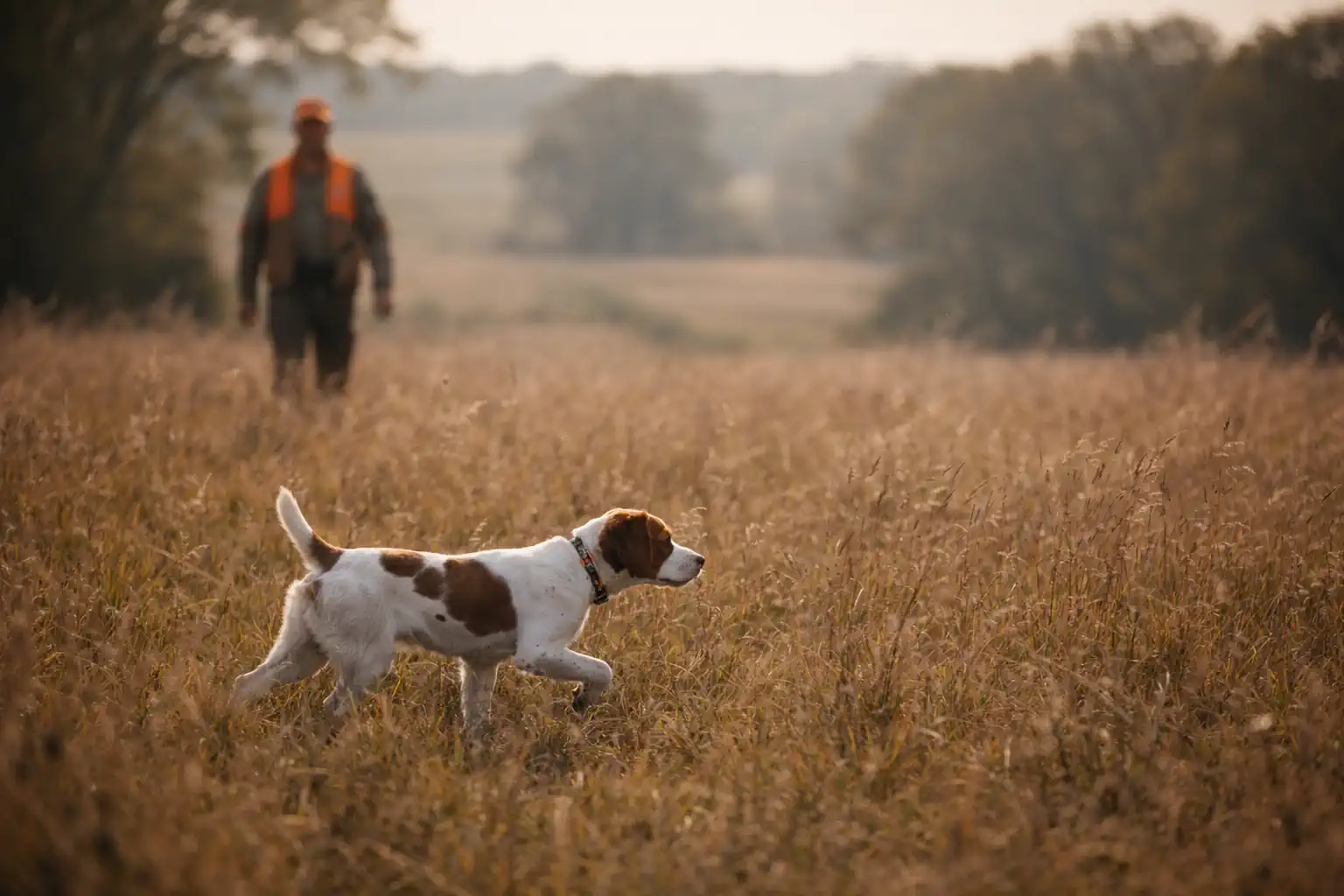
If your bird dog chases a bumper but leaves it in the grass, the missing skill may be picking up or returning. If the dog brings it back and drops it beyond reach, work on the finish. Watch where the retrieve changes, then practice that part in an easier setting. Throwing farther asks for more of the same unfinished chain.
Here, a bumper means a dummy made for retrieving practice. This guide uses a safe toy or bumper on dry land, with no birds, gunfire, or water. It helps a new owner choose a practice goal; it cannot determine the cause of pain, fear, or aggression.
Five links to watch
The following is an observation framework, rather than a test every dog must pass in a fixed order. Separate carrying from returning: a dog can carry an object happily while moving away from you.
FIND → PICK UP → CARRY → RETURN → DELIVER
 locate   lift     keep it    approach    release at
 object   object   while moving handler   agreed place
The cue that starts the task sits before this chain. A dog watching you without leaving has not yet shown you a finding problem. Likewise, delivery needs a definition: for this guide it means approaching within comfortable reach and releasing the object into your offered hand on a learned cue. Other activities may use different finishes.
| What you actually see | Link to look at first | A simpler next task |
|---|---|---|
| Dog runs past a bumper that is hard to see | Finding | Put the familiar object in plain sight nearby |
| Dog reaches it, sniffs, and leaves it | Picking up | Explore willingness to take that object beside you |
| Dog lifts it but drops it while turning | Carrying | Ask for less movement before the familiar finish |
| Dog carries it away from you | Returning | Shorten the separation; reward approaching without pursuit |
| Dog returns, then drops it just beyond reach | Delivery | Rehearse the handover beside you, apart from the long retrieve |
These are practice options, not diagnoses. Record the behavior before deciding what it means. “Dropped at my feet as I reached down” tells you more than “lazy retriever.”
Start beside you
Use a quiet, enclosed space with comfortable footing and an object suitable for your dog's size. Pick something the dog willingly investigates and can carry. Put other pets away so the object does not become a competition.
Begin where the dog can succeed. That may be looking at the toy, touching it, taking it, or holding it briefly. Reward the current achievable response, then make the next request only slightly harder. A dog that already carries needs a different starting point from one that has never picked up a toy. The AKC's fetch guide describes this gradual approach from interest and hold to a nearby pickup and increasing distance.
Choose one clear target: “take the bumper beside me,” for example. Avoid requesting a pickup, long carry, perfect sit, and hand delivery together. If one part keeps failing, shorten the task rather than repeating the whole sequence more insistently.
Make the handover worth approaching
If the dog willingly brings you the object but is reluctant to release it, practice a predictable exchange with a safe toy beside you. Reward the release with food or another suitable toy. When appropriate, let the dog have the original toy again, so approaching you does not always end the activity. Add your release word when the exchange is becoming predictable. The AKC's “drop it” guide explains this trade and why chasing or prying the mouth open is a poor way to obtain an object.
A release onto the floor is useful, but it is a different finish from delivery into a hand. For the latter, begin with the dog and object close to your offered hand. Reward a manageable pickup and handover before adding a return from farther away. Do not keep pulling your hand farther from a dog that is already struggling to finish.
This practice assumes a dog comfortable with you near its toy. Stiffening over the object, growling, or threatening to bite calls for a different plan: stop the exchange practice, give space, and seek qualified help. Veterinary behavior guidance from VCA Animal Hospitals warns against confronting a dog guarding a valued resource.
A worked example: the last few feet
This is an invented teaching example, not a report about a real dog.
Mara's dog finds a visible bumper, picks it up, and comes back. When Mara reaches toward it, the dog drops it two steps away. Her first idea is to make the throw longer so the dog works harder.
Her notes point elsewhere:
Find: yes. Pickup: yes. Carry: yes.
Return: approaches. Delivery: drops as hand reaches forward.
Next practice goal: a calm handover beside the handler.
Mara puts the long throws aside. She works nearby with the same familiar object and rewards a voluntary handover. Once that finish becomes comfortable, she adds a little separation. If dropping returns when she adds distance, she goes back to the shorter version.
This does not prove that her hand movement caused the drop. It identifies a detail worth changing and a clear result to observe. A successful nearby handover also does not establish readiness for a bird in heavy cover.
When to add difficulty—and when to pause
Use the following editorial decision rule: progress when the dog completes your chosen piece comfortably on repeated opportunities and you can describe what “success” looked like. There is no universal number of repetitions or age at which the chain is finished.
Change one feature at a time: a little more distance, a different familiar object, or a modest change of setting. Keep the remaining features easy. Before moving from the yard to field practice, establish the safety responses you need and choose a setting in which you can manage the dog. A changed environment adds a new learning task; it does not merely reveal whether the dog is “obedient.”
Pause if the task becomes less successful, the dog repeatedly disengages, or you find yourself chasing, grabbing, or repeating cues. Record what changed and make the next session easier. Sudden reluctance to carry or move, apparent pain, or a marked behavior change warrants veterinary advice rather than another retrieve test. Fear or guarding needs an individual behavior plan; AVSAB explains the veterinarian's role in checking for medical factors that may contribute to behavior concerns.
The welfare boundary applies throughout. AVSAB's current position, reaffirmed in 2025, recommends reward-based methods for all dog training. Some older retriever manuals discuss physical or electrical pressure; those passages do not establish a current welfare standard, and they are not the basis of this practice guide.
Keep a record you can use
After a short practice, write down the object, place, distance, chosen link, and what happened. Include your own action just before the response. “I stepped toward him; he turned away” is an observation. “He was testing me” is an interpretation.
At the next session, start with the last comfortable version. If you need help, bring those notes to a reward-based trainer; they give the trainer a clearer starting point than “he won't retrieve.”
Where to go next
Choose the step that matches the question you still need to answer.
Prerequisite
Review what a return cue requestsA return to the handler needs a defined finish, not just movement in the right direction.
Related problem
Does a retrieve problem mean force-fetch is required?Understand the method label and reward-based options before accepting pressure as the next step.
Next decision
What does the dog know at the start?Marking and handler direction are different questions from the physical retrieve chain.
Browse guides by question or find your training starting point.