Marked vs Blind Retrieves: What Your Dog Knows at the Start
· 6 min read · HuntWithDog
Understand marked, memory, and blind retrieves, what each asks of a dog, and how to choose a useful next step without confusing missing information with disobedience.
On this page
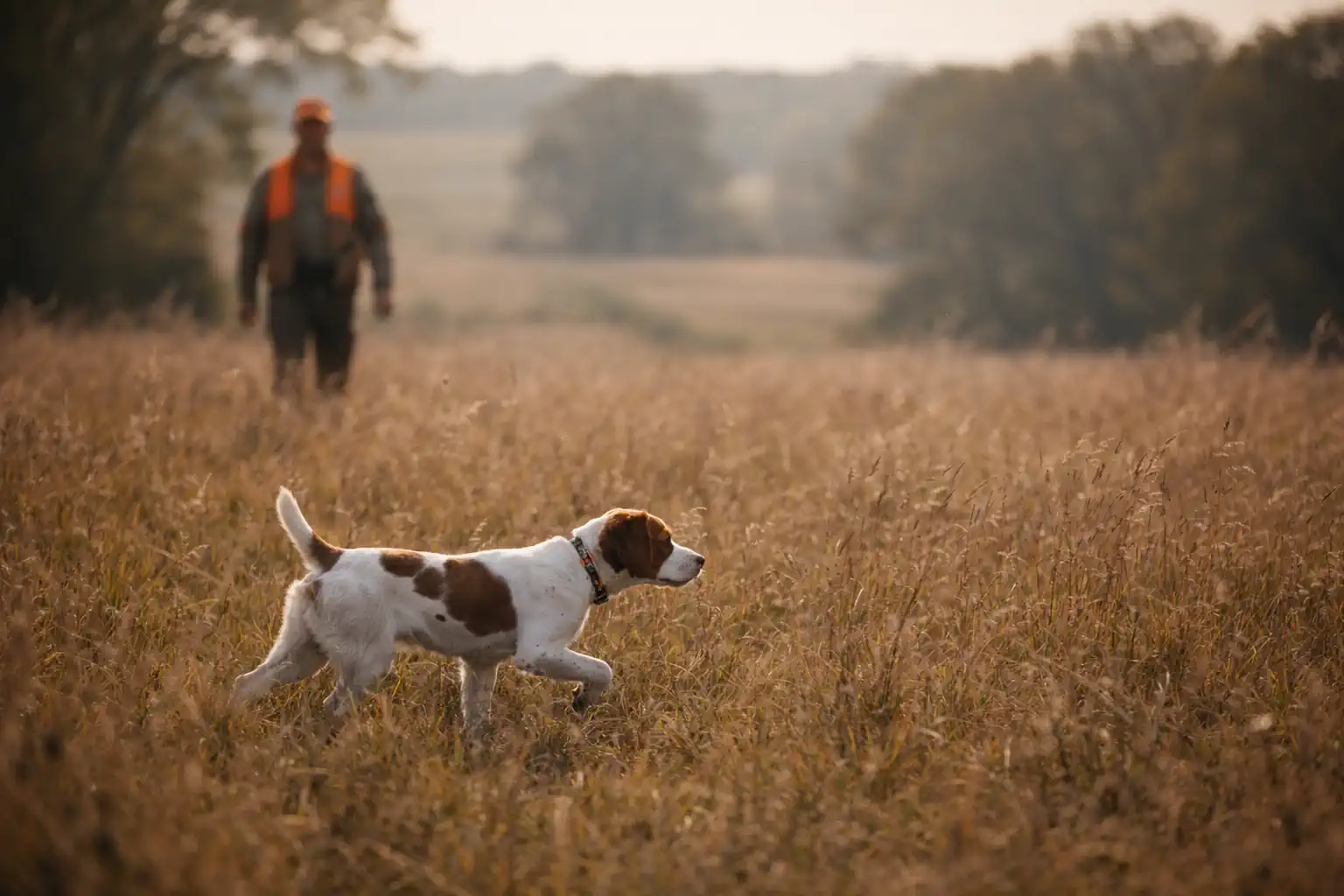
A marked retrieve starts with a fall the dog has seen. A blind retrieve sends the dog to an object whose fall it did not see, using direction from the handler. The difference is the information available at the start. A longer retrieve does not automatically become a blind, and an object disappearing into grass does not erase the fall the dog watched.
This distinction helps you describe a problem before changing the training. Did the dog lose track of a fall, need help finding the object nearby, or receive a direction it had never learned? Those are different questions. AKC's retriever hunting-test guidelines distinguish marking and memory from the control and response assessed in blind work.
Single, double, memory, or blind?
Here is a plain-language guide to the terms you will hear around retrievers. A dummy or bumper is a training object used in place of game.
| Term | What the dog has seen | What the task adds |
|---|---|---|
| Single mark | One fall before that retrieve | Remembering that location, finding the object, and returning |
| Double mark | Two falls before either is retrieved | Keeping track of two locations while collecting one object at a time |
| Memory retrieve | A previously seen fall left for later | Retaining a location through a delay or another task |
| Blind retrieve | No observed fall for that object | Following previously learned direction from the handler toward a known destination |
In a double, the fall left until later is often called the memory bird. It remains a mark: the dog saw it. A blind can also be one of several retrieves, so counting objects alone will not tell you the category. AKC's introduction to the test levels separates single marks, double marks, and blinds; they are related skills with different demands.
Also, blind retrieve does not describe impaired eyesight. Nor does it mean the hunting hide in which a person waits.
Picture the information, then the route
MARK
Dog watches: object travels through air --> lands at A
Later:       dog leaves handler --------> searches around A

MEMORY MARK
Dog watches: object lands at A; another task happens
Later:       dog leaves handler --------> returns to remembered A

BLIND
Dog did not see the object placed at B
Handler knows B --> gives learned direction --> dog works toward B
The arrows show information and sequence, not a prescribed running line. They can be used as an accessible diagram without staging a difficult exercise for a dog.
Fictional example: the grass does not make it a blind
Imagine Maya and her Labrador, Reed, in a familiar enclosed training area. Reed watches a dummy land in short grass. When released, he reaches the right patch but searches briefly before picking it up. That is a marked retrieve even though the dummy was hidden from view after landing. Finding the exact object and remembering the general fall are related parts of the job.
Now imagine Reed was facing Maya when somebody placed a second dummy elsewhere. Pointing toward it does not establish that Reed understands the gesture. The object is unmarked for him; whether the team is ready to work toward it depends on their learned communication. This is an invented illustration, not an account of a trained dog's performance.
Eyes, memory, nose, and handler all have jobs
Marking does not require an exact, uninterrupted beeline to the object. AKC's beginner explanation of marking recognizes a dog reaching the fall area and searching it as a useful response. A dog using its nose there has not necessarily forgotten everything it saw.
A blind still involves finding an object; it does not turn off the dog's nose. The handler contributes location information that the dog lacked. Whistle stops and directional casts—signals asking the dog to move in a particular direction—are communication skills to teach, not gestures a dog should understand by instinct. Wind, cover, and visibility can change the task. Record those conditions along with the information the dog had at the start.
Avoid judging the whole retrieve by its ending. An object returned to hand does not reveal which clues got the dog there. A failed pickup does not, by itself, demonstrate poor marking. If the difficulty comes after finding the dummy, examine that part separately rather than adding more memory work.
Fictional example: two falls, two questions
Imagine Ellis and a spaniel, Pip, watching two dummies fall at A and B. Pip retrieves B first, then goes back toward A. A is the memory mark. If Pip instead returns to B, Ellis's useful note is “returned to the previous fall after collecting B,” rather than “stubborn.” Did Pip attend to A? Was the waiting period different? Were two falls new to this team? This invented scenario raises questions; it does not diagnose Pip's motivation.
Choose the next step from what is already working
For a novice owner, the useful progression is a set of checks rather than a deadline. These are planning questions, not official test-entry standards:
- Before increasing a mark's difficulty: Can the dog comfortably watch one clear fall, wait for the familiar release, find it, and return in the current setting?
- Before adding memory demands: Is that single task becoming familiar across separate, short practices? If not, keep one clear fall and examine where the sequence changes.
- Before attempting blind work: Has the dog learned the intended stop and direction signals separately? Can you recognize its response and explain the task without repeated, conflicting cues? A reward-based retriever instructor can help plan that transition.
Change one feature at a time so your notes remain useful: a new location or more cover, for example, rather than both plus extra distance and a second fall. If a change produces repeated confusion, simplify it at the next practice instead of repeating an unsuccessful send. There is no universal age, yardage, or success percentage at which every dog is ready.
Use rewards and clear setup to teach the needed skills. The American Veterinary Society of Animal Behavior's current position, reaffirmed by its board in 2025, supports reward-based training throughout and opposes aversive methods. Historical retriever manuals contain both useful terminology and coercive techniques; the terminology does not validate those techniques.
Know when to pause
Pause if the dog repeatedly avoids the activity or appears distressed. Cornell's veterinary behavior guidance, updated in December 2025, lists signs such as shaking, ears held back, and lip licking, while emphasizing that anxious behavior needs interpretation of its cause. A single gesture is not a diagnosis.
End the activity and contact your veterinarian if you see pain or a concerning new change in movement or willingness to pick up. AAHA advises owners to report pain signs and behavioral changes; its 2022 pain-management guidelines emphasize behavioral and contextual assessment. Trying a harder blind cannot clarify a possible health problem.
For your next note, record just six things: what the dog saw, which fall was pending, what changed in the setting, which familiar cue you used, what the dog did, and why you stopped. That is enough to make the next conversation with an instructor more precise.
Where to go next
Choose the step that matches the question you still need to answer.
Prerequisite
Which part of the retrieve already works?Task labels do not replace teaching pickup, return and handover.
Related problem
Did the setting change as well as the retrieve?Avoid treating one changed response as proof of a marking or memory problem.
Next decision
Would adding water introduce separate unknowns?The water guide organizes planning questions; it does not provide a swimming lesson.
Browse guides by question or find your training starting point.