Field Introduction for Pointing Dogs: Make the First Walks Manageable
· 6 min read · HuntWithDog
Plan your pointing dog's first field walks with suitable ground, safe management, time to explore, and clear decisions to continue, simplify, or stop.
On this page
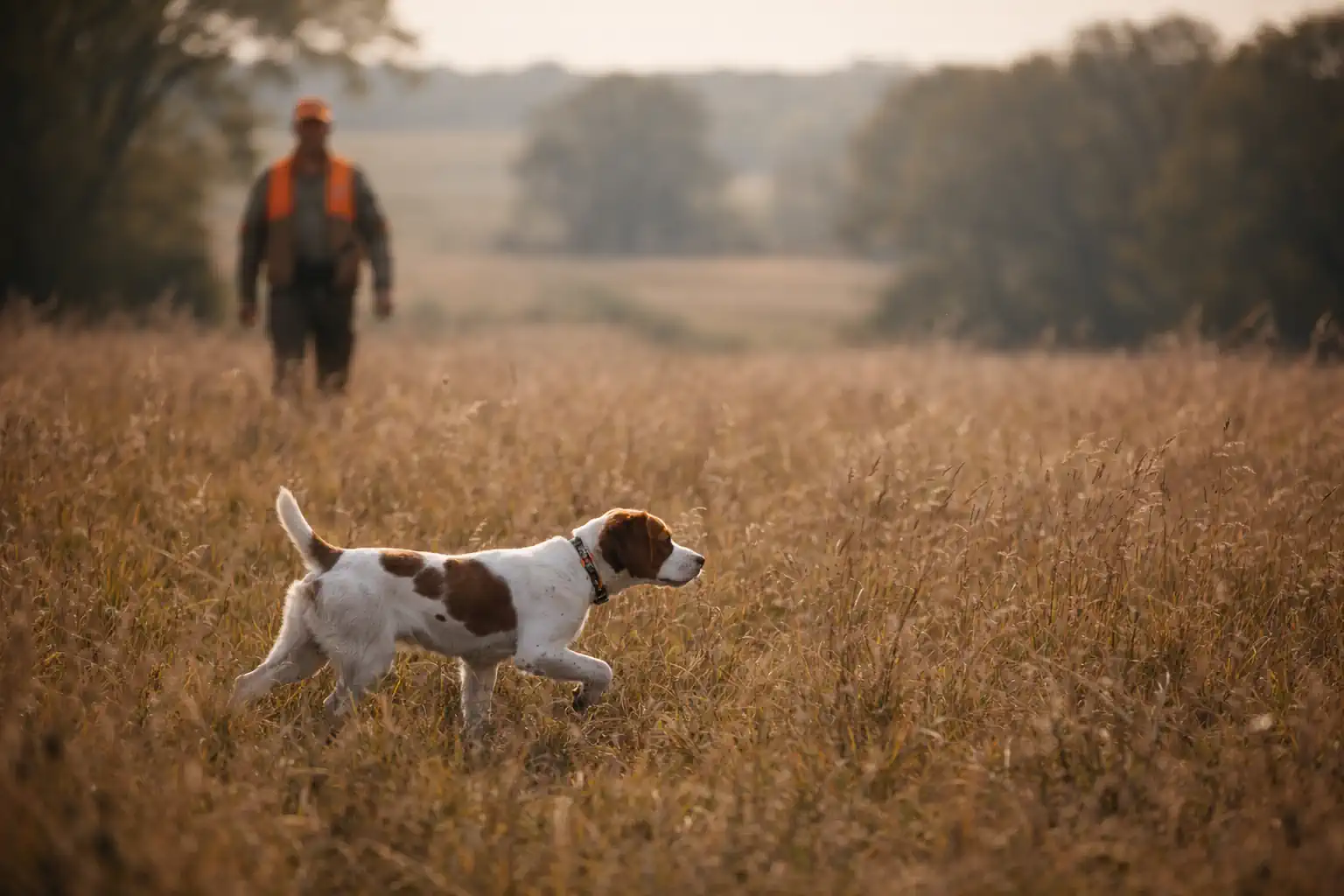
Start with a quiet, easy place where dogs are permitted, keep your dog safely managed, and allow time to sniff, pause, and explore. Your first field outing does not need birds, a point, a chase, or gunfire. A useful result is a dog that investigates comfortably while you can keep the outing safe and bring it to a calm close.
This is a plan for introductory walks, not a test of hunting ability. Exploration and safety cues belong together. You can avoid repetitive drills while still using a familiar cue when you need the dog to return or move away from trouble.
Make a small plan before leaving
Choose a limited area and an easy route back. There is no need to complete a circuit or reach a distant landmark. Before you go, check:
- Access: confirm current permission and dog rules with the landowner or managing agency. Check lead requirements, closed areas, wildlife restrictions, and other activities on the site. Do not assume that walking access permits dog training or free running.
- Ground: look for easy footing, low vegetation, clear sight lines, and space away from roads, livestock, water, wire, and steep banks. Inspect it rather than relying on a map.
- Management: use equipment the dog already wears comfortably and that you can handle. Decide how you will keep the dog close and leave if the setting changes.
- Health: ask your veterinarian what exercise and places are appropriate for this dog, especially a puppy whose vaccination plan is still underway. Discuss local infection and parasite risks.
- Supplies: bring water and a bowl, suitable rewards, waste bags, a phone, and veterinary contact details. Check the dog's identification and your route home.
Safe exposure is a health-and-behavior decision. AVSAB's puppy-socialization statement supports safe experiences without overwhelming puppies; it does not authorize a particular field visit. Let your veterinarian guide the timing and setting rather than borrowing an internet age or vaccination schedule.
Begin on a lead
Use a regular lead for the first visits. The dog can stop, sniff, and investigate within that manageable space. Let it become comfortable with the outing before considering more freedom. Dogs Trust's first-walk guidance recommends lead management even when recall training has begun, plus quiet surroundings and time to investigate.
A longer line is an option later, once you can use it safely and the dog is comfortable with the equipment. Attach it to a well-fitted harness. Choose clear ground; vegetation and obstacles that can catch a line are reasons to use a different setup or location. Get practical help if you are unsure how to handle it. A line is not a device for jerking a dog through cover.
An open gate, untested boundary, or reassuring recall at home is not a substitute for management here. If you cannot prevent a foreseeable problem, choose another place.
Give the visit a simple shape
Pause at the edge. Let the dog look and sniff before moving farther. Check the actual conditions: an approaching dog, new livestock, or machinery may make your planned area unsuitable today.
Explore easy ground. Walk slowly enough for pauses. There is no required direction, search pattern, or distance from you. Do not pull the dog into taller grass to prove it is bold. A sniff beside the path is an opportunity to observe, even if it does not look like hunting.
Keep contact useful. Notice voluntary looks and approaches, and reward them. Use a familiar cue when needed for safe movement or returning within reach. Avoid a stream of unnecessary calls, but do not stay silent when the dog needs guidance. If communication becomes difficult, maintain physical management and leave the harder situation; teach the missing response separately.
Return while the plan still works. Offer water and a quiet break as appropriate. A shorter visit is a valid decision. There is no fixed number of minutes that makes an outing useful or safe, and you need not demand a final successful repetition before going home.
CHECK THE PLACE → PAUSE AT THE EDGE → EXPLORE EASY GROUND
                                             ↓
                                    dog and setting manageable?
                                      yes          no
                                       ↓            ↓
                                  brief repeat   simplify or leave
                                       ↓            ↓
                                     CALM RETURN + REST
Choose, continue, simplify, or stop
Use this planning table with the whole situation in view. It is not a diagnostic scale or a test every dog must pass.
| Decision | What you observe | What to do |
|---|---|---|
| Choose the area | Permission is confirmed; ground is easy; you can manage the lead and return without crossing hazards | Use a small part of it first. If a condition is missing, choose elsewhere. |
| Continue briefly | Dog moves willingly, investigates with a loose body, and remains available for ordinary contact | Allow pauses and repeat the comfortable part; extra distance is optional. |
| Simplify | Dog hesitates at denser cover, leans away, or becomes tense as activity approaches | Move to easier ground or increase space. Do not lure or drag it into the worrying situation. |
| Stop | Dog repeatedly tries to withdraw, cannot settle after space is provided, or the area becomes unsafe | Leave calmly. Plan an easier visit and seek help if the concern persists. |
Read combinations of behavior in context. A still dog may be investigating something; a wagging tail alone does not establish comfort. Dogs Trust's body-language guide explains why the whole body and situation matter. Its confidence guidance recommends gradual introductions and allowing a worried dog space to move away.
If wildlife appears, keep the dog managed and avoid pursuit. Move away rather than turning the encounter into a required training opportunity. This walk is complete without bird contact.
Stop for health concerns
Limping, reluctance to move, apparent pain, or a concerning sudden behavior change warrants stopping and contacting your veterinarian. AAHA's pain-sign guidance cautions that changes in movement or behavior can reflect pain; an outing cannot diagnose the cause.
Heavy panting, drooling, or seeking shade may signal overheating. Stop activity and move to a cool place. Persistent excessive panting, breathing difficulty, weakness, confusion, or collapse needs immediate veterinary care. Cornell's heat-safety guidance describes those signs. Enthusiasm is not a reason to continue through them.
Example: the gate is far enough today
This is a fictional example. Nia takes her young pointer, Ash, to a permitted grassy area after discussing suitable outings with her vet. Ash is comfortable sniffing on lead near the entrance. At taller grass, he leans back and repeatedly turns toward the path.
Nia returns to the open patch instead of pulling him forward. When a noisy vehicle arrives nearby, she ends the visit. Her note says: “Comfortable near the gate; withdrew at taller grass; left when machinery arrived.” It does not say “failed field introduction.”
Next time, she chooses the quiet open patch again. She has a specific place and observation to revisit, without adding birds or asking for a wider search.
Decide what to repeat
Afterward, record the location, conditions, management, what the dog willingly explored, and why you left. Repeat a comfortable visit before extending it. If fear or handling difficulties persist, ask a qualified reward-based trainer and your veterinarian for help.
AVSAB's current training position, reaffirmed in 2025, recommends reward-based methods throughout training. A missed cue or reluctance to enter cover calls for a better plan, not physical or electrical pressure.
Related field guides
Where to go next
Choose the step that matches the question you still need to answer.
Prerequisite
What does your familiar return cue mean?Exploration still needs manageable contact and a way to end the outing.
Next decision
When is a bird encounter a different activity?Compare the purpose, permissions and limits of arranged sessions and wild encounters.
Related problem
What changes when birds enter the picture?Keep the encounter manageable and distinguish an observed response from a finished skill.
Browse guides by question or find your training starting point.