How Far Should a Pointing Dog Range? Match Range to Cover, Wind, Birds, and Control
· 9 min read · HuntWithDog
How far should a pointing dog range? Use cover, wind, terrain, bird behavior, cooperation, and safety to decide what distance is useful in the field.
On this page
- The Short Answer: Useful Range Is Contextual
- Match Range to Cover Before You Match It to a Number
- Open prairie and big grass
- Thick woods, brush, and grouse cover
- Broken hills and chukar-style terrain
- Small parcels and edge-heavy public land
- Wind Can Change the Right Range in Minutes
- Bird Behavior Changes Useful Range
- Young Dogs Need Freedom Before Precision
- Cooperation Is More Important Than Proximity
- How to Adjust Range Without Micromanaging
- 1. Walk the line you want hunted
- 2. Change direction before calling
- 3. Use cover to shape the cast
- 4. Let natural check-ins work
- 5. Build recall and direction control outside high-pressure bird contacts
- What GPS and Tracking Collars Change—and What They Do Not
- A Practical Range Decision Table
- Common Range Mistakes
- A Simple Field Test: Is This Range Working?
- Bottom Line
- FAQ
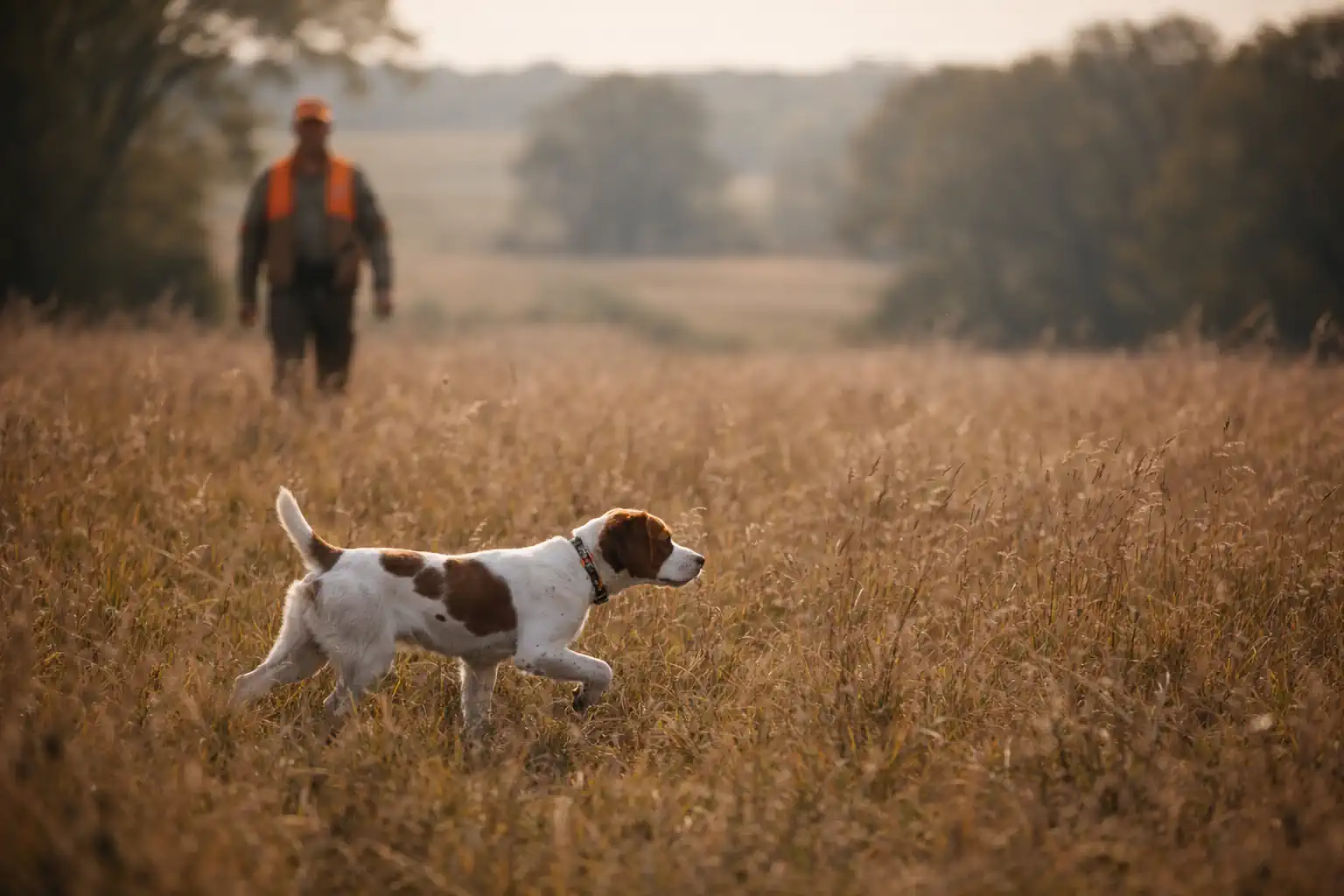
Ask three bird hunters how far a pointing dog should range and you may get three numbers. The numbers are usually less useful than the conditions behind them. A useful range in waist-high CRP with steady wind is not the same as a useful range in alder tangles, steep chukar country, or a small public parcel with roads nearby.
The better question is not “How many yards?” It is: Is the dog hunting productive cover at a distance where it can still cooperate with the handler and be handled safely? Range is a working relationship between dog, cover, wind, birds, terrain, visibility, training, and the hunter’s comfort.
The Short Answer: Useful Range Is Contextual
Pointing breeds are expected to search independently while remaining part of a team. AKC describes pointing dogs as hunters that may range well out from the handler while staying in tune with human direction, and its hunt-test framework evaluates useful search, bird finding, pointing, and trainability rather than prescribing one universal yardage.
NAVHDA likewise evaluates search, use of nose, desire, cooperation, and obedience across field work. In other words, the standard is functional hunting, not a tape measure. See the AKC overview of pointing breeds and NAVHDA testing system.
Match Range to Cover Before You Match It to a Number
Open prairie and big grass
Thick woods, brush, and grouse cover
Broken hills and chukar-style terrain
Small parcels and edge-heavy public land
Cover sets the first boundary because cover controls visibility, movement, scent, and how quickly a handler can reach a point.
In open country, a dog can often hunt farther because both dog and handler can see more of the landscape. A wider cast can be efficient when productive objectives are spaced out. A distant point is still useful if the dog will hold, the handler can reach it, and the route between them is safe.
In dense cover, the same distance can make the dog effectively invisible. Sound is muffled, paths are indirect, and a dog can cross a road, fence, or drainage before the handler realizes it. Shorter range often becomes more useful simply because communication and recovery matter more.
Elevation complicates distance. A dog 150 yards away on a bench you can see may be easier to handle than a dog 70 yards away behind a ridge. Think in terms of access and contact, not flat-map distance.
Property boundaries, roads, livestock, other hunters, and posted ground can shrink the practical range even when the cover is open. Safety and legal access always outrank style.
Wind Can Change the Right Range in Minutes
Wind changes how far scent travels and where a dog can use it. With a steady crosswind in open cover, wider casts may let the dog intersect more scent. In calm, swirling, or turbulent conditions, a dog may need to work closer or spend more time sorting scent in pockets.
Do not correct a dog simply because the pattern looks different on a difficult scenting day. First ask whether wind and terrain explain the change. A dog that shortens in poor scent or reaches farther when scent is carrying may be making a smart adjustment.
For a deeper field model, use the guide on how to read wind when hunting upland birds with a pointing dog.
Bird Behavior Changes Useful Range
Different birds reward different search patterns. Covey birds in open country may favor a broader search. Running pheasants can pull a dog forward as it relocates scent. Ruffed grouse in thick cover may make a closer, more methodical dog easier to hunt behind.
The dog should not be punished for adapting to bird behavior. The handler’s job is to decide whether that adaptation remains productive and safe. A dog that reaches out to a likely objective and checks back is different from a dog that simply disappears and ignores the hunt.
Young Dogs Need Freedom Before Precision
A young pointing dog often starts close, then gains range as confidence grows. Another youngster may explode outward before it understands how to search useful cover. Both patterns can mature.
Early field exposure should teach the dog that hunting is a cooperative exploration, not a constant recall drill. If every outward cast is interrupted, some dogs learn to orbit the handler instead of learning to search. If a young dog is unsafe or unreachable, however, freedom must be reduced until control catches up.
The existing guide on field introduction for pointing dogs is the right foundation before trying to manufacture a “big-running” dog.
Cooperation Is More Important Than Proximity
A cooperative dog does not have to look back every ten seconds. It needs to stay mentally connected to the hunt. Useful signs include adjusting when you change direction, checking in naturally, staying forward rather than self-hunting away from you, and responding when communication is actually needed.
NAVHDA’s field evaluations explicitly include cooperation, and AKC hunt tests emphasize teamwork between handler and dog. Those ideas matter more in real hunting than an arbitrary yardage target.
- Good range: the dog hunts objectives, stays forward, handles naturally, and can be recovered or redirected.
- Too much range: the dog repeatedly leaves the hunt, ignores changes of direction, reaches unsafe boundaries, or points so far away that the team cannot function.
- Too little range: the dog stays underfoot despite safe opportunity to search, repeatedly mirrors the handler instead of hunting, or avoids cover it should investigate.
How to Adjust Range Without Micromanaging
1. Walk the line you want hunted
2. Change direction before calling
3. Use cover to shape the cast
4. Let natural check-ins work
5. Build recall and direction control outside high-pressure bird contacts
The cleanest way to shape range is usually to change the environment and your own movement before adding more pressure.
Move with purpose toward productive cover. Dogs learn to use the handler’s travel as information. Constantly zig-zagging behind the dog can accidentally teach it that the handler will follow anywhere.
When the dog is too far or hunting the wrong objective, quietly turn toward better cover. Many cooperative dogs will notice and swing with you. Save whistles and verbal cues for moments when they are needed.
Narrow strips, edges, objectives, and wind direction can naturally compress or expand range. Training in different cover teaches flexibility better than trying to enforce one distance everywhere.
When a dog checks in, avoid turning every return into a stop-and-command event. A brief acknowledgment and immediate release back to hunting can preserve independence while reinforcing connection.
Recall is a safety behavior. Teach it where the dog can succeed, then proof it gradually. Do not wait until the dog is 300 yards away on moving birds to discover that recall is optional.
What GPS and Tracking Collars Change—and What They Do Not
A tracking collar can make a larger-ranging pointing dog easier to locate, especially when vegetation or terrain hides it. That is useful information, but technology does not turn unsafe range into safe range.
Know the rules where you hunt or compete. AKC allows tracking devices in pointing-breed field trials and hunting tests subject to event rules, with restrictions on how information may be used while a dog is under judgment. In ordinary hunting, local laws and land-manager rules still control.
AKC publishes current tracking-device rules for pointing events. For hunting, verify the regulations that apply to your location and season.
A Practical Range Decision Table
Use these as tendencies, not yardage prescriptions.
- Open prairie, steady wind, good visibility: allow more search if the dog remains cooperative and safe.
- Dense grouse or woodcock cover: favor a closer working relationship because visibility and access are limited.
- Broken mountain terrain: judge range by whether you can maintain contact across terrain features, not only straight-line distance.
- Running pheasants: expect relocation and forward movement; distinguish purposeful tracking from uncontrolled chasing.
- Young dog: protect confidence and exploration while keeping enough control for safety.
- Roads, property edges, livestock, or other hunters nearby: shorten the hunt immediately. Hazard distance is the limit.
Common Range Mistakes
- Choosing a number before seeing the cover. The same dog should hunt differently in different places.
- Calling every time the dog gets excitingly far. This can suppress independent search and teach the dog to hunt the handler.
- Letting GPS replace training. Knowing where the dog is does not mean you can control or safely recover it.
- Confusing speed with search. A dog can cover acres without investigating likely bird objectives.
- Trying to copy someone else’s dog. Breed tendencies matter, but the useful range is the one that works for your dog, your birds, your cover, and your handling.
- Ignoring boundaries. Roads and legal property lines turn a normal cast into a dangerous one very quickly.
A Simple Field Test: Is This Range Working?
On your next hunt or training walk, stop thinking in yards for fifteen minutes. Watch four things instead:
- Productivity: Is the dog reaching cover that is likely to hold birds?
- Pattern: Is it generally forward and using wind and terrain intelligently?
- Cooperation: Does it notice meaningful changes in your direction and stay part of your hunt?
- Safety: Can you keep the dog away from roads, boundaries, livestock, steep hazards, and other hunters?
If all four are working, the distance is probably useful. If one breaks down, adjust the environment, pace, direction, or control before arguing about an exact yardage.
Bottom Line
There is no single correct range for a pointing dog. A dog can be excellent at 40 yards in one cover and excellent at 250 yards in another. The goal is not to manufacture distance. The goal is to develop a dog that searches with purpose, uses its nose, adapts to the country, and remains part of a safe hunting team.
Measure the quality of the search first. Measure the yards second.
FAQ
These questions come up whenever handlers compare close-working and wide-ranging pointing dogs.
Frequently asked questions
How far should a pointing dog range while hunting?
There is no universal distance. Useful range depends on cover, terrain, wind, bird behavior, visibility, training, safety, and the dog’s cooperation with the handler.
Is a wide-ranging pointing dog better?
Not automatically. More range can be efficient in open country, while a closer dog may be far more useful in dense cover or near boundaries and roads.
Should a young pointing dog be kept close?
Young dogs need enough freedom to develop search and confidence, but safety and recall still matter. Use environments where the dog can explore without creating unacceptable risk.
Can a GPS collar replace recall training?
No. GPS helps you locate a dog; it does not create cooperation, recall, or safe decision-making. Treat tracking as a tool, not a substitute for training.
Why does my dog range farther on some days?
Wind, scenting conditions, cover, bird behavior, confidence, and terrain can all change a dog’s search. Evaluate whether the change is purposeful before correcting it.
How do I shorten a pointing dog’s range?
Start by choosing tighter cover, changing direction, rewarding natural check-ins, and strengthening recall and handling separately. Avoid constant micromanagement that can suppress useful independent search.