How to Read Wind When Hunting Upland Birds With a Pointing Dog
· 8 min read · HuntWithDog
A practical guide to reading wind for upland bird hunting. Learn how scent cones work, how to quarter into the wind, handle terrain, thermals, and different wind conditions with a pointing dog.
On this page
- Key Takeaways
- What Is a Scent Cone and How Does a Dog Detect It
- Quartering Into the Wind: Technique and Handler Positioning
- Handler Positioning
- Wind Speed Effects: No Wind vs Light Wind vs Strong Wind
- No Wind or Very Light Wind
- Light, Steady Wind (5–15 mph)
- Strong Wind (20+ mph)
- Terrain Features That Trap Scent
- Morning Thermals vs Evening Thermals
- Pheasant vs Quail Behavior in Wind
- Pheasants: Runners and Relocators
- Quail: Tight Holders
- How to Check Wind in the Field
- Common Handler Mistakes
- Working Downwind
- Over-Handling a Dog on Point in Wind
- Ignoring Wind Shifts
- Training a Young Dog to Work Into the Wind
- Breed Differences in Wind-Working Style
- Field Safety: Wind, Dogs, and Shooting Lanes
- Putting It Together
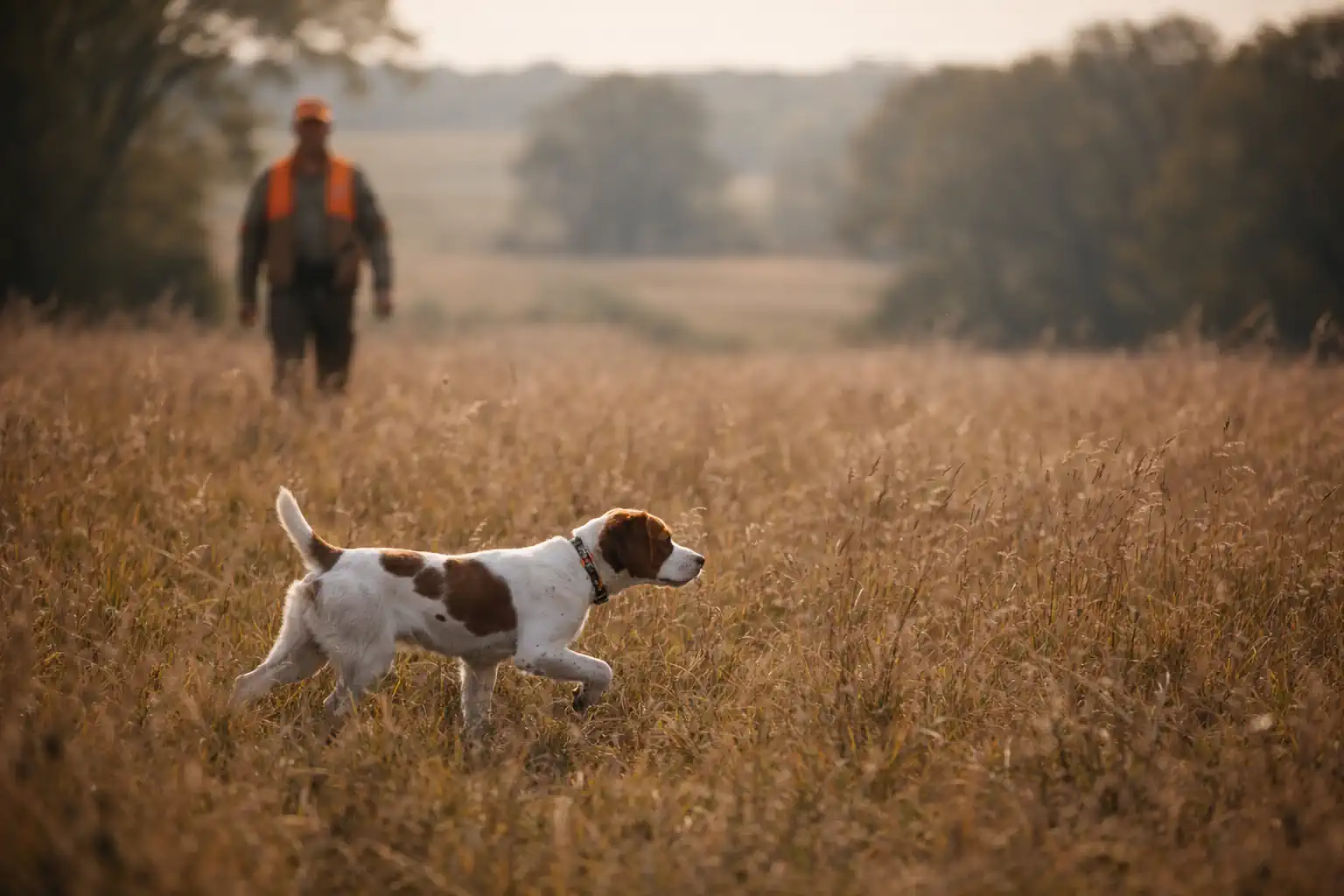
Wind is the most important variable in upland bird hunting, and most handlers underestimate it. You can have the best-bred dog in the county, but if you're working the wrong direction across a field, you're making your dog's job ten times harder. Understanding wind — how scent moves, how terrain shapes it, and how conditions change through the day — separates consistent hunters from frustrated ones.
This guide covers everything you need to use wind intelligently in the field, from first principles to the decisions you make in real-time.
Key Takeaways
- Dogs hunt nose-into-wind. Scent streams downwind from the bird.
- Quartering across the wind cuts scent cones repeatedly — it's the most efficient search pattern.
- Strong wind pushes scent farther but lifts and dilutes it. No wind pools scent unpredictably.
- Terrain features — draws, creek bottoms, leeward slopes — collect scent. Plan your approach around them.
- Morning thermals rise; evening thermals settle. Both affect how far your dog can detect scent.
- Pheasants run into the wind. Quail hold tighter. Each demands a different handling strategy.
- Never shoot over a dog working downwind of you.
What Is a Scent Cone and How Does a Dog Detect It
A scent cone is the plume of odor molecules that drifts downwind from a bird. Think of it like smoke from a campfire — it moves in a widening trail away from the source. At the tip of the cone, near the bird, scent is dense and concentrated. Farther downwind, it spreads wide but grows thinner.
A dog hunting into the wind crosses these cones from the downwind edge. When it hits the edge of the cone, it gets its first hit of bird scent. It follows intensity upwind toward the source, locking up on point once scent becomes strong enough to commit. This is why a good bird dog works nose-up and heads into the breeze: the wind is carrying the information.
Watch your dog's head height as a real-time indicator. Head high means it's reading airborne scent — bird is nearby. Head dropping to ground means it's tracking foot scent, which usually indicates a running bird or stale sign.
Quartering Into the Wind: Technique and Handler Positioning
The classic upland pattern is casting the dog in a series of arcs that cross the wind — not directly into it, not parallel to it, but at roughly 45 degrees. Each arc cuts through multiple potential scent cones. When the dog swings to the far side and turns back, it crosses fresh ground it hasn't covered yet.
The handler walks into the wind down the center of the field. The dog works ahead and to each side. On the return arc, the dog should naturally push further ahead before curling back. When it catches scent, it will freeze, wheel, or drive hard upwind toward the source.
Handler Positioning
Stay on the downwind side of where you expect birds. This keeps your own scent from reaching birds ahead of the dog and pushing them. Walking downwind — with the wind at your back — means your scent stream flows forward into holding cover before your dog can work it. Birds flush wild before the dog ever gets close.
If terrain forces you to approach cover from the downwind side, slow down, give the dog more range, and accept that some birds will flush farther out than ideal. Don't push it.
Wind Speed Effects: No Wind vs Light Wind vs Strong Wind
No Wind or Very Light Wind
Calm conditions are deceptive. Scent pools in low spots, collects against cover edges, and doesn't stream in a predictable direction. Your dog may work back and forth on a scent pocket without being able to pin the source. Points can be short-lived or the dog may circle repeatedly.
In calm conditions: slow your pace, work closer ranges, and trust your dog if it starts circling — it's working a scent pool, not making a mistake. Concentrate effort on low draws, creek margins, and dense cover edges where scent collects naturally.
Light, Steady Wind (5–15 mph)
This is ideal. Scent cones are predictable, move consistently, and carry far enough for a dog to hit them at good range. The quartering pattern works cleanly. Dogs can hunt at their natural range without losing scent contact. These are the conditions that produce the textbook sequences — long point, flush, shot — that make upland hunting satisfying.
Strong Wind (20+ mph)
Strong wind carries scent long distances but also lifts it and dilutes it. Dogs may hit scent from 100+ yards and drive hard toward the source. Allow longer casts and trust the dog — it knows what it smells. The risk is that birds hold tighter against the wind or get flushed wild by your approach. Work more slowly, approach scented areas from downwind, and be ready for long flushes.
In very strong wind, scent can be unreliable near ground level. Focus on cover that acts as a windbreak: leeward sides of hills, thick brush lines, and edges where birds hunker down to get out of the wind.
Terrain Features That Trap Scent
Reading wind isn't just about direction — it's about understanding how terrain shapes airflow. Birds are where the food and cover are, but scent concentrates in specific places based on the land. Learn to read the terrain as a map of scent behavior.
- Draws and creek bottoms: Cool, moist air settles into low areas. Scent sinks and concentrates here, making these spots productive even in variable conditions. Work these by approaching from above, quartering across the draw mouth with wind in your face.
- Leeward slopes: The downwind side of a ridge creates turbulence and collects scent. Birds often hold on leeward slopes for shelter. Approach along the ridge top and let your dog work down into the pocket.
- CRP strips and grass edges: These act as windbreaks. Scent pools at the lee side of a CRP block. Walk the upwind edge and let your dog quarter into the cover.
- Fence lines: Vegetation along fences breaks wind and collects scent. Pheasants especially love running fence lines. Work parallel to the fence with the wind in your face.
- Woodlot edges: The interface between timber and open ground creates a scent shelf. Birds sit in the timber edge and scent carries into the open. Approach from the open side, quartering toward the timber.
Morning Thermals vs Evening Thermals
Thermal currents layer on top of wind direction and are often overlooked. They matter most in still conditions and in broken terrain.
Morning thermals rise. As the sun heats the ground, air starts moving upward. Scent that would otherwise hug the ground lifts and disperses. Your dog may need to work closer and slower in the early morning before thermals establish, or you may find scent scattered unpredictably.
Evening thermals settle. As temperatures drop, cooler air drains downhill and scent settles to ground level. This is often the best scenting time of day. Draws, low fields, and valley bottoms concentrate scent as evening approaches. Dogs work more efficiently in these hours, and points tend to be solid.
Mid-day thermal activity is often unpredictable and inconsistent. On warm days, consider this when interpreting your dog's behavior — erratic wind doesn't mean your dog is wrong; it means conditions are difficult.
Pheasant vs Quail Behavior in Wind
Pheasants: Runners and Relocators
Pheasants run. That's the defining behavior that changes everything about how you work a dog on them. When a rooster catches wind of your approach or your dog's scent cone, his first response is to put distance between himself and the threat — usually moving into or crosswind to break the scent trail.
A dog on a running pheasant will appear to be chasing or repeatedly relocating. This is not a mistake — it's correct behavior. The dog locks at distance, the bird moves, the dog follows scent upwind. You may see the dog flag its tail rather than hold a rigid point. Trust it. Push forward aggressively to cut off the bird's escape route or angle to get ahead of the running bird.
Quail: Tight Holders
Bobwhite quail hold tight, especially when they feel the dog has pinned them. The covey relies on group camouflage and often won't run until the dog is nearly on top of them. Strong winds can make them hunker down even tighter into thick cover. Work your dog slowly through dense brush, trust a solid point, and walk in at a controlled pace — don't rush the flush.
In very high wind, quail may use the wind to flush wild well before the dog gets in position. If birds are flushing out of range consistently, try working heavier cover edges and take a slower, more methodical approach.
How to Check Wind in the Field
You don't need instruments. Simple methods that work:
- Wet your finger: Lick a finger and hold it up. The cold side faces into the wind.
- Milkweed or grass: Pull loose fibers or dried grass and drop them at shoulder height. Watch where they drift.
- Powdered wind indicator: A small squeeze bottle of unscented powder or talc gives a clear visual plume — useful in subtle, shifting conditions.
- Watch your dog: When the dog turns and drives purposefully in one direction with head up, that's your best real-time wind indicator. It found something.
- Feel it on your face: Walk a slow circle and notice where the air feels slightly cooler or you can feel it most on exposed skin.
Check wind at the start of each field — don't assume it's the same as when you parked the truck. Wind shifts, especially as thermals change through the morning.
Common Handler Mistakes
Working Downwind
Walking with the wind at your back pushes your human scent ahead of the dog into holding cover. Birds detect you before the dog can work them properly. The result is wild flushes, birds running out the far end of a field, and frustrated dogs that never get to close the deal. It's the single most common error, and it's entirely avoidable by simply changing where you park and which direction you walk.
Over-Handling a Dog on Point in Wind
When a dog points in difficult wind — quartering wind, variable gusts, or a running bird — it may shift its body, step in, or relocate. Many handlers mistake this for breaking point and call the dog back or add pressure. Don't. The dog is working a dynamic scent situation. Trust the process. Walk in calmly from the side or slightly behind the dog's line of sight, ready to flush.
Ignoring Wind Shifts
Wind shifts are common, especially mid-morning. A plan that made sense at first light can become counterproductive 90 minutes later. Check wind every time you enter a new field or cover type. Adjust your line of approach accordingly. The best upland hunters are constantly aware of wind direction and let it dictate routing.
Training a Young Dog to Work Into the Wind
Young dogs don't automatically understand wind. Their instinct may push them to chase foot scent or run randomly through a field. The way to build wind-working habits is through consistent setup during training sessions.
Always plant training birds with the wind in mind. Set the bird so the dog must work into the wind to reach it. The dog learns that the reward (bird contact) comes from working into the breeze. Over many repetitions, wind-into-the-face becomes the trigger that signals productive ground.
In the field, position yourself so the natural quartering pattern stays crosswind or into the wind. If the dog starts drifting downwind, gently turn it by casting in the correct direction. Don't overcorrect — just redirect the line of travel.
Breed Differences in Wind-Working Style
Not all pointing breeds hunt the same range, and that affects how wind management looks in practice.
Big-running breeds (English Pointers, English Setters, some German Shorthairs) cover enormous ground in a single cast. In a good wind, they may detect scent cones at 200+ yards. In calm or variable wind, this range can be a liability — the dog is far away from the handler when it locks on a difficult scent situation, and the birds may flush before you're in position. On calm days, cast big-running dogs in smaller fields or use a check cord to keep them closer until wind improves.
Close-working breeds (Brittanys, Vizslas, Spaniels) work nearer to the gun by nature. This is an advantage in light and variable conditions because they stay in contact with the handler and the scent pockets are worked more methodically. In a strong, steady wind, encourage them to open up slightly — they may be self-limiting when conditions would support more range.
Field Safety: Wind, Dogs, and Shooting Lanes
Wind awareness has a direct safety dimension. The most important rule: never shoot over a dog that is working downwind of your position. If your dog is between you and the wind source, birds flushing toward you mean the shot goes toward the dog's location. Always know where your dog is relative to wind and your shooting lane before you raise the gun.
When a dog relocates on a running bird, it may swing from one side to another, crossing in front of you. Wait until you are certain of the dog's position and the bird's flight path before taking a shot. In high grass or dense cover where visibility is limited, this matters even more.
Use your GPS tracker or bell collar to know the dog's position in conditions where visual contact is difficult. Wind affects how sound travels too — a bell carried against a strong wind may be inaudible. Don't assume your dog is where you last saw it.
Putting It Together
Reading wind is a skill that compounds over time. Every field you hunt teaches you something about how scent moves in that terrain, at that time of day, under those conditions. The hunters who take the time to understand it consistently find more birds and handle their dogs more effectively.
Start with the basics: always know wind direction before you cast your dog, work into or across the wind, and plan your entry into each field accordingly. Add terrain reading and thermal awareness over time. Eventually it becomes second nature — you'll pull up to a field and automatically start planning your route based on wind before you've even opened the truck door.
Frequently asked questions
What direction should my dog be working relative to the wind?
Your dog should always work into or across the wind, never downwind. Scent travels from bird to dog, so the dog needs to be downwind of the bird to detect it. Working into the wind lets the dog hit the scent cone and follow it to the source.
Why does my dog seem to lose the scent in calm conditions?
In calm or very light wind, scent doesn't stream in one direction — it pools in low spots and disperses unpredictably. Your dog isn't losing the bird; it's struggling to localize a diffuse scent pocket. Slow down, work lower terrain, and trust the dog if it circles — it's trying to center a pooled scent.
My dog points but then breaks and relocates. Is that wrong?
Not necessarily. If the bird is a running pheasant, the dog is doing the right thing by following a moving scent source. A relocating dog on running birds is showing good bird sense. The problem comes only if it's repeatedly breaking on tight-holding birds or pointing empty ground.
How do morning and evening thermals affect my hunting strategy?
Morning thermals rise as the sun heats the ground, lifting scent and making early hunting trickier in still air. Evening thermals settle as temperatures drop, pushing scent down to ground level — often producing the best scenting conditions of the day. Plan to work draws and low areas in the evening when settling air concentrates scent there.
Is it safe to shoot when my dog is on point ahead of me?
Only when you are certain of the dog's exact position and the bird's flight path. Never shoot over a dog working downwind of you. Always know where the dog is before raising the gun, especially in tall cover or when the dog has been relocating on a runner.
Does wind direction matter differently for pheasants vs quail?
Yes. Pheasants tend to run into or crosswind when pressured, so dogs often need to relocate and push them into a corner or fence line. Quail hold tighter, especially when the dog has scented and pinned them. Work more slowly into quail cover and trust a solid point. Both species flush wilder in very high wind.