Wild Birds vs. Pen-Raised Birds for Training: What Each Teaches Your Dog
· 9 min read · HuntWithDog
Pen-raised birds are accessible and repeatable. Wild birds build the real skills. A practical breakdown of what each type actually teaches a pointing dog — and how to get the most from whichever you have access to.
On this page
- The Question Behind the Debate
- What Pen-Raised Birds Actually Teach
- Where Pen-Raised Birds Work Well
- The Real Pitfalls of Relying Only on Planted Birds
- What Wild Birds Teach That Planted Birds Can't
- Scent and Wind Work on Wild Birds
- Mouth and Retrieve Quality
- Practical Access: Working With What You Have
- Making the Most of Planted Birds
- Using Wild Bird Access When You Have It
- Using Both Intentionally Through the Season
- FAQ
- Can a dog trained entirely on pen-raised birds become a good hunting dog?
- Do pen-raised birds actually ruin a dog's nose?
- When should I start using wild birds in training?
- Why do some dogs develop hard mouth on pen-raised birds but not wild birds?
- Is there a minimum number of bird contacts per week that matters for development?
- Can I mix pen-raised birds and wild birds in the same training session?
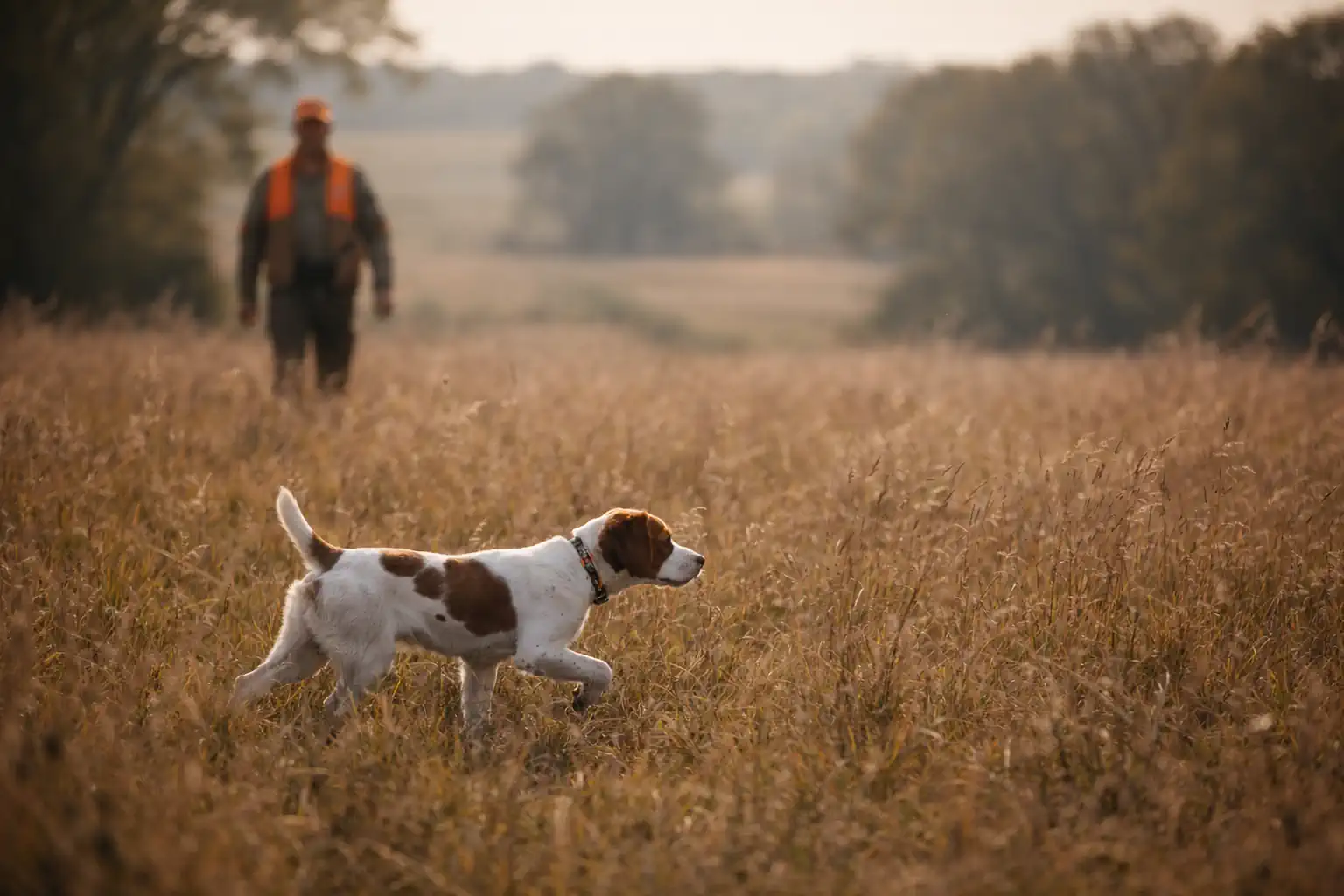
The Question Behind the Debate
If you spend any time in pointing dog communities online or at a field trial, you'll hear the same argument running in the background: pen-raised birds are crutches that ruin a dog's nose, or wild birds are impossible to find so they're not a practical training tool. Both camps say it with conviction, and both are partially right and partially missing the point.
The more useful question isn't which is better in the abstract. It's what does each type of bird actually teach — and what does each fail to teach — so you can use them with intention rather than habit. Most handlers who have access to both and use them well don't pick sides. They use each for what it's genuinely good for.
What Pen-Raised Birds Actually Teach
Pen-raised birds — typically bobwhite quail, chukar, or pheasant raised in a controlled environment — are the backbone of most training programs simply because they're available. You can plant them in a field on a schedule, repeat a session the same way the following week, and control exactly how many bird contacts your dog gets in a session. That consistency has real training value.
For a young dog building its first pointing instinct, pen-raised birds are close to ideal. They hold tighter than wild birds, which gives a green dog enough time to lock up on scent and actually experience the full pointing posture before anything flushes. A bird that flushes in two seconds doesn't give a puppy enough exposure to understand what it's supposed to be doing. A pen-raised bird sitting in light cover gives the dog five, ten, sometimes twenty seconds on scent — and that repetition is how pointing becomes a trained habit rather than a lucky accident.
Where Pen-Raised Birds Work Well
Planted birds are most useful for the early stages of building pointing behavior, for controlled whoa and steadiness work, and for scenarios where you need to repeat a specific training sequence — like steadiness to flush and shot — multiple times in a single session. You can't do that with wild birds. You're at the mercy of where birds are, how they behave that day, and how many contacts you happen to find.
Planted birds also let a handler control distance, cover type, and wind when introducing specific concepts. When you're teaching a dog to honor another dog's point, you need the first dog to hold a point long enough for the second dog to come around a tree line and see it. A pen-raised bird that sits gives you that. A wild bird that flushed the moment it heard footsteps does not.
The Real Pitfalls of Relying Only on Planted Birds
The problems with pen-raised birds emerge when they become the only birds a dog ever works. Pen-raised birds tend to have a stronger, more concentrated ground scent than wild birds — they sit, they walk slowly, they leave a heavy scent cone that even a mediocre nose can handle. A dog trained exclusively on planted birds can develop lazy scenting habits: it learns to locate birds by ground scent rather than by working body scent into the wind. Those are two very different skills, and one of them transfers well to hunting season and one doesn't.
The bigger risk is chase behavior. A pen-raised bird that gets up from a flat field and flies thirty yards before landing again is an irresistible target, especially for a dog that has never learned what happens when it chases. Wild birds flush with real urgency and typically disappear. Pen-raised birds often glide and land nearby, rewarding a dog that breaks and runs. If the handler doesn't prevent the chase every time it starts, the dog is rehearsing exactly the wrong behavior with every bird contact.
There's also the question of mouth. A pen-raised bird that sits in a dog's mouth for a moment longer than it should — because the bird isn't struggling as hard as a wild one — can start building a dog toward hard mouth. This isn't inevitable, but it's a real risk with birds that don't have the full survival instinct of a wild bird.
What Wild Birds Teach That Planted Birds Can't
Wild birds are difficult to find, harder to access, and completely outside your control as a trainer. For those reasons, most handlers undervalue them during the training season and then wonder why their dog looks average when hunting season opens on real birds. The gap is usually scent work.
Wild birds move. They run, they hold tight in specific cover types based on weather and pressure, and they flush with commitment. A wild quail covey on a cold morning in thick switchgrass holds because it's warm there, and a dog working into the wind toward that covey is solving a real scent problem — not following a trail of ground disturbance left by a bird dropped from a sack thirty minutes earlier. That distinction matters more than most handlers admit.
Scent and Wind Work on Wild Birds
A dog that has worked enough wild birds learns to differentiate scent intensity and direction precisely. It learns to cut across wind to work a scent cone from the edges rather than blundering in from downwind. It learns what a running bird smells like versus a holding bird. These are things that pen-raised birds in light cover with a fresh plant can't teach, because the scent picture is too simple and too predictable.
Wild birds also teach dogs to stay in range without being told. A dog that has bumped a dozen wild coveys from fifty yards out — and had those birds disappear for the day — starts to understand that the point is the event, not the flush. Pen-raised birds that land nearby and flush again don't teach that lesson.
Mouth and Retrieve Quality
Wild birds retrieved properly tend to produce better mouth than pen-raised birds. A wild bird that a dog has hunted hard for and finally brought to hand tends to be delivered cleanly. There's genuine prey value in a wild bird that pen-raised birds can lack after repeated use. This doesn't mean wild birds are a cure for hard mouth — a dog with a gripping habit will grip either — but a dog that's soft on pen birds and sloppy with live ones will often be cleaner on wild birds simply because of the difference in bird quality and the context around the retrieve.
Practical Access: Working With What You Have
Most handlers don't choose between pen-raised and wild birds by preference — they use what they can get. Wild bird access in many parts of the country is genuinely limited: public land quail populations have collapsed in a lot of traditional range, pheasant numbers vary wildly by year and location, and the good wild bird ground is often private or requires a guide. If you hunt the Midwest or Great Plains you may have reasonable public land pheasant access; if you're in the Southeast without lease access, wild quail may be almost theoretical for most of your training year.
Making the Most of Planted Birds
If pen-raised birds are what you have, use them with more structure than most handlers do. Plant birds in cover that requires real scent work — thick grass, downwind of a tree line, somewhere the dog has to actually figure out where the bird is rather than walk straight to it. Don't plant birds in the same spots repeatedly; rotate locations so the dog develops a real search pattern rather than a path memory. Use a check cord for every session where chase prevention matters, and end every chase before it becomes a reward. If your pen-raised birds are chukar or pheasant, choose birds with good flight — a bird that lands twenty yards away and runs matters less than one that clears the field and disappears.
Using Wild Bird Access When You Have It
When you have wild bird access, don't waste it on a dog that isn't ready for it. A young dog that hasn't learned basic range control and hasn't experienced a whoa command on planted birds will just bump wild coveys and learn to chasing. Wild bird exposure pays best when the dog already has the foundation — it has pointed, it respects the whoa to some degree, it knows that birds flush and that its job isn't to go after them. At that stage, wild bird contacts accelerate development in ways that controlled training simply can't replicate.
Using Both Intentionally Through the Season
The handlers who produce the most consistent dogs tend to use pen-raised birds for specific training sequences — building pointing behavior, teaching steadiness, drilling honoring — and save wild bird exposure for general hunting pressure that challenges the dog's nose and self-control in realistic conditions. The two aren't in competition. They address different gaps.
Early in a dog's development, more planted bird contacts is almost always better than fewer. Late in development, or when transitioning into hunting season, wild bird exposure matters more. A finished dog that only ever sees pen-raised birds will often show it in late November when wild roosters are running instead of holding and the dog's scent work isn't as sharp as it needs to be. That's not a genetics problem. It's a training history problem.
Neither pen-raised birds nor wild birds will produce a good hunting dog on their own. The birds are only as useful as what the handler does with the contacts. Structured planted bird work with real flight quality, combined with wild bird exposure once the dog is ready for it, is the path most serious handlers end up on — not because it was handed to them as doctrine, but because it's what produces the results they're after.
FAQ
Can a dog trained entirely on pen-raised birds become a good hunting dog?
Yes, if the training is structured and the handler manages the pitfalls. Pen-raised birds with good flight quality, planted in cover that requires real scent work, and used with strict chase prevention, can produce a solid dog. The gap compared to a dog with wild bird exposure tends to show in late-season conditions when birds are educated and running — but it's a workable gap, not an insurmountable one.
Do pen-raised birds actually ruin a dog's nose?
Not exactly. Pen-raised birds don't damage the physical nose. What they can do is allow a dog to develop a shortcut — following ground disturbance and heavy scent trails instead of learning to work body scent on a moving bird into the wind. Whether that shortcut becomes a habit depends on how the training is structured. A dog that only works simple, fresh-planted birds in open cover for years is reinforcing a simpler scenting strategy than it would develop with more varied bird work.
When should I start using wild birds in training?
Once the dog has a functional foundation — it points reliably, responds to a basic whoa command, and doesn't immediately break and chase. Using wild birds on a dog that has no self-control will mostly produce bumped flushes and reinforce chasing. The wild bird contacts pay most when the dog can hold long enough to have a real point experience, even if steadiness isn't finished yet.
Why do some dogs develop hard mouth on pen-raised birds but not wild birds?
Pen-raised birds are often weaker, less vigorous, and easier to grip than wild birds. A dog that lingers with a pen bird in its mouth — or grips slightly to control a bird that isn't fighting back hard — can start rehearsing grip pressure. Wild birds typically struggle more and trigger a softer hold response in dogs that aren't chronic grippers. If mouth is a concern, using birds with better flight and more vigor, and keeping retrieves short and prompt, reduces the risk with either bird type.
Is there a minimum number of bird contacts per week that matters for development?
There's no magic number. Quality matters more than volume. Three well-structured, repeatable contacts where the dog pointed, held, and had a clean flush teach more than ten sloppy contacts where the dog bumped birds and chased half of them. That said, frequency does matter for young dogs building the pointing habit — too few contacts over too long a gap means the behavior doesn't consolidate. Consistent exposure during the formative stages, even modest contact counts, beats occasional high-volume days.
Can I mix pen-raised birds and wild birds in the same training session?
You can, but it rarely makes sense unless the wild bird contact is incidental. If you're running a structured planted bird session on a training field and the dog happens to find a wild bird, handle it the same way you'd handle any point. Don't save planted birds for the end of a wild bird hunt just to add contacts — a dog that has already had intense wild bird exposure in real cover will often be overstimulated for precise planted bird work. Use each type of bird for the context it's best suited to.
Frequently asked questions
Can a dog trained entirely on pen-raised birds become a good hunting dog?
Yes, if the training is structured and the handler manages the pitfalls. Pen-raised birds with good flight quality, planted in cover that requires real scent work, and used with strict chase prevention, can produce a solid dog. The gap compared to a dog with wild bird exposure tends to show in late-season conditions when birds are educated and running — but it's a workable gap, not an insurmountable one.
Do pen-raised birds actually ruin a dog's nose?
Not exactly. Pen-raised birds don't damage the physical nose. What they can do is allow a dog to develop a shortcut — following ground disturbance and heavy scent trails instead of learning to work body scent on a moving bird into the wind. Whether that shortcut becomes a habit depends on how the training is structured.
When should I start using wild birds in training?
Once the dog has a functional foundation — it points reliably, responds to a basic whoa command, and doesn't immediately break and chase. Using wild birds on a dog that has no self-control will mostly produce bumped flushes and reinforce chasing. The wild bird contacts pay most when the dog can hold long enough to have a real point experience.
Why do some dogs develop hard mouth on pen-raised birds but not wild birds?
Pen-raised birds are often weaker and easier to grip than wild birds. A dog that lingers with a pen bird in its mouth can start rehearsing grip pressure. Wild birds typically struggle more and trigger a softer hold response. If mouth is a concern, using birds with better flight and more vigor, and keeping retrieves short and prompt, reduces the risk with either bird type.
Is there a minimum number of bird contacts per week that matters for development?
There's no magic number. Quality matters more than volume. Three well-structured contacts where the dog pointed, held, and had a clean flush teach more than ten sloppy contacts where the dog bumped birds and chased half of them. Consistent exposure during the formative stages, even modest contact counts, beats occasional high-volume days.
Can I mix pen-raised birds and wild birds in the same training session?
You can, but it rarely makes sense unless the wild bird contact is incidental. A dog that has already had intense wild bird exposure in real cover will often be overstimulated for precise planted bird work. Use each type of bird for the context it's best suited to.