Hunting With a Flushing Dog: Range, Cover and Cooperation
· 8 min read · HuntWithDog
Manage a flushing dog’s search around contact, cover and learned skills. Separate quartering, stopping, gunfire and retrieving without a universal range recipe.
On this page
- Flushing dogs hunt a different job
- Keep the search manageable for this setting
- Build cooperation before adding bird excitement
- A useful pattern follows the cover
- Thick cover changes the commitment
- Stopping, gunfire and retrieving are separate skills
- Two dogs add another management task
- When birds keep getting up beyond the plan
- Keep the people and dog accounted for
Flushing dogs hunt a different job
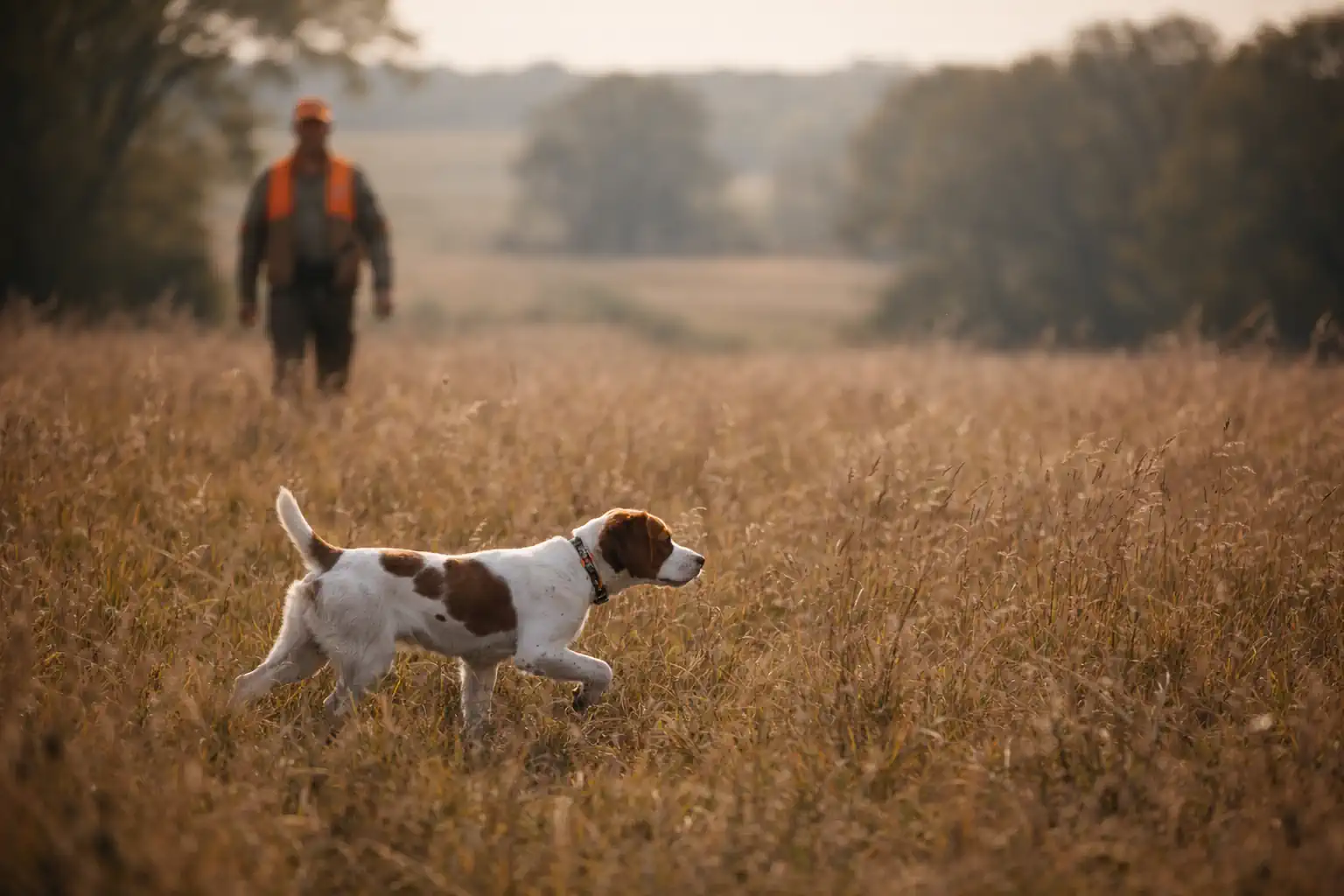
A flushing dog searches for birds and puts them into the air, rather than being expected to locate and hold a point. That makes cooperation during the moving search central to your plan. This guide is about managing that partnership in upland cover, not choosing a breed or turning a new dog into a finished hunter in a set number of sessions.
AKC’s English Springer hunting-style sheet describes quartering within gun range and responsive teamwork. Its Labrador upland-style sheet also describes flushing and retrieving. These describe working roles, not evidence that every Lab ranges wider than every Springer, or that one breed can safely enter cover another cannot. Judge the individual dog in front of you.
Keep the search manageable for this setting
The practical question is whether you can maintain communication, follow the dog’s work and safely deal with a flush from the cover being searched. A fixed yardage cannot establish that. Visibility can disappear before the dog is physically far away; a familiar open field does not predict the same control in tall grass.
AKC’s spaniel hunting-test standards evaluate suitable working range and a useful pattern in a defined test setting. They are not a universal safe-shooting distance. Set your field plan from the actual dog, cover, people and access. If the dog is repeatedly beyond that plan, recover it and simplify the outing instead of hurrying after it with a gun.
Build cooperation before adding bird excitement
Away from birds and shooting, reward voluntary check-ins and a response to the turn or recall cue you have chosen. Practice a change of direction in a manageable place and observe whether the dog can rejoin comfortably before adding more distractions. A safely handled lead or line can prevent an uncontrolled departure where the terrain permits it; it is not a way to drag the dog across the front. Avoid trailing lines around wire, snagging vegetation or other hazards.
Choose signals you can use consistently rather than treating a particular whistle pattern as universal. If communication falls apart, reduce the difficulty and use the recall and whistle guide. HuntWithDog uses reward-based training in line with AVSAB’s current position; electronic stimulation is not the next step in this progression. Persistent difficulties are a reason to seek qualified reward-based help.
A useful pattern follows the cover
Quartering describes a search that works across the handler’s forward route, rather than simply running away along it. Assess whether the dog is investigating the available cover while staying in cooperative contact. Do not demand a geometrically identical cast every time. Keep your own route clear enough to follow and regain the dog.
Check the breeze locally and reconsider at an edge. An approach that lets air arrive from the cover can be useful when it is safe and permitted. That does not make downwind travel automatically wrong, or prove that a dog bumped a bird because it had no scent. The wind-reading guide supplies the observation method; its pointing-dog context does not supply a flushing-dog distance.
Thick cover changes the commitment
Before entering Conservation Reserve Program grass or another tall stand, ask where you can walk, what you can see and how you would bring the dog back. Do not send it through a strip you cannot safely follow merely because a breed description praises boldness. An attractive patch beyond wire or hidden water can be left unhunted.
Fictional example: Morgan’s Springer stays in contact in short grass, then disappears behind a dense strip while Morgan is delayed by a fence. Morgan recovers the dog and chooses a visible accessible edge. The change solves a management problem; it does not prove the dog needs a correction or the cover contains running pheasants. This is an invented scenario, not a recorded result.
Stopping, gunfire and retrieving are separate skills
A familiar stop-and-wait response can help keep a moving search manageable. Teach it with rewards away from birds before planning a more exciting learning setup. Do not improvise a bird, blank and live-shot sequence to see what the dog will tolerate; enthusiasm for birds does not establish comfort with gunfire. The noise-history decision aid explains when to pause and seek individual help.
Test labels are not interchangeable with complete hunting readiness. AKC’s spaniel rules distinguish the Senior land steadiness requirement from the more advanced Master requirement. That difference is a reason to ask what a title actually covers, not permission to shoot over an uncontrolled dog. If location, control or the shot’s path is uncertain, pass the shot. Work on the missing skill separately.
Retrieving is a further task: locating, picking up, carrying, returning and releasing. Use the retrieve-component guide when one part is missing rather than assuming a stronger stop cue will produce delivery.
Two dogs add another management task
A flusher and pointer can be asked to do different jobs, but the presence of an experienced dog does not establish that a pair is ready. Before considering shared work, both dogs need to remain safely manageable around one another without interfering. The people need clear responsibilities and a plan to separate them.
For a beginner, separate outings make it easier to see what each dog can do. Do not release a flusher into another dog’s point just to produce a demonstration. If the intended cooperation is unclear or either dog becomes competitive, work separately and get suitable instruction. The two-dog guide explains those prerequisites for pointing dogs; it is not a complete mixed-brace training program.
When birds keep getting up beyond the plan
Record the actual sequence: where the dog was, when communication changed, where a bird rose and whether you could safely follow. Recover the dog, then decide whether smaller cover, a clearer route or foundation practice would address what you observed. Do not label every distant flush as a range-training failure; you may not know whether the dog caused it.
For repeated difficulties, stop trying to solve them while hunting. Compare the response in an easier bird-free setting and ask for help. If the dog appears distressed, unwilling to continue or physically uncomfortable, end the outing rather than adding another contact to get a satisfactory finish.
Keep the people and dog accounted for
Agree on shooting zones and positions before starting. TPWD’s firearm-safety guidance says to pass shots between or behind a moving group and communicate adjustments as the hunt changes. Knowing that a dog normally stops does not replace knowing its actual location, the target and what lies beyond.
Check access restrictions and the route home before entering cover. Use season-long soundness planning and heat warning and emergency planning for those separate questions. No breed, collar or working title removes the need to shorten or cancel an outing.
Frequently asked questions
How close should a flushing dog hunt on pheasants?
Close enough for cooperative contact and a manageable search in the actual cover. This guide does not give a yardage that guarantees safe or effective shooting. If you cannot follow the work or recover the dog, simplify or end the free search.
What is the difference between a Lab and a Springer in upland cover?
Both can perform flushing and retrieving work. Their working-style descriptions do not rank every individual’s range, cover handling or training needs. Watch the particular dog and ask what work it has actually learned.
Should I teach sit-to-flush before the first hunting season?
Build a rewarded stop-and-wait response away from birds and distinguish that skill from bird work, gunfire comfort and retrieving. A season date or one successful repetition does not establish readiness to combine them.
Can I hunt a flushing dog and a pointing dog together?
Only consider shared work when both dogs remain manageable without interference and the people have a clear separation plan. Separate outings are often clearer for a beginner. An experienced dog is not a substitute for the other dog’s readiness.
My dog keeps flushing birds beyond my workable range. What should I do first?
Recover the dog and record the sequence before assigning a cause. Choose a smaller, more visible setting or return to rewarded communication practice away from birds. Do not keep repeating an uncontrolled hunt to test whether it improves.
Is an e-collar required to keep a Lab close in upland cover?
No. This site recommends reward-based teaching and safe management. Tracking and stimulation are different functions, and neither teaches an unlearned turn or recall cue. Seek qualified reward-based help for persistent difficulties.
Where to go next
Choose the step that matches the question you still need to answer.
Prerequisite
Keep the flushing job separate from pointingA flusher puts birds into flight; a pointing-dog range example is not its handling plan.
Next decision
Clarify the return cue before changing field demandsThis general foundation concerns a taught response, not a universal hunting distance.
Related problem
What changed when handling stopped working?Review the particular response and setting rather than substituting a breed rule.
Browse guides by question or find your training starting point.