Keeping a Working Dog Sound Through the Hunting Season
· 8 min read · HuntWithDog
Pre-season fitness gets the attention. But the hunting season itself is when most physical damage actually happens. A practical guide to in-season dog management: fatigue signs, hunt-day limits, nutrition adjustments, pad care, and the handler mistake of pushing too hard when birds are good.
On this page
- The Season Is When the Damage Actually Happens
- Recognizing Early Fatigue — Before It Becomes a Problem
- Physical Signs to Check Each Day
- Behavioral Signs Handlers Often Miss
- How Many Hunt Days Per Week Is Realistic?
- Nutrition and Hydration During High-Output Weeks
- Pad Care Under Regular Use
- The Handler Problem: Pushing When the Birds Are Good
- When to Pull Your Dog for the Day
- FAQ
- How do I know if my dog is just tired or actually injured after a hard hunt?
- Should I increase my dog's food during the hunting season?
- My dog's pads look rough but aren't cut yet — should I rest the dog?
- Is there a general rule for how many consecutive days a bird dog should hunt?
- My dog seems to lose weight every season despite eating well. What should I check?
- What's the most common mid-season handler mistake that shortens a dog's season?
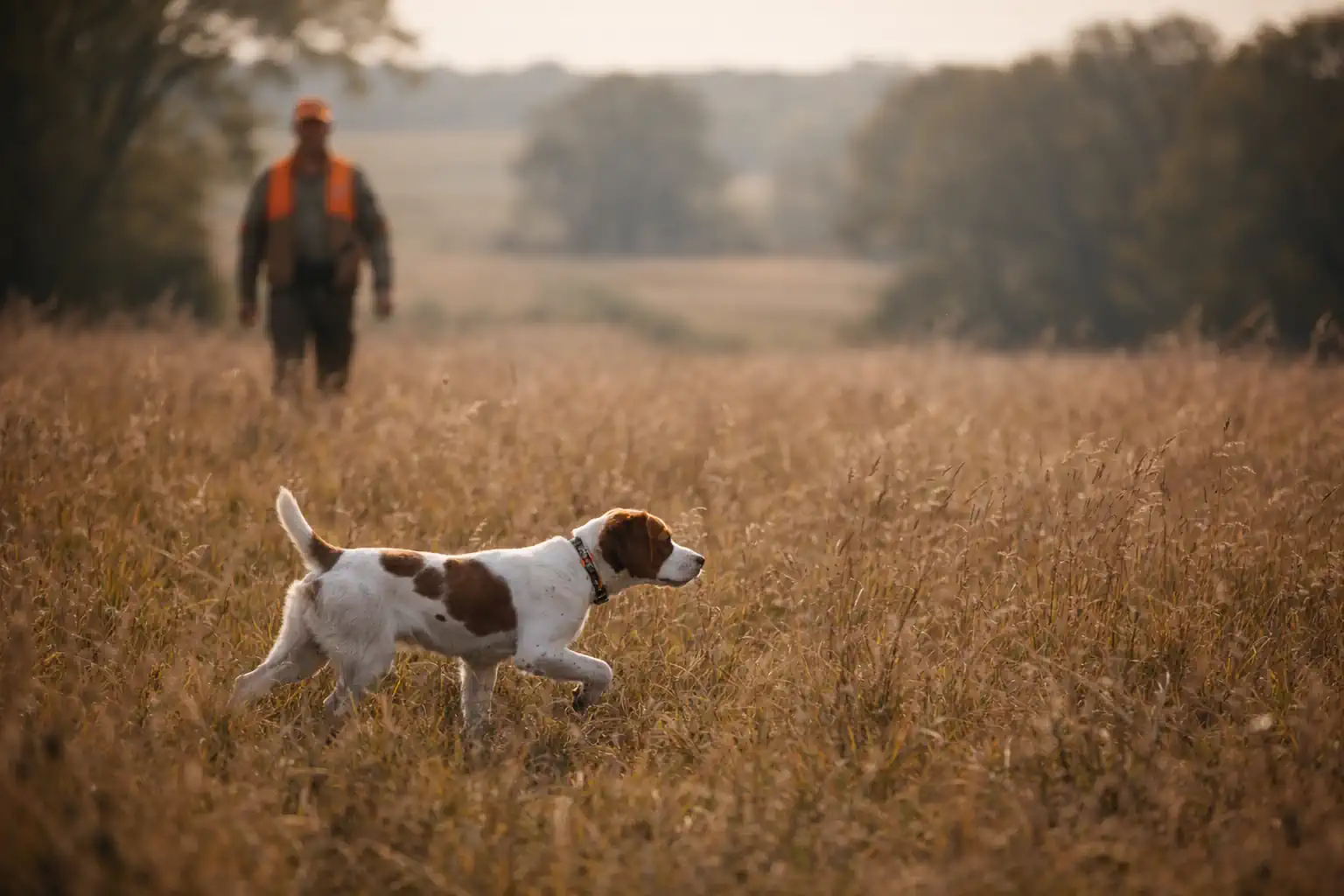
The Season Is When the Damage Actually Happens
Most bird dog handlers put serious thought into pre-season conditioning. They run their dog in the heat of August, do road work, get the dog to a vet for a checkup, and make sure the animal is in the best shape it can be before the first day of season. That preparation matters. But the physical damage — the injuries, the cumulative fatigue, the issues that cut a season short or carry into the next one — mostly happens after opening day.
The hunting season is a sustained high-output period in a way that pre-season conditioning usually isn't. A dog that runs an hour of road work three mornings a week in August is working hard. A dog that hunts eight hours in heavy cover on back-to-back weekends with four-hour days sprinkled in between is working harder, on rougher terrain, with more adrenaline, and often with a handler who doesn't want to stop because the birds are right there.
Managing a working dog through a full season without breaking it down is its own skill set. It's mostly about watching closely, being honest about what you're seeing, and making the calls that the dog can't make for itself.
Recognizing Early Fatigue — Before It Becomes a Problem
Dogs don't tell you they're tired. They keep working until they can't. By the time a dog is visibly struggling — lagging behind, stopping to rest on its own, refusing cover — you've already pushed past the warning window. The signs worth knowing are the ones that show up before things get obvious.
Physical Signs to Check Each Day
After every hunt, run your hands over the dog before you do anything else. You're checking pads for cuts, cracks, and worn areas that haven't opened yet. You're feeling for heat or swelling in the legs, shoulders, and feet. You're looking at the body condition — not just whether the dog ate, but whether it looks lean in a way that's different from yesterday.
Recovery rate is one of the most useful indicators. A well-conditioned, adequately rested dog should look reasonably normal within a few hours of finishing a hard hunt. Persistent heavy panting, reluctance to move, and unusual stiffness when it gets up from rest are signs that the recovery is incomplete. The dog that's stiff getting up the morning after a hunt probably needed a lighter day before it got there.
Behavioral Signs Handlers Often Miss
A fatigued dog often shows behavioral changes before physical ones. A dog that's normally enthusiastic about loading up in the morning that suddenly needs to be coaxed to the truck is telling you something. A dog that's normally a strong, confident hunter that starts hunting close, pulling up short on birds, or skipping cover it would normally dive into is probably not having a bad day — it's having a depleted one.
Pointing intensity often drops when a dog is running on empty. A dog that normally locks up hard and holds will sometimes take shorter, sloppier points when it's fatigued. This can look like a training problem when it's actually a management one. If a dog that has been solid is suddenly pointing poorly, exhaustion is worth ruling out before you decide there's a hole in the training.
How Many Hunt Days Per Week Is Realistic?
There's no single answer that fits every dog, every cover type, or every season. A six-year-old dog in peak condition hunting moderate prairie habitat is a different animal from a two-year-old hunting thick CRP in 55-degree weather, which is different again from an eight-year-old working pheasant in December cold. What's reasonable varies, and a handler who doesn't adjust for those variables is the real risk factor.
That said, most working dogs with good base conditioning can handle three to four full hunting days per week during the heart of the season if the days are genuinely full days rather than light outings, and if the off days are actual rest, not long vehicle rides and kennel stress followed by no physical outlet. Two consecutive hard hunting days followed by one full rest day is a common structure that works for a lot of dogs in good condition.
Younger dogs — first- and second-season animals — generally need more recovery time, not less. The enthusiasm is there; the physical adaptation to sustained work takes longer to build than the desire to go. A young dog that hunts hard every day for two weeks in October may look fine for the first ten days and fall apart in the eleventh. Building in enforced rest days for a young dog even when it seems like it wants to go is just season planning.
Older dogs tend to know their limits better than young ones, but they also recover more slowly. An eight-year-old hunting dog that's still strong and enthusiastic will often push itself harder than it should given its actual recovery capacity. Age isn't a reason to retire a healthy dog from hunting, but it's a reason to be conservative with the schedule and honest about what the signs are telling you.
Nutrition and Hydration During High-Output Weeks
A hunting dog burning 2,000 to 3,000 extra calories per day in the field cannot maintain weight or performance on the same feed volume it gets in the off-season. Most handlers who have a dog that loses visible condition mid-season are simply underfeeding it relative to the work load. The fix is usually straightforward: increase caloric density, increase volume, or both. Performance-oriented foods with higher fat percentages are formulated for exactly this situation.
Timing matters too. A large meal immediately before a hunt is a bad idea — the digestive burden conflicts with hard physical work. Many handlers feed a moderate meal the evening before and a light top-off after the hunt rather than a single large feeding. This varies by dog and by routine, and what the dog actually eats and keeps down matters more than any specific schedule.
Water is the underrated one. A dog hunting in 40-degree weather doesn't appear to be working in the heat, but it's still losing fluid at a rate most handlers don't account for. Offering water before, during, and after the hunt — not just at the truck when you're done — is basic care that gets skipped in the excitement of a good day. Carry enough water for the dog, not just yourself.
Pad Care Under Regular Use
Pad problems are among the most common reasons a dog misses days mid-season, and most of them are preventable. Pads that go into the season in good condition — thick, smooth, not cracked — hold up far better than pads that were already showing wear before October. If you do pre-season conditioning, running the dog on varied terrain including some harder surfaces helps build pad toughness naturally.
During the season, check the pads after every hunt. Worn spots — areas where the pad surface looks abraded but hasn't opened — need a rest day before they become cuts. Once a pad opens, healing takes significantly longer than the few hours a worn spot needs. Catching it early is the difference between missing one day and missing a week.
Musher's Secret and similar wax-based products can reduce friction and slow the rate of wear in particularly rough conditions. They won't prevent pad damage if you're hunting a dog on rocky or frozen terrain every day, but they're a reasonable addition to a routine that already includes daily checks and appropriate rest days. Boots are an option in extreme conditions; most bird dogs tolerate them if you introduce them before the season rather than mid-crisis.
The Handler Problem: Pushing When the Birds Are Good
Here's the thing most handlers already know but still do: you push the dog harder when the birds are there. A slow day with no contacts, it's easy to cut the afternoon short and head back. A morning where the dog has found eight coveys and you've shot well and there are still hours of light — that's when the dog runs an extra two hours it probably shouldn't have.
The good days are the days that accumulate damage. The dog doesn't want to stop. You don't want to stop. And nothing visible is going wrong yet. The discipline required to call it at three hours on a great day is harder than calling it early on a bad one, and it's exactly the call that protects the rest of the season.
One practical approach: decide your daily time limit before you go out, not while the dog is hunting hot birds in the afternoon. A limit set in advance is easier to hold than one you're negotiating with yourself in the field. If the plan was three hours of hunting, it's three hours, even if the last covey flushed ten minutes ago and you know there are more birds in the next draw.
When to Pull Your Dog for the Day
There are signs that should end a hunt regardless of how the day is going. A dog that's visibly limping, even if it appears willing to keep hunting, needs to stop. Dogs will hunt through pain that would stop most humans, which means a limping dog is telling you something significant. Continuing on a leg injury because the dog still seems willing is how acute injuries become chronic ones.
A dog that has lost its hunting pattern — no longer ranging, not working cover, staying close to the handler with its tail down — is done for the day. This is different from a dog that had a slow morning; this is a dog that has crossed into genuine fatigue. Continuing won't rehabilitate the performance; it'll just deepen the hole you're digging.
Any sign of heat exhaustion — heavy panting in moderate temperatures, glazed expression, stumbling — is an immediate stop. This is not a situation where you give the dog five minutes at the truck and go back out. Heat injury can progress quickly, and a dog that appears to recover at the truck may still need veterinary attention. If you're unsure, stop. The season is long enough to lose a few hours; it isn't long enough to lose the dog.
FAQ
How do I know if my dog is just tired or actually injured after a hard hunt?
Normal tiredness shows as a dog that rests, recovers with sleep and food, and is back to itself the next morning. Injury usually shows as localized heat, swelling, or tenderness in a specific area; persistent lameness; or a dog that doesn't return to normal behavior after rest. If you're not sure, a day off and a close recheck the next morning often clarifies it. When something feels off and rest doesn't resolve it, that's when it's time to involve a veterinarian.
Should I increase my dog's food during the hunting season?
For most dogs that are hunting regularly, yes. A dog burning significant energy in the field needs more calories than its off-season baseline provides. How much more depends on the dog's size, the intensity of the work, and the cover conditions. Visible weight loss over the course of a hard season week is the clearest signal that intake isn't keeping up with output. Performance-oriented kibble with higher fat content handles the caloric demand better than standard maintenance formulas.
My dog's pads look rough but aren't cut yet — should I rest the dog?
Yes, take a day off before they open. Worn pads that haven't broken yet are in the window where rest and a protective wax can allow recovery. Once they crack or cut, healing time increases substantially and the dog may be out for three to five days instead of one. Catching it early is always the better trade.
Is there a general rule for how many consecutive days a bird dog should hunt?
Two to three consecutive full hunting days followed by at least one genuine rest day is a reasonable baseline for a dog in good condition. That rest day means actual rest — the dog is not stuck in a hot kennel, not riding eight hours to the next location, not being drilled in obedience. Whether that baseline holds across the season depends on the dog's age, fitness, cover type, and daily duration. Adjust based on what you're observing, not just a fixed schedule.
My dog seems to lose weight every season despite eating well. What should I check?
First, verify that "eating well" means adequate volume for the actual work level — performance dogs in hard hunting often need two to three times their off-season intake. Second, look at the caloric density of the food. A high-volume, lower-fat food may not deliver enough energy even when the dog finishes every meal. Third, consider whether stress, travel, or kennel changes are reducing appetite. If none of those explain it, a pre-season and mid-season vet check that includes a fecal exam and body condition assessment is worth doing annually for any dog that works this hard.
What's the most common mid-season handler mistake that shortens a dog's season?
Hunting the dog every available day without enforced rest days is the most common one. The dog looks fine, the birds are there, the weather is right — it feels wrong to leave the dog home. But cumulative fatigue builds invisibly until it breaks in a way that forces a longer pause than any planned rest day would have cost. The handlers who finish the season with a sound dog are almost always the ones who were willing to miss some days by choice, not necessity.
Frequently asked questions
How do I know if my dog is just tired or actually injured after a hard hunt?
Normal tiredness shows as a dog that rests, recovers with sleep and food, and is back to itself the next morning. Injury usually shows as localized heat, swelling, or tenderness in a specific area; persistent lameness; or a dog that doesn't return to normal behavior after rest. If you're not sure, a day off and a close recheck the next morning often clarifies it. When something feels off and rest doesn't resolve it, that's when it's time to involve a veterinarian.
Should I increase my dog's food during the hunting season?
For most dogs that are hunting regularly, yes. A dog burning significant energy in the field needs more calories than its off-season baseline provides. How much more depends on the dog's size, the intensity of the work, and the cover conditions. Visible weight loss over the course of a hard season week is the clearest signal that intake isn't keeping up with output. Performance-oriented kibble with higher fat content handles the caloric demand better than standard maintenance formulas.
My dog's pads look rough but aren't cut yet — should I rest the dog?
Yes, take a day off before they open. Worn pads that haven't broken yet are in the window where rest and a protective wax can allow recovery. Once they crack or cut, healing time increases substantially and the dog may be out for three to five days instead of one. Catching it early is always the better trade.
Is there a general rule for how many consecutive days a bird dog should hunt?
Two to three consecutive full hunting days followed by at least one genuine rest day is a reasonable baseline for a dog in good condition. That rest day means actual rest — the dog is not stuck in a hot kennel, not riding eight hours to the next location, not being drilled in obedience. Whether that baseline holds across the season depends on the dog's age, fitness, cover type, and daily duration. Adjust based on what you're observing, not just a fixed schedule.
My dog seems to lose weight every season despite eating well. What should I check?
First, verify that 'eating well' means adequate volume for the actual work level — performance dogs in hard hunting often need two to three times their off-season intake. Second, look at the caloric density of the food. A high-volume, lower-fat food may not deliver enough energy even when the dog finishes every meal. Third, consider whether stress, travel, or kennel changes are reducing appetite. If none of those explain it, a pre-season and mid-season vet check is worth doing annually for any dog that works this hard.
What's the most common mid-season handler mistake that shortens a dog's season?
Hunting the dog every available day without enforced rest days is the most common one. The dog looks fine, the birds are there, the weather is right — it feels wrong to leave the dog home. But cumulative fatigue builds invisibly until it breaks in a way that forces a longer pause than any planned rest day would have cost. The handlers who finish the season with a sound dog are almost always the ones who were willing to miss some days by choice, not necessity.