Air Scenting vs Tracking: What Task Is Your Bird Dog Doing?
· 5 min read · HuntWithDog
Compare finding an odor source, following a route and searching an area. Learn why head position and the final find cannot identify every clue a dog used.
On this page
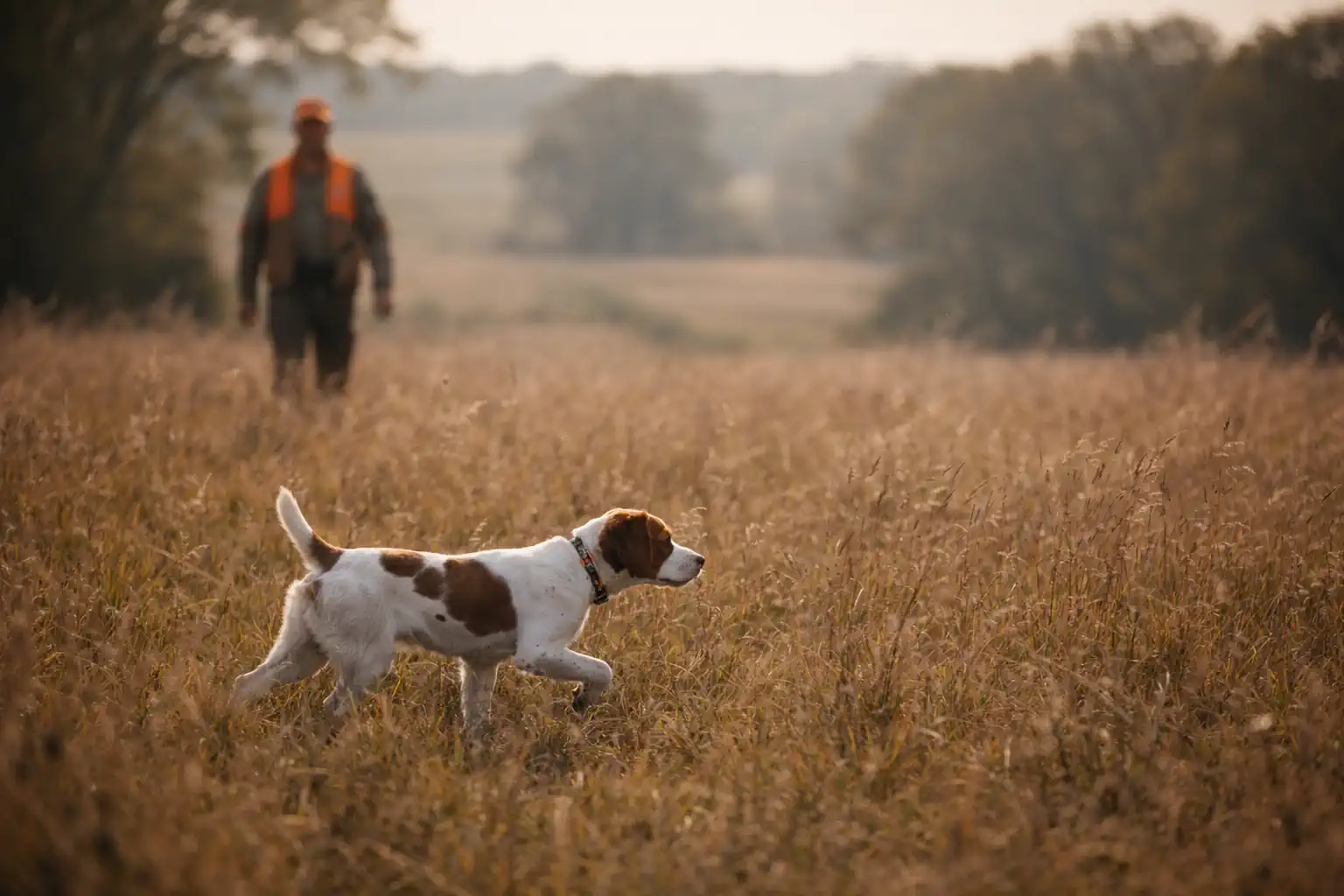
Air scenting usually describes searching for a source using odor carried through the air. Tracking describes following a scent route. Searching a defined area asks a different question again: what can be found within these boundaries? These descriptions concern the task. A high or low head, a loop or a successful find cannot identify every clue the dog used.
Begin by asking what the dog was meant to find and whether following a particular route mattered. “Using its nose” is too broad to answer either question.
Compare the goal before comparing the movement
| Task being described | Main question | Information needed to interpret the account |
|---|---|---|
| Locate an odor source | Where is the source? | The intended target and search setting; a prescribed ground route may not be part of the task. |
| Follow a scent route | Where does this route continue? | What made the route, what is known about its course and what counts as following it. |
| Search an area | Where is the target within this area? | The boundaries, target and any starting information or handler assistance. |
The third row describes the scope of a search, not a separate sense. An area search may involve odor, vision, prior information or a combination. Likewise, reaching an object does not show that the dog followed the route by which it arrived there.
These fictional conceptual sketches show three different questions. They are not measured scent distributions, recommended dog paths or exercises to reproduce.
A. FIND A SOURCE            B. FOLLOW A ROUTE

Search setting             Known route: start ~~~ bend ~~~ end
      ? source             Question: where does it continue?
Question: where is it?

C. SEARCH AN AREA

+-----------------------+
| target somewhere here |
+-----------------------+
Question: where within these boundaries?
No arrow or line in a drawing tells you where a real dog's nose received odor. For airflow observations and route decisions, use the wind-reading guide. This comparison does not add a preferred wind angle or detection distance.
Does a low head mean tracking?
Not by itself. NAVHDA's February 2026 test guidance allows variation in head position during productive field search. Its Natural Ability tracking section also recognizes successful tracking with the head higher or lower and with the dog close to, or downwind of, the track.
The useful distinction is between the intended job and the observations supporting an assessment. A moment of nose-down movement is an observation. “Following this particular route” needs additional context. A head raised above the vegetation does not establish that the dog has abandoned tracking, either.
What current research can—and cannot—add
A 2024 study by Mejia and colleagues compared fourteen trained civilian detection dogs searching for two chemical targets in a controlled close-quarters setting. Their search movements differed. The paper describes sniffing as sampling nearby air: “ground scent” does not mean bypassing air at the nose. These are working labels, not visible olfactory channels.
The experiment did not test upland bird work or whether tracking training affects air-scent search. Its findings cannot identify what an individual bird dog smelled from its route or nose height, or supply a universal weather rule.
Ask what “tracking” or “trailing” means here
Check the discipline behind the word. In AKC tracking, the task follows a human-laid path and includes finding articles. NAVHDA assesses field search and tracking as distinct phases within its Natural Ability Test. Those are different targets and assessment settings, not interchangeable descriptions of any dog sniffing outside.
If someone calls a performance “trailing,” ask what target was followed, what route information was available and what the assessment required. Do not assume a universal rule that tracking means vegetation odor only, while trailing means body odor only.
The existence of separate tasks in one program does not prove that every training method transfers well between them. Equally, a historical author's preference for a high-headed field search does not establish that learning to track necessarily damages it. Discuss the actual goals and evidence rather than treating the terms as incompatible abilities. For the broader working repertoire, see what versatile hunting work includes.
A fictional example: the find does not reveal the whole search
Rory, the dog Ash and this account are invented. Rory watches a clip from a supervised session. Ash lowers its head, circles within a patch and finds a training object. Rory describes the clip as “tracking.”
The clip does not show the object's placement, an established route or the information Ash had at the start. Later, the organizer explains that the intended task was to locate the object within a defined area; following a route was not a criterion.
Rory can now describe the intended area-search task and the visible movements. That still does not identify every sensory clue Ash used. The lowered head did not establish tracking, and the final find did not reconstruct the approach.
If the missing question concerns what the dog saw before a retrieve, use marked versus blind retrieves. That information has its own explanation; a hidden object does not automatically turn a retrieve into tracking.
Use the distinction in your next conversation
Ask an instructor to name the target, the task and the information already available before discussing how well a dog performed. Clarify whether success means locating a source, following a route or finding something within an area. Leave unknown sensory details unknown.
These sketches require no wildlife encounter, laid animal trail or water exercise. Do not arrange a harder search simply to prove a label. If you seek practical instruction, choose humane methods: AVSAB's current position recommends reward-based training throughout. A precise question about the task gives you a better starting point than a verdict about the dog's nose.
Where to go next
Choose the step that matches the question you still need to answer.
Prerequisite
What wind observation can you actually make?Start with direction and local movement before explaining a search.
Next decision
How should you record an uncertain search?Keep the intended task, observed movement and unknowns separate.
Related problem
Is the search manageable for a pointing dog here?Naming a scent task does not settle contact, access or useful working range.
Browse guides by question or find your training starting point.