Teaching a Pointing Dog to Be Steady to Wing and Shot
· 8 min read · HuntWithDog
Steadiness — holding the point through flush and shot without breaking — is the most-asked technical training question in pointing dog work. Here is the actual progression, from solid whoa to the full hunt sequence.
On this page
- What Steadiness Actually Means
- The Foundation: Whoa on the Ground
- Adding Bird Flush: The First Test
- Creeping vs. Full Breaking
- Adding the Shot
- Adding the Retrieve Release
- Where the E-Collar Fits Into This
- How Long This Takes
- FAQ
- My dog holds point but always breaks at the flush — where is the gap?
- Should I correct the dog while it is still on point or only if it breaks?
- Can I train steadiness hunting wild birds or do I need planted birds?
- My dog is steady to wing but breaks at the shot — is that common?
- At what age should I start steadiness training?
- Will an unsteady dog ever settle down on its own with enough hunting?
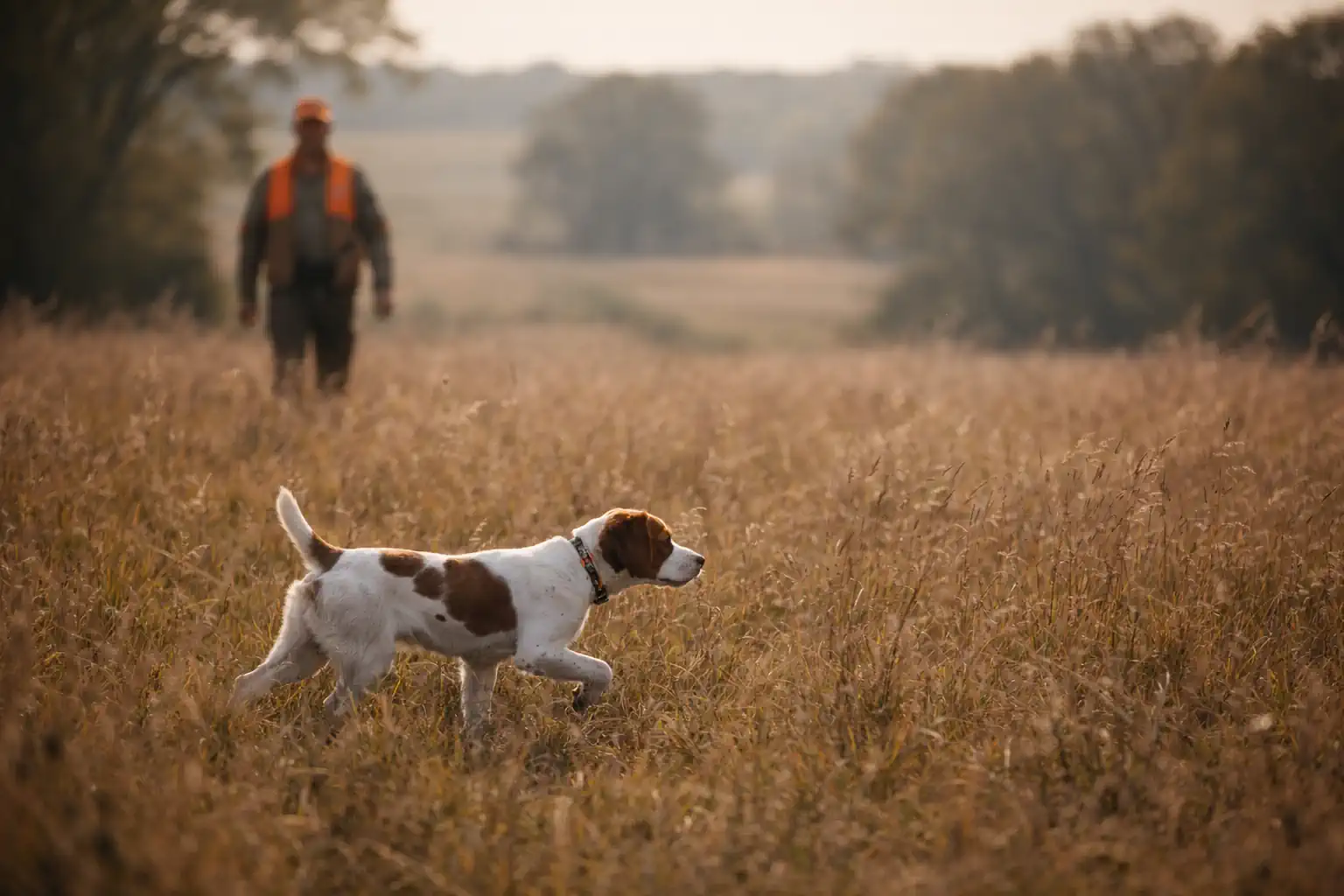
What Steadiness Actually Means
Steadiness means the dog finds birds, goes on point, and stays there — through the flush, through the shot, until released. The dog doesn't creep forward when the bird lifts. It doesn't break at the gun. It stands, watches, and waits for the handler's word before it does anything else.
That sounds simple. In practice it is one of the harder things to train a pointing dog, because every instinct the dog has is pulling in the opposite direction. Bird comes up, dog wants to chase. Gun fires, dog wants to mark and run. The dog has been rewarded for bird enthusiasm its entire life — and now you are asking it to contain that enthusiasm at the exact moment it peaks.
Steadiness is not just polish. It is a safety habit. A dog breaking at the shot puts itself in the pattern, scrambles the hunt, and can push runners into cover before you've closed the distance. A steady dog stands where you last saw it, the bird is down, and you can move to the mark with confidence. That is the difference in the field.
The Foundation: Whoa on the Ground
Before you do any steadiness work near birds, the dog needs a reliable whoa away from birds. A dog that won't hold position on command in a yard or field with no distractions is not ready for the pressure of a live bird flush. Trying to build steadiness on a dog that doesn't have a solid planted stop is one of the most common shortcuts that turns into a problem later.
Whoa is taught as a stationary command — the dog stops and stands still on command, and does not move until released with a word like "okay" or "all right." The dog learns this first on a check cord, walking at heel or during a cast, calling whoa and stopping forward movement with the cord. You build duration before distance. The dog stands for five seconds, then ten, then a minute, with you walking around it and eventually moving out of sight. The dog doesn't break to come to you; it waits.
This step takes as long as it takes. For some dogs whoa is natural and sharp within a few sessions. Others take weeks of daily repetition before they will hold position reliably when you walk behind them. Do not move forward in the steadiness progression until whoa is rock solid away from birds. Every shortcut here costs you double the time later.
Adding Bird Flush: The First Test
Once whoa is reliable away from birds, you start introducing it at the point. The dog goes on point naturally. You walk in, the bird flushes. Before the flush — while the dog is locked and before you move the bird — you calmly say whoa once and give the check cord a gentle reminder of position if needed. Then you walk in and flush the bird.
The dog's job at this stage is only to not break at the flush. If it creeps, you stop it with the cord and whoa. If it breaks and chases, you bring it back to the exact spot it was pointing from, replace it there, and wait. You do not chase the dog down shouting — that teaches the dog that breaking produces a chase game. You call it back, walk it back, plant it back. The correction is clear but not dramatic.
No shot at this stage. The bird goes up and that is the end of the sequence. You release the dog after a pause, or you work on a controlled retrieve of a dead bird thrown from your hand. The point is to build the association: bird flushes, dog holds, good things happen afterward. Rushing to add the gun before the flush is steady produces a double problem — a dog that isn't sure about either.
Creeping vs. Full Breaking
There is a difference between a dog that creeps a step or two at the flush and a dog that launches into a full chase. Creeping is a natural expression of prey drive in transition — the dog is trying to comply but the instinct is stronger than the habit at that moment. Address it calmly and consistently. Full breaking is a bigger indicator that whoa isn't solid enough yet, or that the pressure being used is not matching what the dog can absorb. Back up a step in the progression rather than escalating the correction.
Adding the Shot
When the dog is holding flush reliably — not perfectly, but consistently — you add the shot. Use a .22 blank or a starter pistol before you use a shotgun. Fire after the flush while the dog is still holding. The dog's job is still the same: stand still. The gun is not a release cue. The gun is just something that happens while the dog holds.
Many dogs that were properly introduced to gunfire as puppies handle this step without drama. Dogs that were never properly exposed to gunfire will need a separate gun-introduction protocol before you add live fire to steadiness work. Do not assume a dog is gun-safe just because it didn't react during regular field hunting — the context of holding on point with a bird in the air is a different level of stimulation.
Some dogs that were holding flush just fine will break at the first shot. That is common and does not mean you have failed. It means the stimulation increased and the whoa habit wasn't strong enough yet to hold through the new variable. Go back to holding flush without shot for a few more sessions, then reintroduce the blank at lower intensity — fire it further away first, then closer as the dog demonstrates it can hold.
Adding the Retrieve Release
Once the dog holds through flush and shot consistently, you introduce the retrieve release. The sequence is now: point, flush, shot, dog holds — then "back" or whatever your retrieve command is. The dog learns that it does not go after the bird until it hears the command. The shot is not the retrieve cue. Your voice is.
This is where dogs that were never force-fetched sometimes show gaps. A dog that retrieves when it feels like it may start deciding when to break for the mark on its own terms. If your dog has a solid force-fetch, the "fetch" command here is clean and the dog waits for it. If your dog has a natural retrieve, you may need extra repetitions to convince it that the retrieve command — not the falling bird — is the signal.
For hunters who don't use the dog for retrieve at all, this step is simpler: the dog holds through shot, you walk to the bird, the dog is released to find it or you handle it yourself. The hold through shot is still the goal regardless of what follows.
Where the E-Collar Fits Into This
The e-collar is not a shortcut to steadiness. It is a tool for reinforcing a trained behavior at distance — specifically, for a dog that already understands whoa but needs a consequence for breaking when you can't physically reach it with a check cord.
The correct sequence is: whoa is fully trained on the check cord first. The e-collar is introduced on the ground away from birds as a conditioned response — the dog learns that a nick at a low level means "stand still," which it already knows how to do. Only after that association is clean does the e-collar come into the bird field. A nick at the moment of breaking communicates the same "whoa" cue the dog already knows, now applied remotely.
Using the e-collar near birds on a dog that doesn't yet understand what the stimulation means is how blinking gets created. The dog experiences an aversive at the moment it encounters birds, and the association it forms is "birds equal bad" rather than "breaking equals correction." That is the opposite of what you want. The collar goes on the dog when you are confident the dog knows the command, not before.
How Long This Takes
There is no honest single answer to how long steadiness training takes. A young dog with strong natural pointing instinct, a handler who works consistently twice a week, access to birds, and good timing can be reasonably steady by mid-first-season. Many dogs take a full season of serious work plus a second season of refinement before they are reliably steady across different bird species, cover types, and hunting pressure.
The mistake is measuring progress in calendar time rather than in the dog's behavior. Some dogs hold flush cleanly after three sessions. Some take three months. Both outcomes are normal. Rushing the timeline by adding variables before each step is solid creates a dog that is unreliable across all of them — holds sometimes, breaks sometimes, depending on the bird species or cover or excitement level that day. That inconsistency is harder to fix than simply taking more time with each step.
Hunting pressure is not a substitute for training sessions. A dog that hunts every weekend of a season without consistent steadiness work will get faster at birds and more excited but not more steady. Birds are not the classroom — they are the test. The work that makes a dog steady happens in controlled sessions with check cord and planted birds before you put it in front of wild birds where you have no control over what flushes and when.
FAQ
My dog holds point but always breaks at the flush — where is the gap?
The gap is between whoa as a static command and whoa as a cue that holds through high-stimulation events. The dog understands "stand still" but hasn't practiced it through the specific trigger of a bird lifting. Go back to the check cord flush sequence — no gun — and make the holding-at-flush behavior a trained habit before adding any other variables.
Should I correct the dog while it is still on point or only if it breaks?
Only if it moves. A dog on a solid point should be left alone — no commands, no touching, no whoa reminder unless it is already starting to creep. Nagging a dog on point teaches it that something always happens while it holds, which can erode the point itself. Let the point stand, walk in quietly, flush the bird, then reinforce position only if the dog moves.
Can I train steadiness hunting wild birds or do I need planted birds?
Planted birds give you control over timing, check cord access, and the ability to repeat the sequence. Wild bird hunting does not. You can reinforce steadiness in the field when your dog points a wild bird and you have the cord attached, but you cannot teach steadiness reliably from wild bird hunting alone. The controlled setup is how the habit gets built; the field is where you proof it.
My dog is steady to wing but breaks at the shot — is that common?
Yes. Flush and shot are two distinct stimulation events. A dog can hold one reliably before the other is solid. Treat shot steadiness as its own step — introduce the blank after the flush, proof it at lower intensity before using a full shotgun, and give the dog enough repetitions that the gun becomes just another event during which it stands still rather than a release cue.
At what age should I start steadiness training?
Most handlers start steadiness work after the dog has at least a full season of bird work where natural pointing was established and encouraged. Starting too early — before the dog's pointing instinct is well-developed and enthusiastic — can create a mechanically correct dog that lacks desire. There is no fixed age, but for most breeds this means mid-to-late first season at the earliest, and often not seriously until the second season.
Will an unsteady dog ever settle down on its own with enough hunting?
Some dogs become more controlled with age and experience, but hunting experience alone rarely produces a reliably steady dog. The habit of breaking gets rehearsed repeatedly during every hunt, which reinforces it. If steadiness matters to how you hunt, it needs to be trained — not waited out.
Frequently asked questions
My dog holds point but always breaks at the flush — where is the gap?
The gap is between whoa as a static command and whoa as a cue that holds through high-stimulation events. The dog understands "stand still" but hasn't practiced it through the specific trigger of a bird lifting. Go back to the check cord flush sequence — no gun — and make the holding-at-flush behavior a trained habit before adding any other variables.
Should I correct the dog while it is still on point or only if it breaks?
Only if it moves. A dog on a solid point should be left alone — no commands, no touching, no whoa reminder unless it is already starting to creep. Nagging a dog on point can erode the point itself. Let the point stand, walk in quietly, flush the bird, then reinforce position only if the dog moves.
Can I train steadiness hunting wild birds or do I need planted birds?
Planted birds give you control over timing, check cord access, and the ability to repeat the sequence. You can reinforce steadiness in the field when your dog points a wild bird and you have the cord attached, but you cannot teach steadiness reliably from wild bird hunting alone. The controlled setup is how the habit gets built; the field is where you proof it.
My dog is steady to wing but breaks at the shot — is that common?
Yes. Flush and shot are two distinct stimulation events. A dog can hold one reliably before the other is solid. Treat shot steadiness as its own step — introduce the blank after the flush, proof it at lower intensity before using a full shotgun, and give the dog enough repetitions that the gun becomes just another event during which it stands still.
At what age should I start steadiness training?
Most handlers start steadiness work after the dog has at least a full season of bird work where natural pointing was established and encouraged. Starting too early can create a mechanically correct dog that lacks desire. There is no fixed age, but for most breeds this means mid-to-late first season at the earliest, and often not seriously until the second season.
Will an unsteady dog ever settle down on its own with enough hunting?
Some dogs become more controlled with age and experience, but hunting experience alone rarely produces a reliably steady dog. The habit of breaking gets rehearsed repeatedly during every hunt, which reinforces it. If steadiness matters to how you hunt, it needs to be trained — not waited out.