Start Training a Brittany Puppy for Upland Hunting
· 9 min read · HuntWithDog
A readiness-based Brittany puppy guide: build home foundations, plan manageable field and bird encounters, and keep noise preparation and hunt readiness separate.
On this page
- Quick answer: what should you train first?
- Why the first months matter
- A readiness-based planning roadmap
- Build the foundation at home without overhandling the dog
- First field walks: exploration before performance
- Early bird contacts: curiosity within safe management
- Gunfire preparation is a separate decision
- When to add more control
- Better first-season goals
- Common mistakes that slow a Brittany puppy down
- Treating the calendar as a test
- Making obedience more important than search
- Correcting confusion around birds
- Using bird enthusiasm as a gunfire-readiness test
- Training past the useful point
- A simple weekly structure
- Field safety for a growing puppy
- Choose the next manageable step
- Sources and further reading
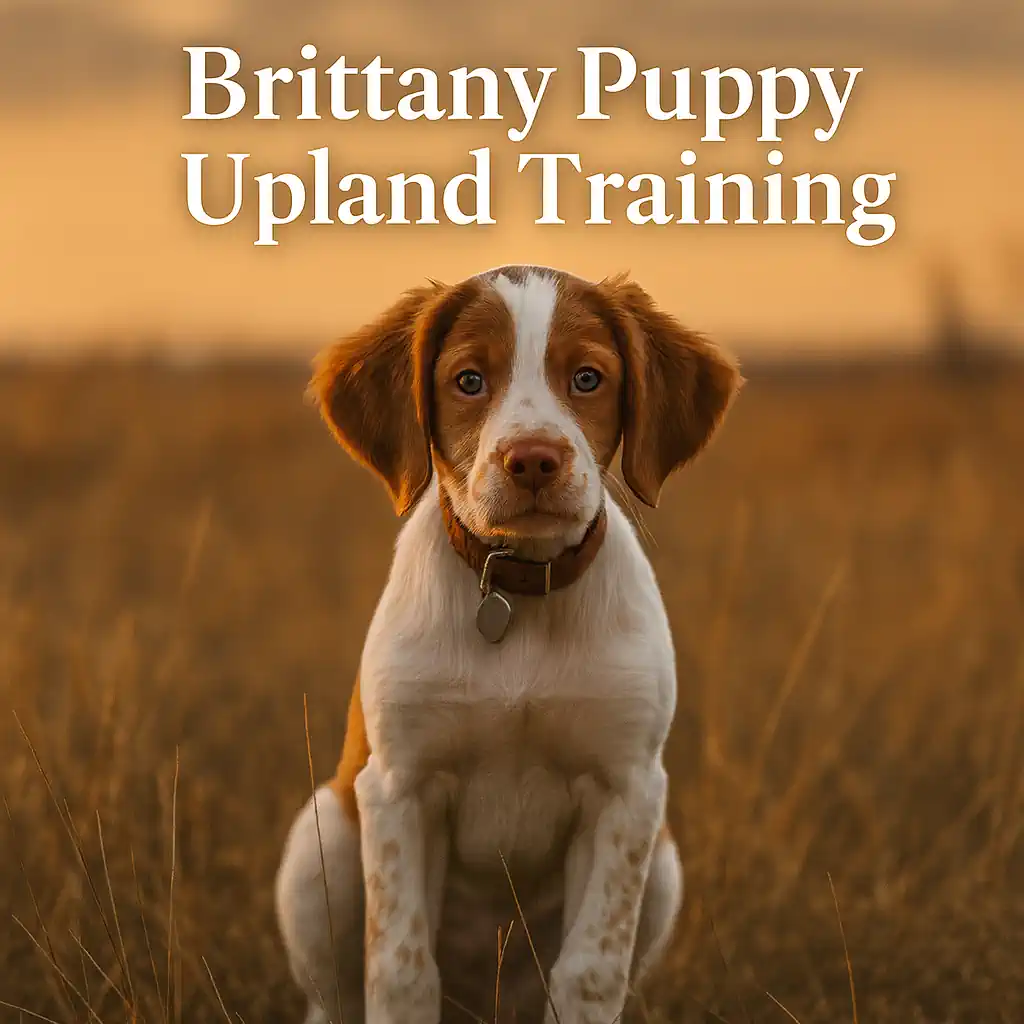
A Brittany puppy does not need a rigid calendar to become a useful upland dog. The early job is simpler: build confidence, cooperation, a reliable recall, comfort in new environments, and a strong desire to find birds. Age matters, but readiness matters more.
This guide uses observable preparation rather than age milestones. Choose manageable learning, pause at concern, and keep health, field skills and comfort with noise as separate questions. A puppy’s enthusiasm alone does not clear it for a hunt.
Quick answer: what should you train first?
- At home: relationship, safe socialization, name response, recall games, crate comfort and handling.
- On suitable ground: short exploratory walks, familiar cues and the ability to move away from and return to the handler.
- At early bird contacts: manageable curiosity and safe stopping, without shooting or a required final point.
- For later goals: teach the relevant steadiness and retrieve components separately with rewards. A birthday does not establish those skills.
Age provides context, not clearance for a hunt. Physical development, health, terrain, intensity, recovery and learned skills all matter. Ask your veterinarian about appropriate exercise for your growing dog, and ask a qualified trainer about the skills the proposed outing requires.
Why the first months matter
Safe socialization means helping the puppy encounter ordinary people, places and handling without overwhelming it. The existing AVSAB puppy-socialization statement addresses broad, positive exposure; it is not a hunting-readiness timetable.
For a future bird dog, practical experiences can include suitable new ground, car travel, comfortable body handling and calm recovery after excitement. An early difficulty is a reason to adjust the plan, not proof that a puppy’s potential has been fixed.
A readiness-based planning roadmap
| Planning area | What to observe | What it does not establish |
|---|---|---|
| Home foundations | Comfort with handling, rest and familiar rewarded cues | That the response transfers to birds or a new field |
| Field exploration | Manageable exploration, recovery and connection with the handler | Physical clearance for a demanding hunt |
| Early bird observation | Curiosity in a setting you can manage before pursuit or distress | Finished steadiness or comfort with gunfire |
| Later skills | A repeatable response at the difficulty actually taught | Reliability under every condition |
These areas can overlap. Return to an easier version when needed; there is no required month in which the puppy must enter the next row.
Build the foundation at home without overhandling the dog
Useful puppy obedience is small and practical. Teach the name, a happy recall, waiting briefly at doors, comfortable crate time, calm body handling, and the ability to settle after excitement. Reward correct choices. Keep sessions short enough that the puppy wants another repetition.
Do not turn every walk into heel work. A pointing dog also needs independence. In safe places, let the puppy move ahead, investigate scent, solve small terrain problems, and learn that checking back does not end the fun.
First field walks: exploration before performance
Choose simple ground with low risk: no traffic, livestock conflicts, deep water, heavy fencing, or cover that can hide dangerous obstacles. Ten minutes of confident exploration can be more valuable than forty minutes of fatigue.
Walk into or across the wind at times, change direction naturally, and let the puppy discover that finding you again is part of the game. If you use a check cord, treat it as a safety and guidance tool rather than a way to drag the puppy into position. In heavy brush or fencing, a trailing line can snag, so match the setup to the ground.
For a deeper progression, see Field Introduction for Pointing Dogs.
Early bird contacts: curiosity within safe management
Keep early bird encounters manageable and focus on curiosity, not a finished point. Plan the setup so you can stop before pursuit, distress or loss of control. Do not punish an unexpected response or keep adding encounters to get one last “good” result. Ending while the dog is comfortable is enough; a final point, chase or retrieve is not required.
Do not turn an early bird encounter into an obedience test. Build recall and a stop cue separately with rewards, and manage the setting so safety does not depend on an untrained response. Safety still takes priority; this is not a rule to withhold recall when the dog is at risk. Formal steadiness belongs to a later, separately planned progression.
HuntWithDog recommends reward-based training, consistent with AVSAB’s humane-training position. This is the site’s editorial approach, not a claim that every hunting-dog program handles early bird contacts identically.
Gunfire preparation is a separate decision
Bird enthusiasm does not establish readiness for gunfire. Keep these introductory encounters free of shooting. If gunfire preparation is the next question, review the dog’s history with a qualified reward-based professional rather than testing its reaction.
If the dog’s history is uncertain, pause and gather information. If fear, avoidance or shutdown is already present, stop exposure, move away safely and contact your veterinarian for assessment and suitable behavior support. Do not recreate a reaction to film it or increase bird excitement to push through it.
Use the gun-shyness decision guide to separate prevention, uncertain history and an existing fear problem; it does not prescribe a shooting distance or load.
When to add more control
Teach recall around manageable distractions, connection with the handler and later steadiness as separate rewarded skills. A hunting dog need not look finished in its first season, but a season label does not excuse an outing you cannot manage safely.
Our guidance does not recommend electronic stimulation for recall, range or steadiness. GPS tracking and electronic stimulation are different functions; locating equipment does not teach a cue.
Better first-season goals
- The dog wants to hunt when you open the door.
- It searches enough ground to find birds but remains findable and cooperative.
- It learns that wind, objectives, edges, and cover predict bird contact.
- Recall is improving even when excitement is high.
- Bird contacts make the dog more confident, not more worried.
- You finish most days wishing for one more contact rather than grinding the dog into fatigue.
For expectations during the first actual hunting season, read First-Season Expectations for a Young Bird Dog.
Common mistakes that slow a Brittany puppy down
Treating the calendar as a test
Age ranges are planning tools. Development, confidence, health, experience, and the quality of your training ground all change the pace.
Making obedience more important than search
A puppy that never gets permission to explore can become dependent on the handler. Build recall and manners, but also create safe opportunities for independent hunting behavior.
Correcting confusion around birds
Early bird work should create desire and understanding. If a setup goes badly, change the setup rather than escalating pressure.
Using bird enthusiasm as a gunfire-readiness test
Bird enthusiasm does not establish readiness for gunfire. Keep these introductory encounters free of shooting. If gunfire preparation is the next question, review the dog’s history with a qualified reward-based professional rather than testing its reaction.
Training past the useful point
Stop before fatigue, distress or loss of control, whether or not the last repetition looked successful. If a new limp, unusual stiffness, reluctance or apparent pain occurs, stop and ask your veterinarian. A generic schedule cannot establish an individual dog’s physical limits.
A simple weekly structure
You do not need a seven-day formal program. A useful week for a young puppy might include several two-to-five-minute recall or handling games at home, two or three short exploration walks in different safe environments, normal household socialization, and one field outing when the dog is fresh. Bird work can be occasional and high quality rather than frequent and mediocre.
As the puppy becomes a real hunting companion, field time gradually replaces "training time." That is the point: the dog learns to make useful decisions in the places where you actually hunt.
Field safety for a growing puppy
- Choose ground away from roads and uncontrolled livestock.
- Carry water and shorten work in warm or humid conditions.
- Inspect paws, eyes, ears, and coat after cover.
- Follow your veterinarian's vaccination and parasite-prevention plan for your area.
- Do not use a trailing cord where it can easily snag.
- End the session if the puppy becomes disoriented, overheated, sore, or emotionally shut down.
- Follow local hunting, training-bird, firearm, and public-land rules.
For a task-by-task companion, use the Brittany puppy checklist. For a broader planning framework, see the stages of bird dog training.
Choose the next manageable step
Begin with useful life skills and manageable exploration. Describe what the puppy can do under the conditions actually taught; do not infer readiness for birds, gunfire or a hunt from a birthday or enthusiasm alone. Choose the next useful question and leave room to simplify or stop.
Sources and further reading
Frequently asked questions
What age should I start training a Brittany puppy?
Start relationship building, safe socialization, name response, recall games, crate work, and calm handling as soon as the puppy comes home. Field and bird work should advance by confidence and readiness rather than a fixed birthday.
When should a Brittany puppy first see birds?
Choose an individually manageable encounter rather than a fixed birthday. Plan safe management so you can stop before pursuit, distress or loss of control. Formal steadiness and gunfire preparation are separate questions.
Should a young pointing dog chase birds?
Keep early contacts manageable and stop before pursuit, distress or loss of control. Do not punish an unexpected response or require one last point, chase or retrieve. Early observation and later trained steadiness are different stages.
When should I introduce gunfire?
Bird enthusiasm does not establish readiness for gunfire. Keep introductory bird encounters free of shooting and review the dog’s history with a qualified professional. An uncertain history or an existing fear response needs individual assessment, not a generic exposure recipe.
When should I use a check cord?
Use a check cord when it solves a practical management or safety problem and the puppy is comfortable exploring. Avoid trailing lines where they can snag in fences or heavy brush. Teach recall and a stop cue separately with rewards; the cord is not a way to drag the dog into position or force an untrained response.
Does a Brittany puppy need an e-collar?
HuntWithDog recommends reward-based training. Electronic stimulation is not a substitute for a learned response or safe field management; GPS tracking is a different function.
How long should puppy training sessions be?
Keep the activity within what the puppy can manage comfortably. Stop before fatigue or distress; a final successful performance is not required. Ask your veterinarian about individual exercise limits.
Where to go next
Choose the step that matches the question you still need to answer.
Prerequisite
Begin with a clear return cueTeach one recognizable response before expecting it around hunting distractions.
Next decision
Plan the first field walksExploration can begin without requiring birds, a point or gunfire.
Next decision
What would make a first hunt manageable for this dog?Age, bird interest and a comfortable walk do not establish all the preparation a hunt needs.
Browse guides by question or find your training starting point.