GPS Collar vs E-Collar for Upland Bird Dogs
· 8 min read · HuntWithDog
GPS collars and e-collars do completely different jobs. Here is how to decide which one fits your terrain, your dog, and your hunting style.
On this page
- Two Tools, One Common Confusion
- What a GPS Collar Actually Does
- What an E-Collar Actually Does
- When GPS Is Essential
- When E-Collar Is Essential
- Combo Units: When You Need Both
- Does GPS Make Dogs Rangier — or Lazier?
- Battery and Tech Failure in the Field
- Regional and Terrain Breakdown
- Western Chukar and Huns
- Southern Quail in Tight Cover
- Midwest CRP Pheasant
- Recommendation Framework
- FAQ
- Can a GPS collar replace an e-collar for training?
- Do combo units sacrifice quality on either function?
- What stimulation level should I start at with my pointing dog?
- How does update rate affect GPS usefulness for pointing dogs?
- Is it safe to use an e-collar on a young pointing dog?
- What if my GPS unit loses satellite signal in the field?
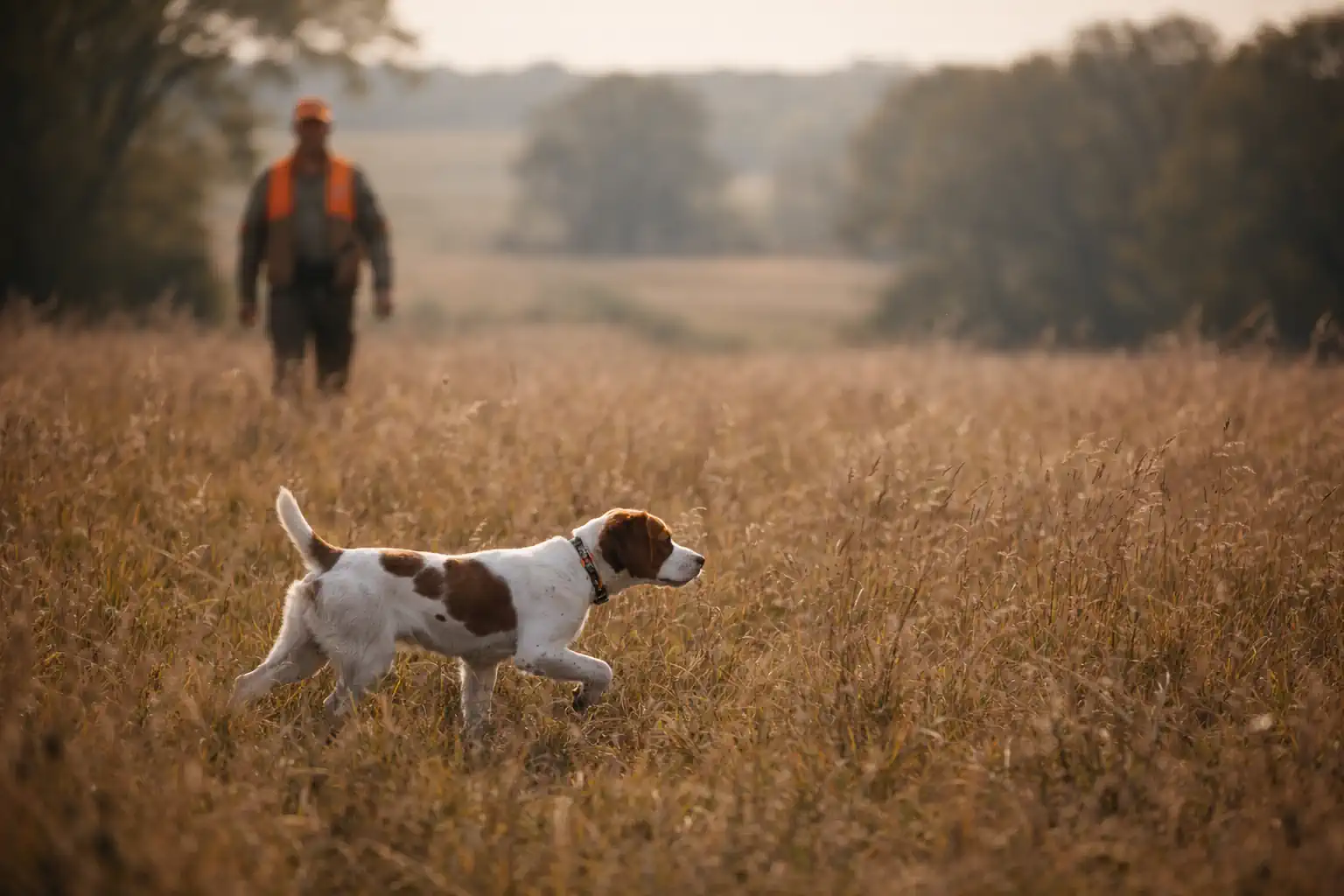
Two Tools, One Common Confusion
The GPS collar vs e-collar question comes up constantly in hunting dog forums, and it reveals a fundamental misunderstanding: these two pieces of gear do not compete with each other. They address completely different problems. A GPS collar tells you where your dog is. An e-collar influences what your dog does. Choosing between them is only necessary if budget forces it. Understanding what each does is always necessary.
Get this distinction wrong and you end up either chasing a dog you can't see or pressing a button on a dog you can track fine but can't communicate with. Neither situation helps your hunting.
What a GPS Collar Actually Does
A GPS collar tracks your dog's location on a digital map in real time. The handheld receiver or paired smartphone app shows a moving dot. You know your dog's position, heading, speed, and in some units whether the dog is on point or treed. That is the entire value proposition: location awareness.
What it does not do: influence behavior, issue corrections, reinforce commands, or help your dog understand anything. A GPS collar is purely observational from the handler's side.
Update rate matters. Units that ping every one second give you a smoother track and better on-point detection. Units running on a 2.5-second interval are slower to show a dog locked up on a covey. For big running dogs in broken terrain, faster update rates are worth the added battery draw. Mapping apps also vary: Garmin's BaseCamp maps, Onx Hunt integration, and proprietary dog-tracking maps each have tradeoffs in coverage and usability in the field.
What an E-Collar Actually Does
An e-collar delivers a remote stimulation — vibration, tone, or electrical stim at adjustable levels — that the handler triggers. Used correctly with a trained dog, it becomes a remote leash: you can reinforce recall, apply a correction for a known command violation, or interrupt unwanted behavior at distances a voice or whistle cannot reach.
Used incorrectly — wrong timing, too much stimulation, or on a dog that hasn't learned the commands yet — it creates confusion or fear. E-collar effectiveness depends entirely on prior training. A dog that doesn't know what the correction means gets nothing useful from it. This is why the e-collar is a training tool, not a shortcut.
Fit and stimulation level matter as much as timing. The collar should sit snug with contact points touching skin — not so tight it restricts breathing, not so loose it shifts. Start stimulation levels low and find the minimum that gets a response. For pointing dogs, most experienced trainers use the e-collar for recall and range control, not for anything related to bird work itself.
When GPS Is Essential
There are situations where hunting without GPS tracking is genuinely risky, both for the dog and for your day:
- Big country chukar and Huns in the intermountain West — a wide-running Pointer can disappear into canyon country in under a minute and stay there, on point, for twenty
- Thick cover situations — Southern bottomlands, CRP edges, tall grass where visual contact breaks immediately
- Running breeds in any terrain — a dog that covers four hundred yards in two minutes and works out of sight constantly
- Multi-dog hunts — knowing where both dogs are prevents shooting accidents when you can't see either
- Remote areas with poor cell coverage — GPS radio communication works where your phone map app does not
The safety argument for GPS is real and underappreciated: knowing a dog's position before taking a shot is a direct contribution to firearm safety in the field.
When E-Collar Is Essential
The e-collar earns its place when communication beyond voice range is critical:
- Recall reliability in real hunting pressure — a dog that knows the command but occasionally blows it off needs a tool that reaches them at distance
- Range control on a dog that drifts wider than your hunting terrain allows
- Steady-to-shot training at the intermediate and advanced stages
- Reinforcing known commands in exciting situations where distraction overrides response
Tight cover quail hunting in the South is the terrain where experienced handlers lean hardest on the e-collar: you may be within sight of the dog most of the time, so GPS is less critical, but precise behavioral control — keeping a dog from busting a covey before you're in position — matters more.
Combo Units: When You Need Both
Combination GPS-plus-e-collar units — Garmin Alpha series, Garmin Astro with add-on remote, SportDOG TEK series — put both functions on a single handheld. For the hunter who needs both capabilities, the combo unit is nearly always the right call. Running one device beats managing two handhelds while also carrying a gun and minding terrain.
Combo units do cost more. Entry-level dedicated GPS setups start around $350–450. Entry-level e-collars run $150–300 for quality brands. A Garmin Alpha 200i with collar runs $900–1,000. That gap is real. But for a serious hunter who will use both functions — and most should — the math often works out when you account for not buying two separate systems plus the convenience value in the field.
Does GPS Make Dogs Rangier — or Lazier?
This debate runs through upland hunting communities and deserves a direct answer: a GPS collar does not change a dog's behavior. The collar emits no signal the dog perceives. If your dog is running too wide, the GPS showed you what was already happening before you had it. If your dog seems lazier after you added GPS, look elsewhere — conditioning, cover type, heat, season fatigue.
The valid version of this concern is handler behavior change: some hunters relax their whistle discipline once they can see the dog on screen, allowing range to creep out because they're comfortable watching the dot instead of managing the dog. The GPS enables the drift but doesn't cause it. The fix is handler discipline, not removing the collar.
Battery and Tech Failure in the Field
Both devices depend on battery life and electronics. Cold temperatures drop battery capacity fast. A GPS unit that lasts eight hours in September may deliver four in January. Plan accordingly:
- Charge both handheld and collar the night before every hunt, not once a week
- Carry a small power bank for the handheld if you hunt long days
- Know your dog's training well enough to hunt them without the e-collar as a backup plan — a dead remote should not end the day
- Check satellite acquisition before entering cover; units can take two to three minutes to lock from cold
Regional and Terrain Breakdown
Western Chukar and Huns
Big country, canyon terrain, extreme elevation changes, and wide-running dogs make GPS close to mandatory here. If your Pointer locks up four hundred yards away and six hundred feet below you in a draw, you need to know it. E-collar is useful for range control on the approach but secondary to tracking.
Southern Quail in Tight Cover
Piney woods, broomsedge fields, and brushy creek drains in the South often have dogs working within a hundred yards. Visual contact is intermittent but more frequent than Western hunting. GPS is a nice-to-have; the e-collar is the working tool that keeps dogs aligned with covey routes and prevents busting birds early.
Midwest CRP Pheasant
CRP fields sit between the extremes. Cover breaks visual contact, but field scale is manageable. Running pheasant push dogs hard. Both tools earn their place: GPS for knowing which end of the field the dog is working, e-collar for recall timing when roosters are running.
Recommendation Framework
Use these factors to make your decision:
- Dog loses visual frequently? — GPS is your priority
- Dog has recall or range control gaps? — E-collar is your priority
- You hunt big open country with a wide-running breed? — GPS first, then e-collar
- You hunt close cover with a dog that works nearby? — E-collar first, GPS optional
- Budget allows one unit? — Match the tool to the problem your specific terrain creates
- Budget allows both or a combo? — Get the combo and use both functions; the overlap in coverage is worth it
Neither collar makes a better hunter out of a poorly trained dog. The GPS shows you where a problem is; the e-collar helps you address it. Both work best as extensions of solid foundation work, not substitutes for it.
FAQ
Can a GPS collar replace an e-collar for training?
No. A GPS collar only tracks location. It has no ability to communicate with or influence the dog's behavior. They are separate tools for separate purposes.
Do combo units sacrifice quality on either function?
At current prices, Garmin's Alpha and SportDOG's TEK series deliver quality tracking and quality stimulation control. The main tradeoff is cost, not performance.
What stimulation level should I start at with my pointing dog?
Start at the lowest level and increase slowly until you see a subtle response — a head turn, ear movement, change in pace. That working level varies by individual dog and should be confirmed before each hunt since conditioning and environment shift sensitivity.
How does update rate affect GPS usefulness for pointing dogs?
Faster update rates (1-second) are more useful for detecting when a running dog stops on point. Slower rates (2.5-second) are adequate for general location tracking but may lag when a dog locks up suddenly in cover.
Is it safe to use an e-collar on a young pointing dog?
The e-collar should only be used after a dog understands a command through other means first. Introducing the collar too early — before the dog knows what the stimulation means — causes confusion and can create lasting training problems. Most trainers recommend waiting until basic obedience is solid, typically around 6–8 months at the earliest depending on the individual dog.
What if my GPS unit loses satellite signal in the field?
Deep canyon walls, heavy timber, and certain weather conditions can briefly interrupt GPS signal. Most units reconnect within seconds. Know your terrain's dead zones in advance and manage range accordingly — especially in areas known for signal drop.
Frequently asked questions
Can a GPS collar replace an e-collar for training?
No. A GPS collar only tracks location. It has no ability to communicate with or influence the dog's behavior. They are separate tools for separate purposes.
Do combo units sacrifice quality on either function?
At current prices, Garmin's Alpha and SportDOG's TEK series deliver quality tracking and quality stimulation control. The main tradeoff is cost, not performance.
What stimulation level should I start at with my pointing dog?
Start at the lowest level and increase slowly until you see a subtle response — a head turn, ear movement, change in pace. That working level varies by individual dog and should be confirmed before each hunt.
How does update rate affect GPS usefulness for pointing dogs?
Faster update rates (1-second) are more useful for detecting when a running dog stops on point. Slower rates (2.5-second) are adequate for general location tracking but may lag when a dog locks up suddenly in cover.
Is it safe to use an e-collar on a young pointing dog?
The e-collar should only be used after a dog understands a command through other means first. Most trainers recommend waiting until basic obedience is solid, typically around 6–8 months at the earliest depending on the individual dog.
What if my GPS unit loses satellite signal in the field?
Deep canyon walls, heavy timber, and certain weather conditions can briefly interrupt GPS signal. Most units reconnect within seconds. Know your terrain's dead zones in advance and manage range accordingly.