What Age Should a Pointing Dog Puppy Start Hunting
· 7 min read · HuntWithDog
The real question is not age but readiness — mental and physical. Here is a practical framework for knowing when your pointing dog puppy is ready for the field.
On this page
- It Is Not About Age Alone
- Physical Readiness: Growth Plates Matter
- Mental Readiness Signals
- Exposure Is Not the Same as Hunting
- Age Ranges by Category
- Real Bird Exposure (No Shooting): 3–6 Months
- First Controlled Hunts With a Mentor Dog: 8–12 Months
- Full Hunting Days Like an Adult Dog: Not Before 12–18 Months
- Signs Your Puppy Is Not Ready
- The Risk of Waiting Too Long
- First Season Physical Protection
- FAQ
- At what age can a pointing dog puppy start bird exposure?
- Is it harmful to hunt a puppy before growth plates close?
- My puppy is 14 months and shows no bird interest. Is something wrong?
- Should I hunt my puppy its first season or wait for the second?
- Does breed affect when a puppy is ready to hunt?
It Is Not About Age Alone
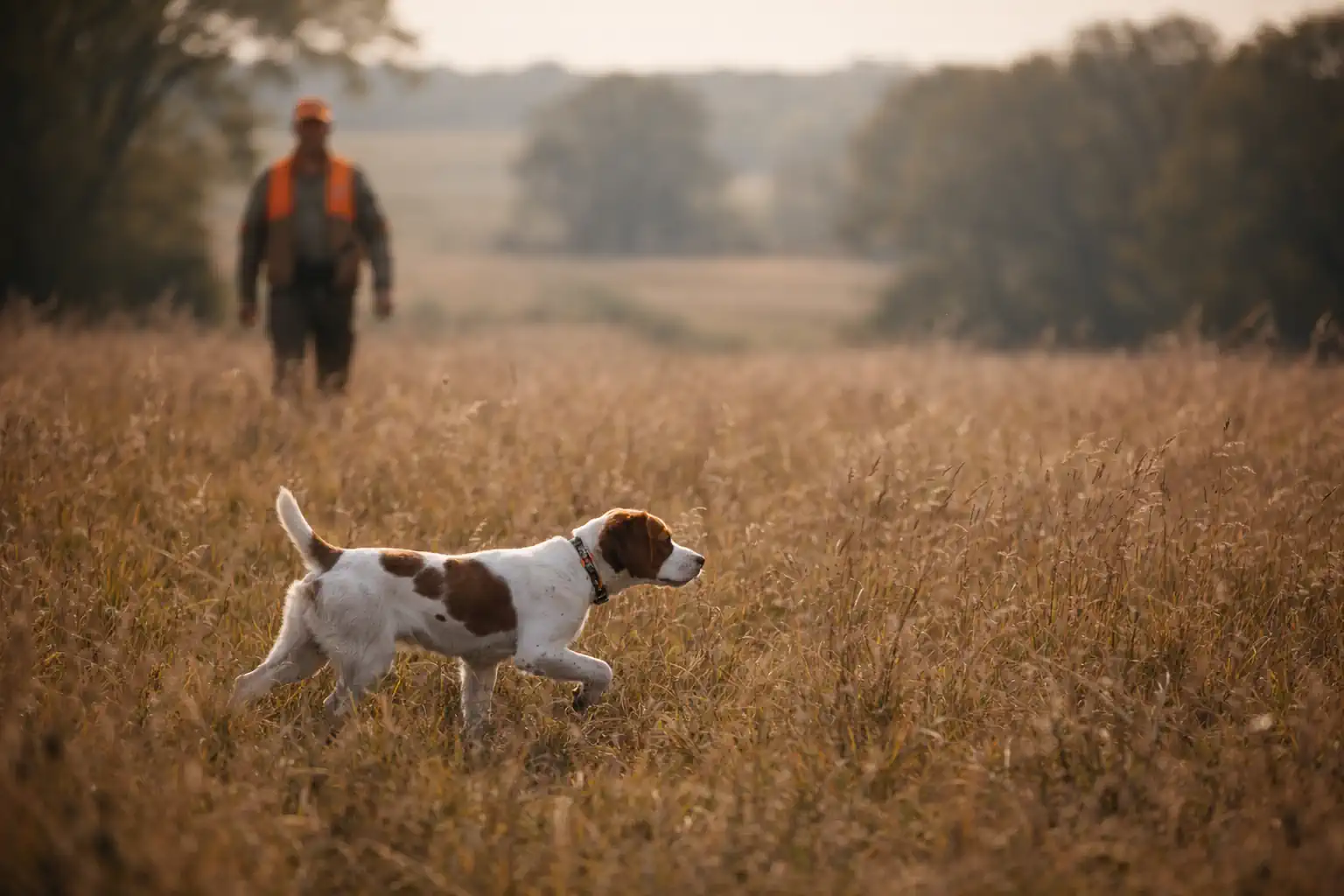
The question of when to start hunting a pointing dog puppy almost always gets answered with an age. But age is a proxy, not the actual measure. The real question is readiness — and readiness has two components that are independent of each other: physical readiness and mental readiness. A puppy can be mentally on fire for bird work at seven months and still need another four months before its joints are ready for a full day in hard terrain. A physically mature dog at fourteen months may still be mentally immature, shutting down in pressure situations or showing anxiety in the field.
The hunters who push puppies into full hunting days too early tend to regret it on the veterinary side. The hunters who wait too long out of caution sometimes find a dog that has lost the edge of natural drive it would have had at its prime development window. Both errors are real. The framework below is meant to help you find the balance.
Physical Readiness: Growth Plates Matter
Growth plates are the soft cartilage zones at the ends of long bones where new bone tissue is produced. Until they close, the joint is more vulnerable than the surrounding bone — repetitive impact on hard or rough terrain during this window can cause damage that affects the dog structurally for life. Growth plate closure timelines vary by breed size:
- Small breeds (Brittany, smaller Setters): roughly 9–12 months
- Medium breeds (GSP, Vizsla, medium Setters): roughly 12–14 months
- Large breeds (English Pointer, large Setters, larger GSPs): roughly 14–18 months
These are general ranges, not exact cutoffs. Individual dogs vary, and your veterinarian can take radiographs to confirm closure if you need certainty before a demanding first season. The practical application: avoid repetitive long days on hard, rocky terrain before growth plates close. Light field exposure on forgiving ground carries much lower risk than full hunting days in lava rock, steep shale, or heavily rutted terrain.
This is not a reason to keep the puppy penned until its second birthday. It is a reason to calibrate the demand level to the developmental stage.
Mental Readiness Signals
Mental readiness is harder to put on a calendar than growth plate closure. Look for these indicators before putting real hunting pressure on a young dog:
- Moves into cover confidently rather than hanging back at the edge
- Shows bird interest — any form: nose up, chasing, intensity when encountering feathers
- Does not shut down or tuck tail when something unexpected happens in the field
- Ranges away from the handler without constant check-in anxiety
- Recovers quickly from startling experiences rather than shutting down for the rest of the session
A dog that checks all of these boxes at ten months is mentally ready for more than a dog showing none of them at fourteen. Mental development has its own pace, influenced by genetics, socialization history, and the quality of early field exposure.
Exposure Is Not the Same as Hunting
This distinction matters more than any age number. Exposure means short, low-pressure field contacts: the puppy runs, investigates, finds bird scent, maybe contacts a planted bird, and comes home before it is fatigued or overwhelmed. Hunting means a real day in the field with shooting, sustained effort, and the full demands of the adult job.
Puppies can and should have exposure sessions starting early — as young as eight to twelve weeks for simple yard work and basic field introduction on easy ground. Real bird exposure with planted birds can begin at three to six months in many cases, tailored to the individual dog's confidence. These sessions build the foundation that makes full hunting possible later.
Full hunting days — following an adult dog into real hunting situations, covering serious ground, processing gunfire and birds repeatedly in a single session — belong in the second season for most dogs. The first season is for building on exposure, not replacing it with demands the dog is not ready to meet.
Age Ranges by Category
Real Bird Exposure (No Shooting): 3–6 Months
Planted pigeons or quail in light cover. Short sessions. No commands, no corrections, no expectations beyond exploration. The goal is building positive association between the field and bird scent. Let the puppy make its own choices. Chase, point, flush — all are fine at this stage.
First Controlled Hunts With a Mentor Dog: 8–12 Months (Breed-Dependent)
Short days, easy cover, abundant birds. Following an experienced dog that models bird work gives the young dog context it cannot get from planted birds alone. Keep sessions under two to three hours. Watch for mental fatigue — a dog that starts ignoring birds, hanging back, or showing flat body language is done for the day. End before that point.
Breed note: Brittanys and smaller pointing breeds often reach this stage at the lower end of the range. GSPs, English Pointers, and larger Setters may need a few more months of exposure-level work before handling the added stimulation of a real hunt well.
Full Hunting Days Like an Adult Dog: Not Before 12–18 Months
Even at 12 months, a full day should be built up gradually over the season rather than starting with maximum demand. The first season for a young dog should feel shorter and easier than it would for a seasoned adult — which means choosing your cover, limiting your hours, and watching the dog's condition rather than hunting to bag limit.
Signs Your Puppy Is Not Ready
- Shuts down in cover — stops moving, lags behind, seeks the handler constantly
- Tucks tail at gunfire or shows sustained fear response
- Ignores birds or shows no interest after multiple exposures
- Extreme anxiety when away from the handler in the field
- Physical signs: stiffness after sessions, limping, reluctance to jump
Any of these signals warrants a step back — shorter sessions, lower pressure, or in the case of physical symptoms, a veterinary check before continuing field work.
The Risk of Waiting Too Long
There is a real cost to excessive caution. Dogs that never get serious field time before two years occasionally show reduced drive and intensity compared to dogs that had rich field experience throughout their first year and a half. Natural hunting instincts are use-dependent: they develop through use, and they can soften through long periods of disuse during the prime development window.
The goal is not to wait for the perfect moment — it is to build appropriate exposure from early on, with demand scaled to readiness at each stage. A dog that has been finding birds since four months in light pressure contexts and working short hunts since ten months is far better prepared for a productive first season than one kept in the yard until it was physically mature.
First Season Physical Protection
Treat the first real season as diagnostic. Watch for lameness after long days. Check pads after every hunt — young dogs have softer pads than seasoned hunters and tear more easily on rough terrain. Monitor energy levels the day after a hunt; unusual soreness or stiffness warrants rest and possibly a vet check. Build mileage progressively, not all at once at the season opener.
A young dog that comes through its first season sound, confident, and hungry for more is ready to step into full hunting the following year. That is the outcome to plan for.
FAQ
At what age can a pointing dog puppy start bird exposure?
Light bird exposure — planted birds, no shooting, short sessions — can begin as early as three to four months for confident, curious puppies. The earlier sessions build drive and positive association that make everything later easier.
Is it harmful to hunt a puppy before growth plates close?
Short sessions on soft, forgiving terrain carry low risk. Full hunting days with hard running on rocky or steep ground before growth plate closure can damage developing joints. The risk is in duration and terrain type, not in field exposure itself.
My puppy is 14 months and shows no bird interest. Is something wrong?
Possibly a lack of prior bird exposure rather than a genetic deficiency. Dogs that were not introduced to birds during key developmental windows can be slow to show bird interest later. Structured exposure with planted birds, positive only, over multiple sessions often brings drive to the surface. If there is genuinely no interest after thorough exposure, a conversation with an experienced trainer is worthwhile.
Should I hunt my puppy its first season or wait for the second?
A puppy with solid exposure history and good mental readiness can have a first season — short days, easy cover, low pressure. But the second season is where the real hunting begins. First season is about confirming readiness and building confidence, not maximizing bag limit.
Does breed affect when a puppy is ready to hunt?
Yes. Smaller breeds like the Brittany mature faster both physically and mentally than larger breeds like the English Pointer or large-framed Setters. A Brittany may be ready for first controlled hunts at 8–9 months; a large Pointer or Setter may need until 12–14 months for the same demand level.
Frequently asked questions
At what age can a pointing dog puppy start bird exposure?
Light bird exposure with planted birds and no shooting can begin as early as three to four months for confident, curious puppies. These early sessions build drive and positive association.
Is it harmful to hunt a puppy before growth plates close?
Short sessions on soft terrain carry low risk. Full hunting days with hard running on rocky or steep ground before growth plate closure can damage developing joints. The risk is in duration and terrain type, not field exposure itself.
My puppy is 14 months and shows no bird interest. Is something wrong?
Possibly a lack of prior bird exposure rather than a genetic issue. Structured bird exposure with planted birds, positive only, over multiple sessions often surfaces drive that wasn't developed earlier.
Should I hunt my puppy its first season or wait for the second?
A puppy with solid exposure history can have a first season with short days and low pressure. The second season is where real hunting begins. First season is about confirming readiness and building confidence.
Does breed affect when a puppy is ready to hunt?
Yes. Smaller breeds like the Brittany mature faster both physically and mentally than larger breeds like the English Pointer or large-framed Setters.