What Age Should a Pointing Dog Puppy Start Hunting? Assess First-Hunt Readiness
· 8 min read · HuntWithDog
Assess your pointing dog's first-hunt readiness through health, preparation, handling and conditions. Find the gaps and choose a manageable next step.
On this page
- First, define what you mean by hunting
- Discuss physical demands with your veterinarian
- Review preparation one part at a time
- First controlled outings: readiness, not a birthday
- Resolve noise concerns before a shooting outing
- Choose the next step
- Example: change the trip before leaving
- Reassess during and after any first hunt
- Related field guides
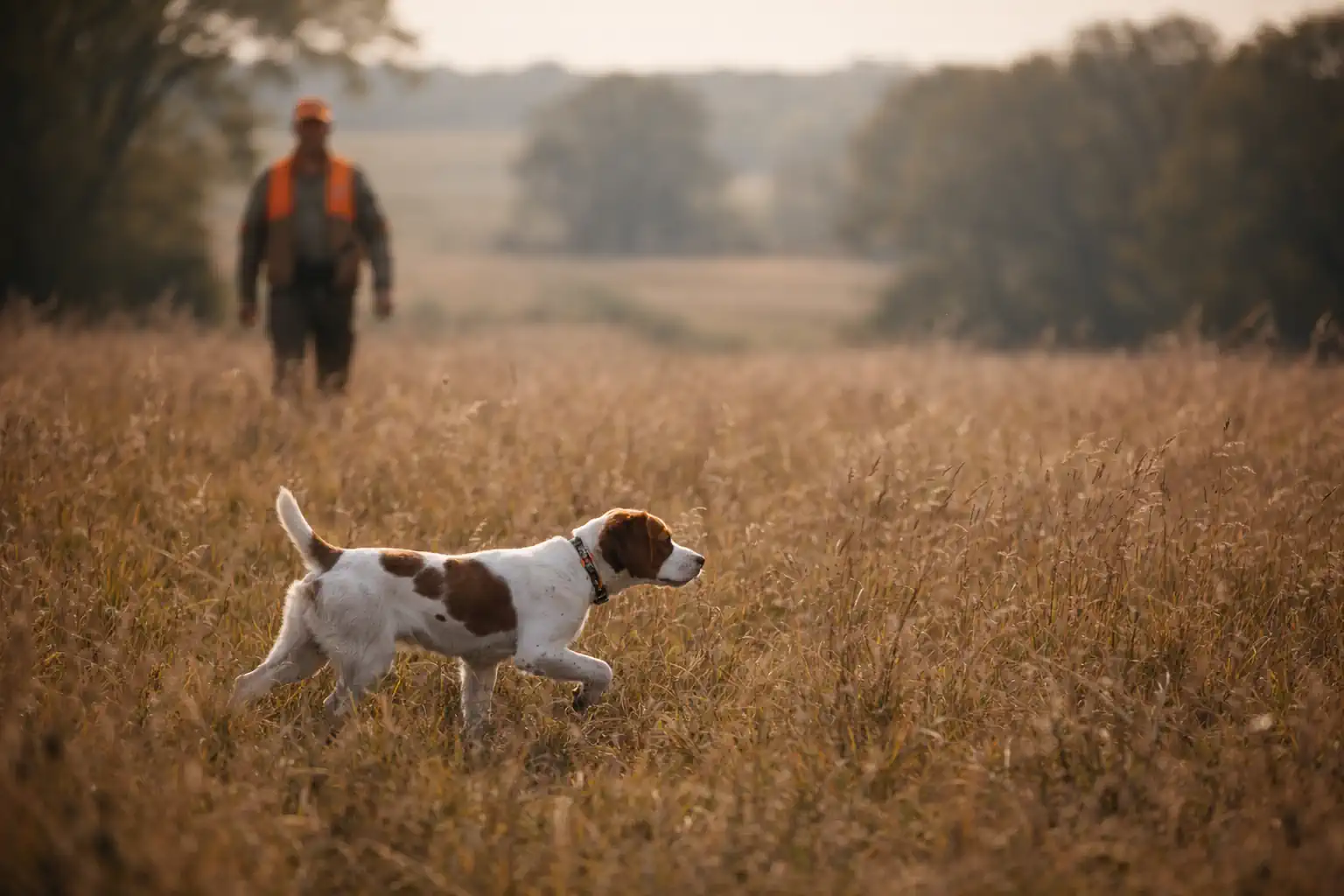
Plan a first hunt when the individual dog's health, preparation, handling and the day's conditions support a manageable outing. A birthday alone cannot establish those things. Ask your veterinarian about the physical demands, and review the dog's preparation with a competent reward-based bird-dog instructor. If an essential part is uncertain, postpone the hunt and work on that part separately.
The useful question is specific: “Can we manage this outing with this dog today?” Being comfortable on an introductory walk, showing interest in birds and being prepared for an actual hunt are different achievements.
First, define what you mean by hunting
Write down the outing you are considering. Include the cover, footing, likely weather, travel, other people and dogs, possible shooting, and how you would leave early. “A short hunt” says little if the return crosses a steep hillside or the group intends to keep going.
Keep three activities separate:
| Activity | What you can choose | What it does not establish |
|---|---|---|
| Introductory field walk | A permitted place to investigate, with suitable management and an easy return | Readiness for birds, gunfire, free running or sustained hunting |
| Planned training | A defined skill in a setting an instructor can manage appropriately | Reliable performance in every hunting situation |
| Actual hunt | Whether to participate, where to go, whom to join and when to stop | Control over when wildlife moves or other unexpected events occur |
Choose the activity that matches what is already known. Do not bring an unprepared dog along merely to see what happens when shooting starts.
Discuss physical demands with your veterinarian
Describe the real activity: repeated running through cover, uneven ground, travel and the effort needed to return. Mention previous discomfort, illness, activity restrictions and how the dog behaved after recent exercise. Ask about an appropriate progression, infection and parasite protection, and signs that should prompt a call.
PDSA's veterinary puppy-exercise guidance advises protecting growing dogs from excessive or high-impact exercise and building activity gradually. It also notes that the familiar five-minutes-per-month formula lacks scientific evidence. That formula cannot supply a safe hunting duration.
Age provides context, not clearance for a hunt. Physical development, health, terrain, intensity, recovery and learned skills all matter. Ask your veterinarian about appropriate exercise for your growing dog; do not use a breed-average growth-plate date or a short duration as a guarantee of safety. Lameness, unusual stiffness, reluctance or pain calls for stopping and veterinary advice.
Review preparation one part at a time
Use observations from recent, manageable situations. “Came back when called in our quiet yard” is useful information; “recall is finished” hides where it has actually worked. Review these questions with your instructor:
- Can you keep the dog safely managed around the distractions this outing is likely to contain?
- Can you bring it within reach and end the activity using responses it has learned, without escalating pressure?
- Is the dog comfortable with the necessary travel, equipment, people and handling?
- What relevant field or bird experience has it had, and what remains unfamiliar?
- If gunfire is part of the plan, what preparation has actually occurred under competent guidance?
There is no points tally here. A good retrieve cannot compensate for an unresolved safety concern. A promising point also does not demonstrate the rest of the dog's preparation. Choose simpler work when the proposed hunt would require you to assume a missing response.
Use reward-based instruction. AVSAB's current position, reaffirmed in 2025, recommends reward-based methods for all training. Physical or electrical pressure is not a way to make a readiness gap disappear.
First controlled outings: readiness, not a birthday
An experienced human mentor can help you choose a manageable outing and read the young dog's responses. That does not mean turning a puppy loose to follow an older dog. Solo outings make it easier to see what the young dog can do without competition. A carefully managed introduction to another dog is different from running an active hunting brace.
Your veterinarian assesses individual exercise and health concerns; a qualified trainer assesses learned skills and the proposed setup. Neither assessment alone settles total hunting readiness. Review health, handling, noise preparation, access and the day’s conditions together.
For the separate pairing decision, read pointing-dog honor and brace conditions. An older dog cannot supply a response the young dog has not learned.
Resolve noise concerns before a shooting outing
Treat gunfire preparation as a separate responsibility. Comfort with a television, traffic or a recording does not establish readiness for shooting nearby. This guide provides no firing distances, shot sequence or sound-exposure test.
Dogs Trust's noise guidance includes gunshots among sounds that can frighten dogs and cautions against direct loud exposure as puppy socialization. If preparation is absent or unclear, keep the dog away from shooting and obtain qualified help first.
If the dog has shown fear around noises, consult your veterinarian. The Atlantic Veterinary College's noise-fear handout recommends a behavior-focused veterinary appointment for suspected noise fear. Repeated exposure during a hunt is not an assessment or treatment plan.
Choose the next step
This is a planning aid, not a veterinary examination or a hunting-readiness certificate.
| What you know today | Decision |
|---|---|
| Health or exercise suitability is unresolved | Postpone the hunt; discuss the actual demands with your veterinarian. |
| Necessary handling or noise preparation is missing | Return to appropriate separate training with an instructor. Choose an outing without those demands. |
| The dog is prepared for familiar work, but this trip adds unfamiliar cover, a large group or a difficult return | Redesign the trip or decline it. Familiarity with one part does not settle the others. |
| Preparation has been reviewed, conditions suit the plan and the group accepts stopping early | Consider a limited first hunt, with an easy exit and reassessment throughout. |
| Pain, distress, loss of safe management or an unsafe situation appears | Stop. Leave safely; seek veterinary or behavior help according to the concern. |
DEFINE THE HUNT
       |
CHECK HEALTH + PREPARATION + HANDLING + CONDITIONS
       |
uncertain part? ----- yes ----> POSTPONE / PREPARE THAT PART
       |
       no
       |
CONSIDER A LIMITED OUTING --> REASSESS --> END WHEN NEEDED
Before joining others, agree who is responsible for handling the dog, how everyone will communicate and that the dog's outing can end independently of the group's plans. An experienced dog is not a substitute for the young dog's preparation or your ability to manage it.
The humans need their own preparation. Use your jurisdiction's hunter education and current agency rules; Iowa DNR's program, for example, covers firearm safety, wildlife identification, laws and responsibility. That example does not establish requirements elsewhere. Confirm permissions and rules for the actual location and activity.
Example: change the trip before leaving
This is a fictional example. Maya's pointer, Wren, investigates familiar cover comfortably and responds during managed practice. Maya is invited on a group hunt across rough ground. She cannot yet explain Wren's preparation for shooting, and the group plans a long circuit without an easy return.
She declines this trip. She asks an instructor to review the missing preparation and discusses the intended exercise with her veterinarian. Meanwhile, she continues suitable familiar activities. Her next decision concerns a particular gap and a different outing, rather than whether Wren is “behind” another puppy.
Reassess during and after any first hunt
Do not make the day's goal a bird count or a complete adult performance. Keep the option to finish before the original plan is complete. Strong interest does not establish physical safety: Cornell's 2026 report on sporting-dog overheating research explains that drive can outweigh self-preservation.
Stop for a new limp, apparent pain or a concerning behavior change and contact your veterinarian. AAHA's pain-sign guidance explains why changes in movement or behavior deserve assessment. Do not use another run to test whether the problem has gone away.
Record what actually happened, why you ended, and any changes noticed afterward. Repeating a manageable activity may be the next step; adding demands is optional. Positive early experiences matter, but AVSAB's socialization statement supports safe exposure without overwhelming puppies. It is not evidence that a puppy must hunt by a particular age or lose its hunting potential.
Related field guides
Frequently asked questions
Is there one age when a pointing dog puppy is ready to hunt?
No. Age provides context, not clearance. Consider physical development, health, terrain, workload, recovery and learned skills with the appropriate professionals and the demands of the actual outing.
Can a veterinarian or trainer alone clear the whole outing?
A veterinarian can advise on individual health and exercise limits; a qualified trainer can assess skills and the proposed learning setup. Neither alone establishes total readiness for access, handling, noise, terrain and the day’s conditions.
Can an experienced dog make my young dog ready for a brace?
Do not use an experienced dog as a shortcut to a young dog's readiness. Consider a brace only when both dogs can work safely around each other, respond to the needed cues and avoid interfering with one another. If these skills are not established, work separately. A completed season or a particular age is not proof of readiness.
Can a short outing guarantee exercise safety for a growing dog?
Age provides context, not clearance for a hunt. Physical development, health, terrain, intensity, recovery and learned skills all matter. Ask your veterinarian about appropriate exercise for your growing dog; do not use a breed-average growth-plate date or a short duration as a guarantee of safety. Lameness, unusual stiffness, reluctance or pain calls for stopping and veterinary advice.
Where to go next
Choose the step that matches the question you still need to answer.
Prerequisite
Keep a first field walk separate from a huntA comfortable introductory visit does not establish preparation for birds or shooting.
Next decision
Compare a destination's access and trip conditionsThis is planning background; check current season, parcel and activity rules with the managing agency.
Related problem
What do you know about the dog’s history with noise?Separate an unknown history or fear response from the skills needed for an outing; this is not a gunfire recipe.
Browse guides by question or find your training starting point.