Pointing Dog Whistle and Hand Signals: Give Each Cue One Job
· 5 min read · HuntWithDog
Separate a return, a turn and a directional cast. Define each signal's finish, use manageable reward-based practice and recognize when the field task needs help.
On this page
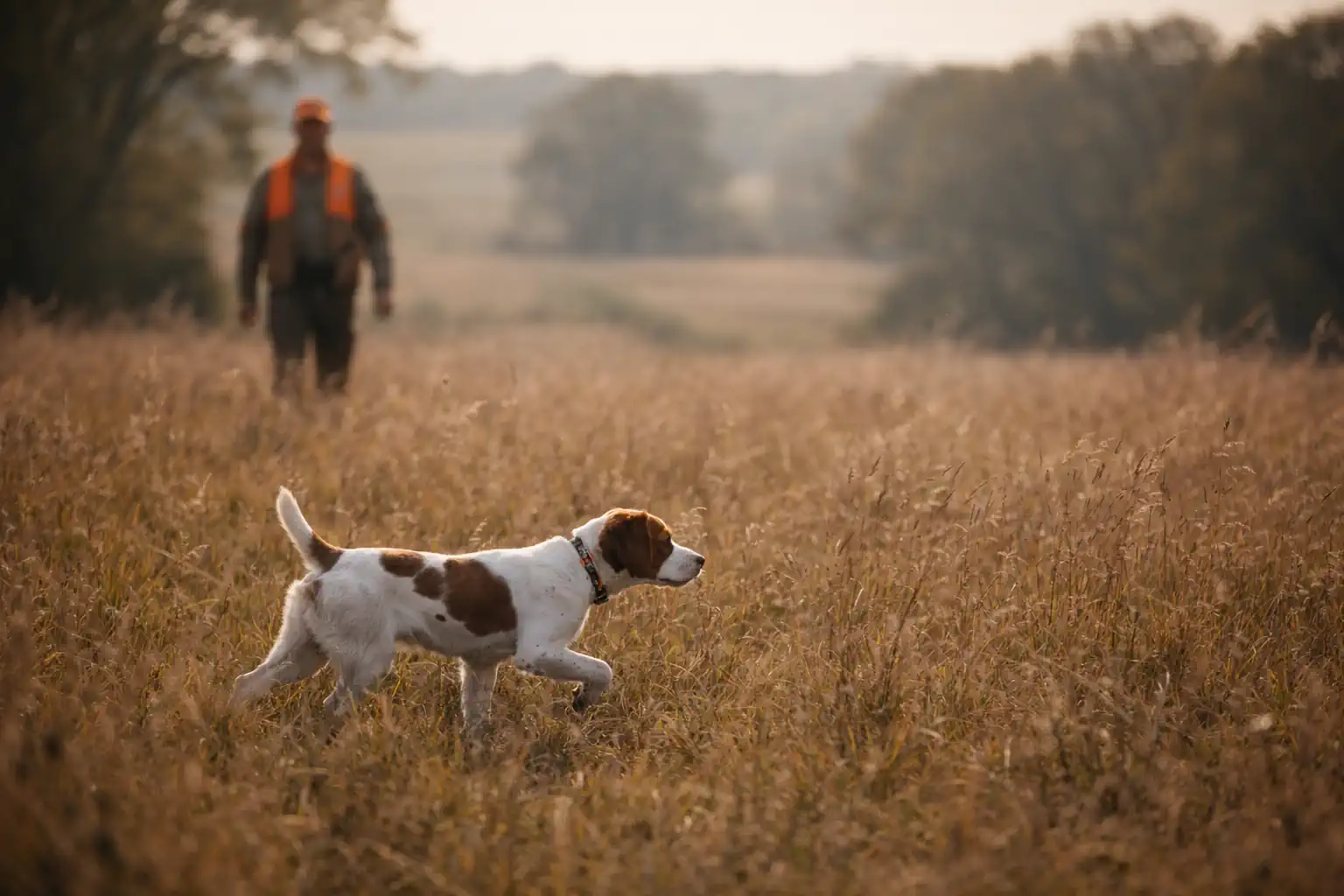
Give each signal one job: return to you, change the search direction, or move toward a specified place. A whistle pattern or raised arm does not supply the missing training. Start by deciding which response you need, and use a cue only when the dog has learned that response in manageable conditions.
If your dog cannot yet return comfortably, start with the recall and whistle foundation. That guide teaches the return. This page helps you organize the different signals without turning every direction change into another recall lesson.
Separate recall, a turn and a cast
| Your intended job | What you would observe | What that does not prove |
|---|---|---|
| Recall | The dog returns close enough for you to take control calmly. | A glance toward you is not the completed return. |
| Change direction | The dog changes its line while remaining within the activity you can manage. | Moving the way you walked does not by itself prove a learned whistle response. |
| Directional cast | The dog moves toward the place specified by a learned directional cue. | Following a nearby hand does not establish an independent send through cover. |
These are the working definitions used here. Agree on the finish with the person helping you train. If one handler uses a sound for returning and another uses it for turning away, the dog is being asked different questions under the same label.
Make a cue card before you practice
Write four things on a small card: the signal you will give, the action it requests, where that action ends, and the reward you will use. Add a separate note about management—fencing, leads or suitable practical help—so an unfinished response is not your only protection.
For example: “My familiar recall sound means approach me and remain close enough for a calm harness touch.” Dogs Trust's recall guidance supports a consistent word or whistle, agreement between handlers, rewarding returns and gradual changes in the practice setting. It does not prescribe a three-blast code for pointing dogs.
There is no need to replace a clear signal that already works with a fashionable pattern. If you have inherited conflicting cues, list the conflicts before adding another sound. Ask a reward-based instructor to help you separate them rather than trying every version during a hunt.
A visible signal is learned, too
A useful close-range demonstration is a hand target: the dog chooses to touch your hand with its nose and receives a reward. Dogs Trust's target lesson explains marking and rewarding that contact in a quiet place, adding a cue once the response is consistent, and making the setting harder gradually. Avoidance or frustration is a reason to simplify or take a break.
That exercise gives you an observable finish: nose touches hand. It is not a left cast, a blind retrieve or evidence that the dog will follow your arm at field distance. A send away from you needs its own taught destination and finish. Get practical help with that task instead of assuming that a larger gesture will explain it.
Change one question at a time
Start with a response the dog already understands and can comfortably complete in a secure, quiet setting. RSPCA's training guidance supports rewards, short sessions and individual learning pace. Use those principles to keep the next attempt understandable; they are not a timetable for a finished hunting dog.
- Identify the current version: cue, starting position, separation, distraction and finish.
- Keep most of that version familiar when you change something. Moving to a new place already changes the task.
- Reward the intended response. Record any extra gesture, verbal cue or movement you used to help.
- If the dog cannot complete it comfortably, return to an easier version or end the session. A final successful repetition is optional.
- Do not add birds or gunfire to find out whether the signal has become reliable.
Progress means seeing the response again under the conditions you actually intend to use, without repeatedly rescuing it with extra cues. One good attempt is useful information, not a pass for every location. You do not need a fixed number of repetitions to recognize that the current version is too difficult.
Before using a signal in cover
Ask whether the dog can detect the signal, whether the requested action is familiar, and whether you can manage a failure without creating a hazard. A hand signal behind dense vegetation is not visible just because your arm is extended. A whistle does not establish hearing, attention or understanding on a particular occasion.
Keep the difference between signal planning and the size of a search clear. The range guide considers cover, contact and the outing; this cue card does not certify a safe working distance. If you cannot keep the situation manageable, change or leave it rather than testing an untrained response.
Pointing, flushing and retrieving are different activities. Do not add repeated handling signals to manufacture proof that the dog is listening while it is on point. Plan specific field work with someone who can assess the dog and setting. The whistle is not a replacement for that preparation.
When a cue fails
First keep the dog safely managed. Then describe the event without a verdict: “looked toward me but did not approach,” or “turned only after I walked away.” That record is more useful than “stubborn.” It shows which part of your cue card needs clarification.
Our training guidance follows AVSAB's reward-based position. It does not recommend electronic stimulation to fix recall, turns or casts. Simplify the task and seek qualified reward-based help instead of adding a remote correction.
A fictional example: one cue, two interpretations
This example is invented. Maya writes “three short sounds = return to me.” In a secure practice area, her dog Finn turns his head after the sound but stays where he is. Maya records attention, not recall. On the next suitable occasion she uses the easier return task she already taught, rather than adding a second whistle code.
Later, an instructor asks whether Maya wants a return or a change of search direction. She chooses to develop that second job separately. The useful improvement is a clearer request and observation, not a claim that Finn now handles at hunting distance.
Choose the next task
Use recall training if the return itself is unfinished. Use yard-to-field transfer if a familiar response changes with the setting. Keep a brief training record when you need to compare attempts. Each answers a different next question.
Frequently asked questions
Which whistle pattern should I use?
Use a consistent signal with one defined response. This guide does not prescribe a universal pointing-dog code. Agree on its meaning with everyone handling the dog.
Is turning toward me a completed recall?
Not under the definition used here. A completed return ends close enough for calm control. Record attention and return separately, and use the recall guide for the teaching steps.
Does hand targeting teach a field cast?
No. Touching a nearby hand has a different destination from moving away on a directional cast. Teach and assess those jobs separately.
Should I use an e-collar when a signal fails?
This guidance recommends reward-based training. Make the task easier and seek qualified help rather than adding stimulation.
Where to go next
Choose the step that matches the question you still need to answer.
Prerequisite
Teach the return before adding other signalsRecall is one defined response; turning and directional cues are separate jobs.
Next decision
Record which cue and setting changedCompare the response you asked for with what happened, without adding several cues at once.
Browse guides by question or find your training starting point.