Wounded-Bird Retrieves With a Pointing Dog: Start With What You Know
· 6 min read · HuntWithDog
Keep the last observed location clear, assess the dog's task and recovery conditions, and use the outcome to choose appropriate help and training afterward.
On this page
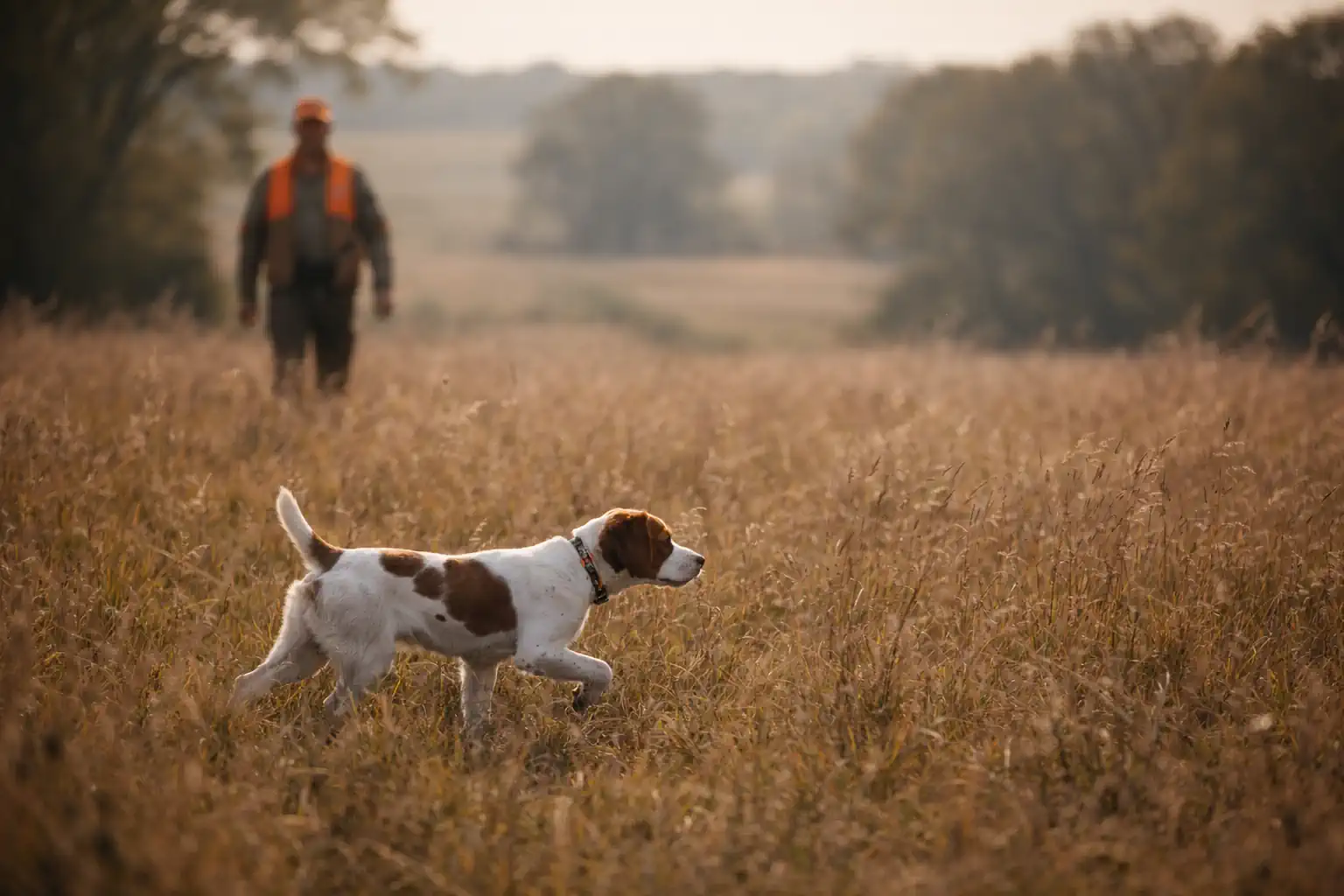
Start a wounded-bird recovery with the last place you actually saw the bird, then decide what you and the dog can safely do with that information. A moving bird can leave the fall area. Keeping the observation clear is more useful than assuming that a posture, a breed label or a familiar retrieve command tells you where it is now.
This guide helps a pointing-dog owner organize the recovery decision and identify what needs attention afterward. It does not teach advanced tracking, a firearm procedure or a method of dispatch. Learn those practical responsibilities through appropriate instruction and check the rules for the actual species, place and activity.
Mark the last known place
While maintaining safe awareness of the situation, identify a definite landmark for the last observed location and any subsequent movement you actually saw. Kentucky Fish & Wildlife's Fair Chase guidance recommends marking the last place game was seen and, for upland birds, attending to the downed location. Here that supports preserving an observation—not importing the same page's big-game waiting advice or prescribing one search pattern for a running bird.
Separate the locations in your description: where it first fell, where you next saw it move, and where sight was lost. If your partner saw something different, clarify that difference before directing the dog toward a guess. Do not silently turn “I think it went toward the ditch” into “the bird is in the ditch.”
Check the recovery plan before adding demands
| Question | Decision it changes |
|---|---|
| Can you identify the last observed place? | Use a clear landmark; keep an uncertain location marked as uncertain. |
| Is access and recovery activity allowed there? | Check the applicable rules and permissions rather than assuming a recovery overrides a boundary. |
| Can the people remain accounted for? | Clarify positions and communication before changing the search. |
| Can this dog do the proposed task in these conditions? | A familiar retrieve on open ground does not establish readiness for hidden water, ice or impenetrable cover. |
These are planning questions, not a legal checklist that certifies an outing. A bird beyond your first search area does not remove the need to assess the next area. Do not turn uncertainty into a longer chase simply because the dog is eager.
Cold water and ice deserve a separate decision. Ducks Unlimited's cold-weather retriever column describes individual limits and situations where experienced handlers choose another location or walk away. It is experience-based guidance about those conditions, not a safe temperature, duration or ice-thickness threshold for your dog.
Give the dog a known task
If the dog already has an appropriate search or retrieve response and the situation is manageable, use that familiar task at the last reliable location. If it does not, a repeated “hunt dead” is a new sound during a difficult problem. Keep the search organized and seek suitable help rather than expecting the phrase to supply the skill.
Watch where the dog goes, what area has actually been covered, what it does with a bird if found, and where you lose useful information. Those are separate observations. A dog can locate an object but struggle with pickup or delivery; it can also retrieve a visible object without having learned a difficult search.
For that distinction, use the retrieve-component guide and marked versus blind retrieves. The former uses manageable toy or bumper practice; the latter explains what the dog saw versus a handler-directed location. Neither is proof of wounded-bird recovery ability.
Observe without inventing a scent story
Write “lowered its head and turned along the edge,” rather than “proved the rooster was running on that line.” The first is what you saw. The second adds an explanation and an identification that the posture alone did not establish.
Dogs Trust's body-language guidance explains why whole-body observation and context matter when interpreting behavior. It is not a study of wounded-bird scent. The narrower distinction used here—observation versus inference—does not diagnose the smell, a bird's condition or the dog's motivation.
Use new information to reconsider the area with an experienced partner or dog handler when available. Avoid replacing every pause with another cast. Equally, do not assume that leaving the dog alone will solve an untrained task. Your decision should follow what is known about this dog and this recovery.
When continuing with this dog is not the answer
Stop the dog's work if you cannot maintain safe contact, access or control of the setting. Preserve the location and observations, and arrange appropriate assistance. Stopping an unsafe activity does not settle your recovery obligations; check the applicable regulations and contact the relevant land manager or wildlife authority when the next lawful step is unclear.
A new limp, apparent pain or a concerning change is a reason to stop work and contact your veterinarian. AAHA's pain-sign guidance identifies movement and behavior changes as possible pain signs. Another retrieve is not an assessment of the cause.
Our training guidance follows AVSAB's reward-based position. Do not respond to a failed recovery by adding electrical stimulation or assuming force-fetch is necessary. A field difficulty needs to be understood before choosing a teaching task.
Review the missing part afterward
After the outing, make a short factual record. This is an editorial planning tool, not a validated test or a diagnosis:
- What did you actually see of the fall and later movement?
- Which place or change did the search rely on, and how certain was it?
- Which familiar cue and assistance did you use?
- Did the difficulty concern reaching the area, searching, pickup, carrying, return or delivery?
- What condition or unknown made you stop or seek help?
Choose practice away from a live recovery. AKC's fetch lesson develops willing engagement, pickup and holding with rewards before increasing the task. Its drop-it lesson teaches trading rather than prying an object from the dog's mouth. Those are toy-training resources, not evidence for a live-bird tracking progression. A qualified reward-based instructor can help assess what transfers and what still needs separate teaching.
A fictional example: clarify the failure
The people and events here are invented. Jordan sees a pheasant fall beside a shrub, then sees movement toward a boundary. He tells his partner both observations instead of sending the dog to the ditch beyond it as though that location were certain. When access beyond the boundary is unclear, they keep the last location recorded and seek the appropriate next step.
Later Jordan's note says the dog carried a found practice bumper away from him on an earlier occasion. That is a return question to discuss with the instructor, not evidence that the missed bird required stronger pressure. The recovery record helps choose a question; it does not prove a cause.
Frequently asked questions
Should I send straight to the fall?
Start from the last reliable observation only when the task, access and conditions are appropriate. An uncertain fall or an unprepared dog needs a different plan, not an automatic send.
Does a low head prove that my dog is tracking a running bird?
No. Record the posture and movement, but do not treat that observation alone as proof of the bird's location, condition or scent. This guide offers no posture-based scent diagnosis.
Does a pointing dog need force-fetch for wounded birds?
A missed recovery does not establish that. Identify the task that needs help and seek a reward-based plan; this guide does not recommend aversive retrieve training.
How long should I keep searching?
This page gives no universal clock. Reassess the evidence, access, conditions and dog's welfare. Stop unsafe work and seek appropriate assistance while checking the recovery rules that apply to the outing.
Can I teach hunt dead during a difficult recovery?
A new phrase does not create a learned search. Develop appropriate skills in suitable training and get practical help; do not use a live wounded bird as an improvised lesson.
Where to go next
Choose the step that matches the question you still need to answer.
Prerequisite
Identify the retrieve skills already establishedA wounded-bird search is not the place to improvise missing pickup, return or delivery training.
Related problem
Separate a known fall from handler directionWhat the dog observed at the start affects the question you are trying to answer.
Browse guides by question or find your training starting point.