Beeper Collars for Pointing Dogs: Understand the Signals Before the Hunt
· 5 min read · HuntWithDog
Understand beeper collar signals, model-specific settings, pre-hunt checks, unexpected silence, and noise-related welfare limits for pointing dogs.
On this page
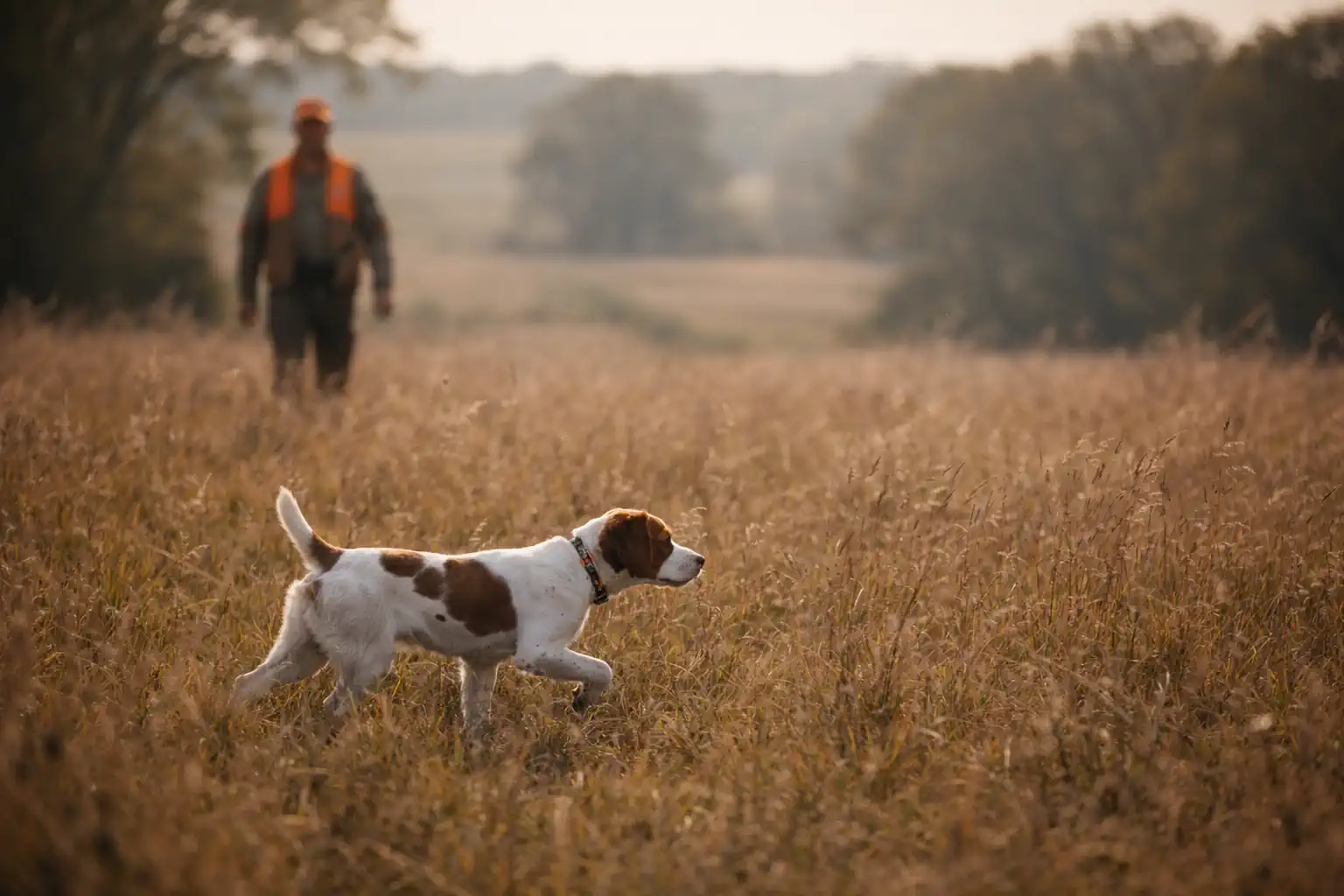
A beeper sounds from somewhere beyond the cover. Before you decide what to do, you need to know what that particular sound means on your particular collar. Is it a periodic signal while the dog moves, a response to stillness, or a sound you requested with a transmitter?
For a first-time upland dog owner, that distinction matters more than learning every available tone. Start with the manual for the exact model you have, then check its behavior before taking it hunting.
What the sounds actually tell you
Manufacturers may use names such as run, hunt, point, and locate. Read those as descriptions of device functions, not conclusions about the dog or the cover ahead.
The SportDOG DSL-400, for example, offers Point Only and Point/Run modes. Its manual describes a test in which holding the unit still for two seconds produces the point sound. No bird is involved in that check. SportDOG DSL-400 manual, pp. 2–5
The practical inference is straightforward: a motion-based point signal cannot confirm a bird, a correct point, or whether it is safe to shoot. It tells you how the device is responding to movement or stillness. You still have to establish what is happening.
An on-demand sound is different again. The Tri-Tronics Upland G3 manual describes Remote Locate with compatible transmitters, sounding for up to eight seconds. It also offers combinations without a HUNT sound. These are features of that named system, not promises about current Garmin equipment or every beeper. Upland G3 manual, sheets 2–4
Before leaving, be able to explain each sound you have enabled in one sentence. Also remember that an audible signal is not automatically a command your dog has learned.
Four settings that do different jobs
Delay is how long the device waits after a change, such as becoming still, before signaling. Repeat interval is the spacing between sounds. Sensitivity concerns which movements the sensor responds to. Volume changes the sound level. A collar may offer some of these adjustments and not others.
Consider two concrete examples:
- The DSL-400 offers run intervals of approximately 5–6 or 9–10 seconds and LO/HI volume. Its manual does not document adjustable motion sensitivity or remote locate. Changing the run interval changes the spacing of run signals; it does not establish a different point-detection threshold. DSL-400 manual, pp. 2–5
- The CANIBEEP RADIO PRO manual describes a stillness threshold of at least five seconds and a point sound every two seconds. Its adjustable run intervals are 5, 10, 15, or 20 seconds. It also documents adjustable sensitivity and volume, but does not establish that the five-second stillness delay is adjustable. These are separate parameters. CANIBEEP RADIO PRO manual, revision D, GB pp. 28–31
That second example illustrates why “more sensitive” is not necessarily “better.” Its manual explains that greater sensitivity allows small movements to interrupt the point sound; lower sensitivity can let that sound continue despite movement. Follow the instructions for your own unit rather than transferring another collar's settings. CANIBEEP RADIO PRO manual, GB pp. 28–31
A short check before leaving home
This is a suggested preparation routine, not a replacement for the manufacturer's procedure:
- Identify the equipment. Match the model and manual revision. If using a transmitter, verify compatibility rather than assuming a button will provide locate.
- Check power and mounting. Follow the manual's battery checks and mounting instructions. Resolve questionable fit or an unclear battery indication before proceeding.
- Test the selected sounds. Perform the manufacturer's movement and stillness test before putting the setup into field use. Know which mode is active and what the controls do.
- Explain expected silence. Does the selected mode omit movement sounds? Is a repeat interval still running? Write down the answer if it is easy to confuse.
- Set a stopping rule. If you cannot reproduce or understand the expected behavior, leave the device out of use until the problem is resolved. Do not discover its meaning by experimenting on the dog during a hunt.
When a sound changes or disappears
Avoid treating an unexpected signal as evidence that the dog has done something wrong. Start with the equipment and the selected mode.
The Upland G3 troubleshooting guidance identifies dirt, battery condition, cold, and interference as possible contributors to problems. That is a reason to consult the model's troubleshooting procedure, not a way to diagnose a silent collar from a distance. Upland G3 manual, sheets 2–4
Recheck the setup in controlled conditions. If it remains inconsistent, stop relying on it and seek manufacturer support. In cover, an unexplained silence leaves the dog's status uncertain. Do not use repeated guessing as a substitute for locating and controlling your dog safely. A beeper does not replace recall training, supervision, or a separate location plan, including GPS where appropriate.
Introduce the noise without forcing it
Keep familiarization separate from hunting pressure. PDSA's general noise guidance supports gradual, low-level exposure paired with rewards under professional guidance, reducing exposure if the dog becomes fearful, and seeking veterinary advice for signs of fear. It does not provide a beeper-specific safe volume or exposure duration. PDSA: noise phobias in dogs
Choose reward-based teaching; AVSAB recommends reward-based methods rather than aversive training. That position is general training guidance, not a beeper hearing-safety study. AVSAB position statements
Do not force prolonged exposure or assume that taking a treat proves the sound is safe for hearing. If the dog shows fear, stop and ask your veterinarian for help. The useful endpoint is a setup you understand and a dog whose welfare remains the priority, not simply a collar that makes noise.
Where to go next
Choose the step that matches the question you still need to answer.
Related problem
Separate audible signals, location and trainingA beeper signal and a tracking fix do not teach a response or establish safety.
Prerequisite
Give handling cues a separate jobAn equipment sound is not automatically a cue the dog has learned.
Browse guides by question or find your training starting point.