Best Quail Dog for Foot Hunters: Brittany, Pointer, or Setter?
· 8 min read · HuntWithDog
Foot hunters have different needs than horseback or ATV hunters. Here is how the Brittany, English Pointer, and English Setter compare for hunters who walk.
On this page
- Why Foot Hunters Have Different Needs
- The Three Contenders
- Brittany
- English Pointer
- English Setter
- Criterion-by-Criterion Comparison
- Natural Range and Foot-Hunter Pace
- Heat Tolerance
- Terrain Toughness
- Natural Retrieve Tendency
- Trainability and Owner Experience
- House Dog Compatibility
- Regional Guidance
- GSP: Honorable Mention
- The Honest Answer
- FAQ
- Is the Brittany the best quail dog for foot hunters?
- Can a wide-running Pointer be adjusted to work close for a foot hunter?
- Does the English Setter retrieve naturally?
- What quail dog breed is best for hot early-season hunting?
- Is the GSP a reasonable quail dog for a foot hunter?
- How do I find a hunting-line Pointer or Setter breeder?
Why Foot Hunters Have Different Needs
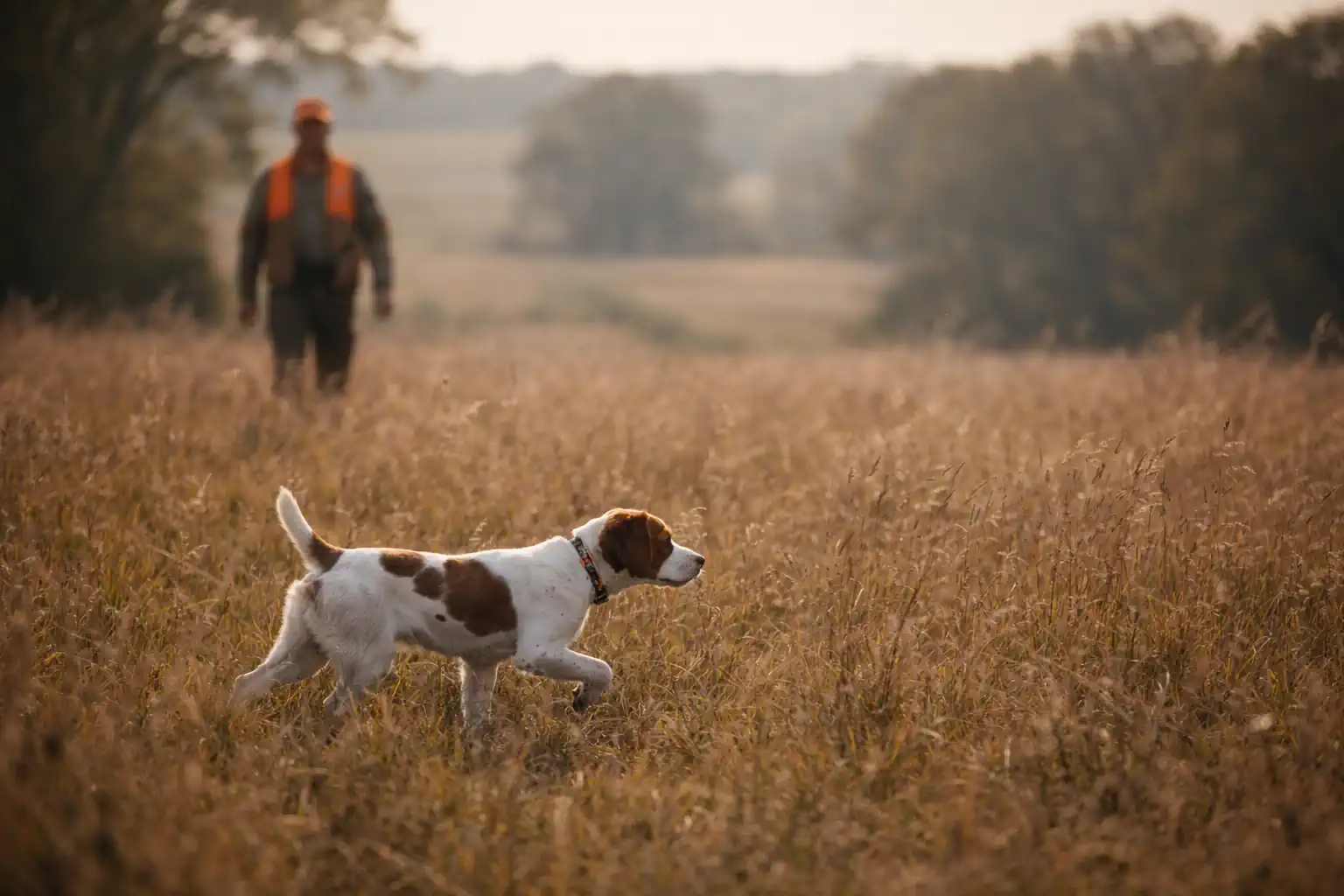
Horseback and ATV quail hunters can cover ground fast. Their dogs can cast wide, run big, and still be found — if not seen, then tracked on GPS while the hunter rides to close the distance. Foot hunters cannot do that. Walking pace is walking pace. A dog that ranges three hundred yards and runs at twenty miles per hour in open country is ahead of you, out of your influence zone, and working birds before you can get close enough to shoot.
The foot hunter's dog needs to work at a pace you can keep up with, hold birds long enough for you to arrive, and do this consistently across terrain that may be rough, brambly, and hot. That narrows the field considerably. The three breeds that consistently come up in this conversation — Brittany, English Pointer, English Setter — each have real arguments. The answer is not obvious, and it is not the same for every hunter in every region.
The Three Contenders
Brittany
The Brittany is the most commonly recommended quail dog for foot hunters, and for good reason. It is a compact breed — 35 to 45 pounds — that naturally works at a closer range than most pointing breeds. A well-bred Brittany working quail cover typically stays within gun range without constant adjustment from the handler. It handles reasonably well, responds to direction, and adapts to a foot hunter's pace.
The breed also tends toward house dog compatibility better than many pointing breeds — easier to manage between seasons, calmer in the home environment, and generally forgiving of the first-time owner's inevitable early mistakes. For someone buying their first quail dog, the Brittany is the least likely to punish inexperience.
The weaknesses: in extreme heat, the Brittany's heavier coat can be a disadvantage compared to the slick-coated Pointer. In particularly rough briar country, the lighter body may take more punishment. And if you want a dog with a big, dramatic range on open ground, the Brittany may feel like it is hunting in low gear.
English Pointer
The English Pointer is the traditional quail dog of the American South. Field-trial bred Pointers run enormous ground at speed — they are not designed for foot hunters, and putting one in a walking hunter's hands creates daily frustration. But there is an important distinction: the field-trial Pointer and the foot-hunter Pointer are almost different dogs. Moderate-range Pointers bred for hunting (not trialing) exist, and they are capable quail dogs for walkers.
The Pointer's advantages for foot hunters are real: heat tolerance is exceptional — that short, white coat sheds heat efficiently in the hot early-season conditions of quail openers across the South and Southwest. The Pointer is also physically tough enough for briars and rough terrain. Its nose is considered first-class for quail, and its natural point is solid.
The challenge: finding a Pointer bred for moderate range requires effort and breeder knowledge. Field-trial breeding is dominant in the breed, and an untested dog from field-trial lines may run wider than most foot hunters can manage. Pointers are also less house-dog-friendly on average than Brittanys — high energy, more single-minded.
English Setter
The English Setter divides into two distinct types: Llewellin-type hunting Setters (smaller, closer-working, practical) and show or field-trial Setters (larger, broader range). For foot hunters, the Llewellin-type Setter — or a hunting-line Setter from a quality breeder — offers a different profile than either the Brittany or Pointer.
Setters are widely considered among the best bird-finding breeds: their noses rival or exceed the Pointer's, their quartering pattern is methodical, and they are notably biddable — they want to please and respond well to direction. They also tend to work naturally close in heavy cover. The coat is longer than the Pointer's, which carries a heat penalty, but Setter enthusiasts argue that the breed's hunting style — methodical, nose-first, less burning speed — compensates in warm conditions.
Availability of quality hunting-line Setters requires research. The show-line Setter is common; the hunting-line Llewellin type is rarer and worth the search for serious quail hunters.
Criterion-by-Criterion Comparison
Natural Range and Foot-Hunter Pace
Brittany: naturally close, easiest match for most foot hunters. Hunting-line Pointer: moderate to wide, requires active range management. Llewellin Setter: typically close to moderate, methodical. Field-trial of any breed: too wide for foot hunters.
Heat Tolerance
Pointer wins clearly with its slick coat. Brittany and Setter carry more coat and need more attention to heat stress during early-season hunting. All three should have water available and rest in shade on hot days — but the Pointer is the most naturally suited to heat.
Terrain Toughness
Piney woods and briar-heavy Southern cover: the Pointer's slick coat sheds briars without collecting them. Texas brush country: smaller breeds — Brittany especially — navigate tight brush with less body mass to push through. Midwest CRP and grass: all three work well, and range matters more than coat in open grass.
Natural Retrieve Tendency
For foot hunters hunting without a separate flusher or retriever, a dog with natural retrieve tendency saves birds. Brittanys tend to retrieve more naturally than Pointers or Setters — not always, and it requires training, but the inclination is more common in the breed. Neither Pointer nor Setter is a natural retriever; both can be trained to retrieve but it is more consistently the Brittany's ground.
Trainability and Owner Experience
Brittany: most forgiving for first-time bird dog owners. Setter: highly biddable, responds well to positive methods. Pointer: more intense, benefits from experienced handling. All three are trainable — the Brittany simply punishes inexperience the least.
House Dog Compatibility
Brittany leads, Setter is second, Pointer third. This matters for the dual-purpose owner who wants the dog in the house between seasons and traveling in the truck comfortably.
Regional Guidance
Southern quail in piney woods and broomsedge: Pointer tradition is strong here, and the slick coat earns its reputation in this terrain. A moderate-range hunting Pointer is a strong choice. Brittany works well in tighter cover.
Texas brush country: Heat and dense brush favor smaller breeds. Brittany and Setter navigate this terrain with less physical punishment. The Pointer handles heat well but may struggle in the densest brush country.
Midwest CRP and mixed grass: All three breeds work. Range matters more here because cover is open enough to walk dogs wider. A Pointer with solid range management may have an advantage finding birds in big CRP blocks, but the Brittany and Setter produce birds reliably too.
GSP: Honorable Mention
The German Shorthaired Pointer is not a traditional quail dog. It was built to work multiple species, and its natural range and drive often push past what close-cover quail hunting requires. But many foot hunters already own one — it is the most popular pointing breed in the country — and a GSP can be a perfectly functional quail dog with range management and strong obedience. If you already have one and are getting into quail, work with what you have before deciding it is the wrong dog. Many GSPs become excellent quail hunters.
The Honest Answer
There is no universal winner. The best quail dog for you as a foot hunter depends on the terrain you hunt, the conditions you face, your experience level, and how much you walk. If you want a single guideline: the Brittany is the most broadly forgiving choice for foot hunters who hunt mixed terrain and value a dog that works close, retrieves, and lives well in the home between seasons. The Pointer earns its traditional reputation in heat and briars if you source from hunting lines. The Setter produces birds with exceptional consistency if you find the right breeding.
Buy from a breeder who hunts their dogs and can tell you the range their dogs naturally work. That conversation will teach you more than any breed comparison chart.
FAQ
Is the Brittany the best quail dog for foot hunters?
It is the most commonly recommended starting point, particularly for first-time bird dog owners, because of its natural close range, trainability, and house dog compatibility. But terrain and hunting style matter — a hunting-line Pointer or Setter can outperform a Brittany in the right conditions.
Can a wide-running Pointer be adjusted to work close for a foot hunter?
A dog bred for moderate range can be trained to work closer with consistent range management. A field-trial bred Pointer with extreme range is very difficult to compress for foot hunting — the genetics are working against you. Source from hunting lines if range is a priority.
Does the English Setter retrieve naturally?
Not consistently. Setters can be trained to retrieve, and some individuals show natural retrieve tendency, but the Setter is not known for it the way the Brittany is. If retrieving birds without a separate dog matters to you, factor that into your decision.
What quail dog breed is best for hot early-season hunting?
The English Pointer handles heat better than the other two because of its short, slick coat. All breeds need water, shade breaks, and monitored exertion in extreme heat — but the Pointer is the most naturally suited to hunting in warm conditions.
Is the GSP a reasonable quail dog for a foot hunter?
Yes, with range management. The GSP is not a traditional quail breed and tends to run wider, but many GSP owners hunt quail successfully. If you already own one, develop its obedience and range control before deciding it is wrong for the job.
How do I find a hunting-line Pointer or Setter breeder?
Look for breeders who hunt their own dogs, not those focused on field trials or conformation. Ask about the natural range of dogs they have produced and request references from hunters in your region. The National Bird Hunters Association and regional quail hunting clubs are good starting points for breeder referrals.
Frequently asked questions
Is the Brittany the best quail dog for foot hunters?
It is the most commonly recommended starting point, particularly for first-time bird dog owners, because of its natural close range, trainability, and house dog compatibility.
Can a wide-running Pointer be adjusted to work close for a foot hunter?
A dog bred for moderate range can be trained to work closer with consistent range management. A field-trial bred Pointer with extreme range is very difficult to compress for foot hunting — source from hunting lines if range is a priority.
Does the English Setter retrieve naturally?
Not consistently. Setters can be trained to retrieve, but the Setter is not known for natural retrieve tendency the way the Brittany is.
What quail dog breed is best for hot early-season hunting?
The English Pointer handles heat better than the other two because of its short, slick coat. All breeds need water, shade breaks, and monitored exertion in extreme heat.
Is the GSP a reasonable quail dog for a foot hunter?
Yes, with range management. The GSP is not a traditional quail breed and tends to run wider, but many GSP owners hunt quail successfully with solid obedience and range control.
How do I find a hunting-line Pointer or Setter breeder?
Look for breeders who hunt their own dogs. Ask about the natural range of dogs they have produced and request references from hunters in your region.