Bird Dog Off-Season Training: Choose a Routine You Can Keep
· 5 min read · HuntWithDog
Choose suitable activity, enrichment, familiar practice and rest between hunts. Adapt your routine to your dog and your circumstances without a fixed training quota.
On this page
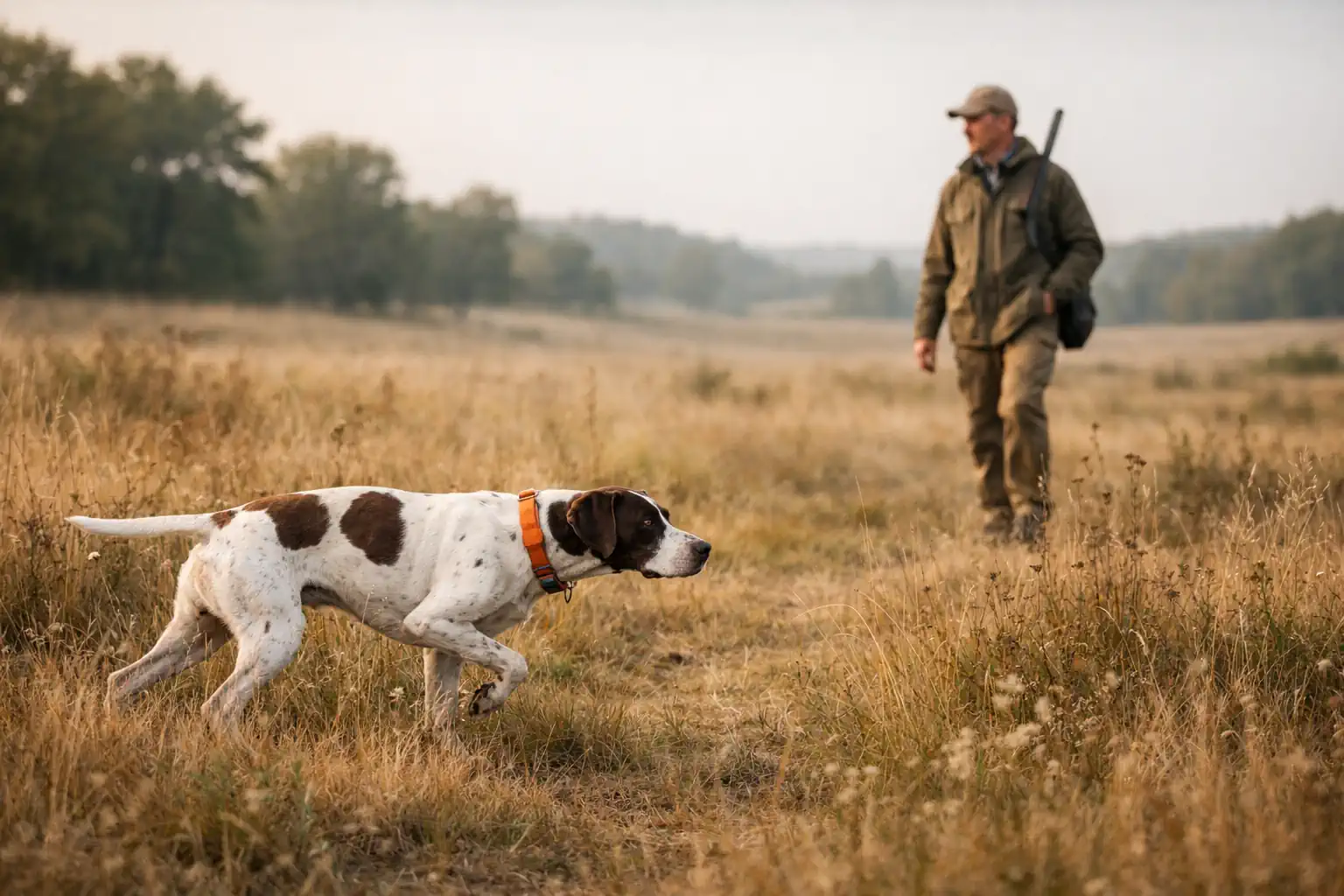
Between hunting seasons, build a routine around your dog's everyday needs and the activities you can provide reliably. Include suitable movement, opportunities to explore or play, manageable practice and undisturbed rest. Choose each activity for a purpose, and have an alternative when access, conditions or your availability change.
Consistency need not mean repeating the same drill on the same days. It means making thoughtful provision for the dog throughout the year. An off-season routine cannot guarantee retained skills, prevent injuries or establish readiness for the next hunt.
Start with daily life, then choose training
Look at the coming days as they really are. Who will care for the dog? Which familiar places are available? What supervision can you provide? Are there medical restrictions, changes in comfort or activities your dog currently avoids?
Protect ordinary care and appropriate activity before adding a training project. A quick trick does not replace exercise or access to care, and a long outing does not remove the need for rest. RSPCA's home-environment guidance emphasizes suitable opportunities for activity, a safe environment and a quiet place to rest undisturbed.
If your available time cannot cover the dog's needs, arrange suitable help and discuss the practical gaps. Do not make an ambitious weekend session the plan for everything missed during the week. For a dog with health restrictions, ask the veterinary team which activities remain appropriate; “gentle” is too vague to substitute for that advice.
Pick an activity by its purpose
The following menu is an original planning aid, not a conditioning program or a weekly prescription. Choose what fits this dog and setting; there is no requirement to complete every row in one day.
| Purpose | A familiar option to consider | When circumstances change | What this does not establish |
|---|---|---|---|
| Explore the surroundings | A managed walk in suitable, permitted ground, with opportunities to investigate rather than constant requests | Choose an appropriate familiar route or arrange help when the preferred location is unavailable | Permission for free running, a required distance or readiness for hunting cover |
| Enjoy interaction | A game the dog already enjoys, with a safe, suitable item and supervision | Choose another familiar interaction the dog accepts, or leave play for another opportunity if it turns away | That a particular toy or game preserves hunting drive |
| Revisit a learned response | Brief reward-based practice of one familiar skill in a manageable setting | Keep the easy version or omit the optional practice when you cannot supervise appropriately | Reliability around birds, another dog or a new location |
| Rest without demands | Access to the dog's comfortable quiet resting place | Protect that space when visitors, household activity or other pets would disturb it | That inactivity caused by discomfort should simply be left unassessed |
Dogs Trust's enrichment guidance recommends considering the individual dog's health, abilities, preferences and response to an activity. It also emphasizes safe choices and rest. Suitability matters more than collecting enrichment products or completing a menu.
Check that any item is appropriately sized, non-toxic and free of parts the dog could swallow. Supervise play and stop using an item that becomes unsafe. Food-based activities also need to fit the dog's feeding and health plan. Those precautions belong in the choice itself, not after a game has gone wrong.
Make familiar practice easy to provide
Choose a response you can describe clearly and have already taught. For example, a familiar hand touch beside you is a different request from returning across a field. Prepare an appropriate reward and use the setting in which the response is manageable.
RSPCA's training advice supports valued rewards, quiet starting conditions, short practices and allowance for individual learning rates. It does not supply a universal number of off-season sessions. End when the activity is no longer comfortable or manageable; a final successful repetition is not an obligation.
If changing the location is your actual goal, use yard-to-field transfer rather than adding unfamiliar surroundings to a busy day's maintenance practice. Keep methods humane: AVSAB's current position recommends reward-based methods throughout training. A missed response after a break is not a reason to add pressure.
Example: adapt the plan before trying to catch up
This household and all events are fictional. Erin plans familiar walks, play with a suitable toy and occasional practice of an already learned hand touch for her spaniel, Tess. Erin expects to use a familiar enclosed field, but access closes and her work schedule changes.
She first confirms who will provide Tess's ordinary care and appropriate walks. She chooses an available familiar route instead of finding an unfamiliar field in a hurry. At home, she offers their usual game when she can supervise, and keeps Tess's resting place quiet. When Tess leaves the game and settles, Erin ends it without asking for a retrieve.
Erin postpones the optional location-change lesson. She does not combine the missed practice into a demanding weekend outing. Her next question is practical: does the revised arrangement provide suitable opportunities Tess engages with, alongside care and rest? The example illustrates a change of plan; it supplies no training data or claim that Tess retained a skill.
Review what works, without turning every day into a test
Ask whether an option is available, manageable and appropriate, and what the dog actually does. If an activity is too difficult, simplify or choose something else. Repeated withdrawal, a concerning new change or difficulty across familiar activities calls for assessment rather than a more entertaining game.
Stop activity for a new limp, apparent pain or a concerning change in usual movement or behavior, and contact your veterinarian. AAHA's pain-sign guidance explains that pain can appear through movement and behavior changes. This guide cannot identify the cause. For broader monitoring around outings, see keeping a working dog sound through the season.
If your concern is a response that has changed or progress that seems absent, use the troubleshooting guide. If a record would clarify a particular training question, the training journal already provides forms; an off-season routine does not need another scoring sheet.
When hunting plans return, reassess the actual demands and the dog's preparation. Do not jump from a comfortable everyday routine to a hard outing because the calendar says the season is close. Keep the useful activities, review any physical progression with your veterinarian, and choose training goals that match what you have observed.
Where to go next
Choose the step that matches the question you still need to answer.
Next decision
Choose a small task and record what happenedA useful routine leaves enough context to compare the next practice.
Next decision
What changes when preparing physical demands for a season?The conditioning article treats phases as adjustable planning, not a universal fitness deadline.
Related problem
Which changes should alter the next outing?Enthusiasm and a consistent routine cannot establish comfort or readiness.
Browse guides by question or find your training starting point.